Imagine stepping outside and hearing not the usual honk-and-hyperlink cacophony but the purred rustle of leaves, a chorus of local birds, and the soft clack of insect wings. Rewilding cities is the deliberate effort to restore fragments of nature into the urban fabric so that humans and wildlife can thrive together. From green roofs and …
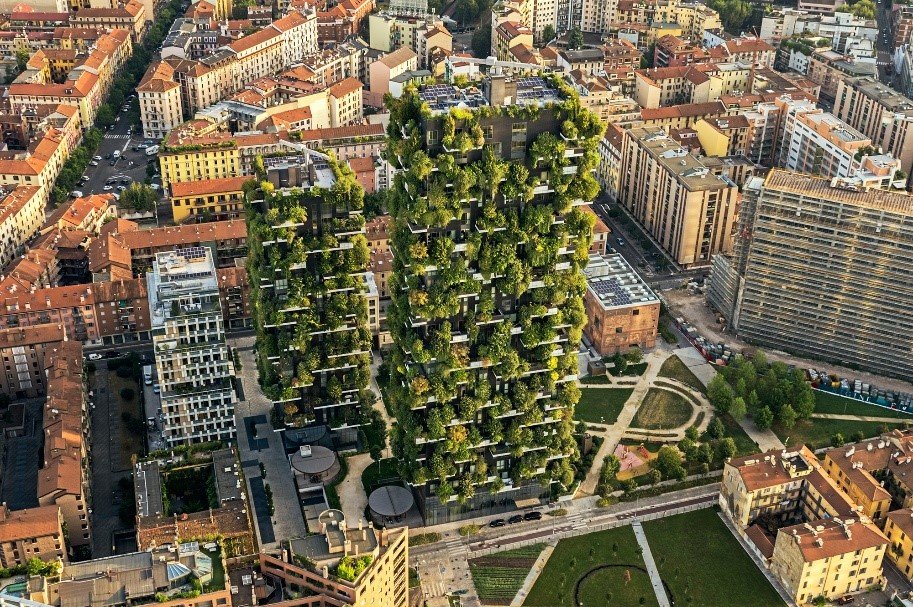
Table of Contents
- What is urban rewilding?
- Why rewilding matters for cities
- Design strategies for rewilding
- Global examples
- Wildlife corridors and connectivity: the arteries of urban ecosystems
- Green roofs and living facades: small footprint, high value
- Social co-benefits: equity, health, and local economies
- Practical challenges and design responses
- How architects and planners can get started (practical checklist)
- Rewilding as an attitude, not only a recipe
- Closing: small actions, big ripple effects
Imagine stepping outside and hearing not the usual honk-and-hyperlink cacophony but the purred rustle of leaves, a chorus of local birds, and the soft clack of insect wings. Rewilding cities is the deliberate effort to restore fragments of nature into the urban fabric so that humans and wildlife can thrive together. From green roofs and vertical forests to daylighted streams and wildlife corridors, rewilding reframes cities as ecosystems, not just anthills of concrete.
This isn’t about turning downtown into a Jurassic Park. It’s about pragmatic, scalable interventions that reintroduce habitat, connectivity, and ecological function into built environments. The result? Cooler streets, cleaner air, richer biodiversity, community resilience, and often, happier humans. Below I unpack the concept, the design strategies, and global exemplars showing rewilding in action.
What is urban rewilding?
Urban rewilding borrows ideas from conservation biology (habitat restoration, connectivity, native planting) and applies them to cities. It’s less about letting nature “do whatever” and more about designing with ecological intention. Key aims include:
- Restoring native plant communities.
- Reconnecting fragmented habitats with corridors and greenways.
- Creating microhabitats (pools, log piles, pollinator gardens) within public and private spaces.
- Using blue-green infrastructure (streams, wetlands, bioswales) to manage water and provide habitat.
- Using buildings as vertical habitat green roofs, living facades, and “vertical forests.”
Rewilding works at all scales: a 1 m² pollinator patch on a rooftop, an intercepted stream, or a citywide network of green corridors that let species move and adapt.
Why rewilding matters for cities
- Biodiversity loss is not just rural Cities can be havens for certain species and stepping stones for others. Restoring habitat in urban places helps halt local extinctions.
- Climate resilience Trees, green roofs, and wetlands cool cities, reduce flood risk, and sequester carbon.
- Human wellbeing Access to biodiverse nature reduces stress, improves mental health, and strengthens community ties.
- Ecosystem services Pollination, pest regulation, stormwater attenuation, and improved air quality all rise with more nature.
Urban rewilding is therefore a triple win: ecological, social, and infrastructural.
Design strategies for rewilding
Architects, landscape architects, planners, and community groups deploy a toolkit of strategies:
- Green roofs & rooftop parks Provide habitat for pollinators and birds, reduce heat gain, and capture stormwater.
- Vertical greening & living facades Turn plain walls into plant habitat; reduce urban heat and provide micro-refugia.
- Daylighting buried streams Restores aquatic habitats and reconnects people to water.
- Wildlife corridors & greenways Linear strips of habitat that connect parks, riverbanks, and remnant patches.
- Native planting palettes Support local insect and bird communities better than exotic ornamentals.
- Pocket wetlands & bioswales Small-scale water features that treat runoff and support amphibians and aquatic insects.
- Rewilded railways / disused infrastructure Abandoned tracks and industrial edges often become unexpectedly biodiverse refuges.
Implementation must balance human use and wildlife needs design for coexistence, not exclusion.
Global examples
Bosco Verticale (Milan, Italy) Vertical foresting in dense cities
The “Vertical Forest” towers in Milan are perhaps the most famous example of using buildings as habitat. These residential towers are clad with hundreds of trees, shrubs, and groundcover species planted in balconies and terraces. The dense planting reduces façade temperatures, improves air quality, and creates microhabitats for birds and insects within a highly urbanized district.
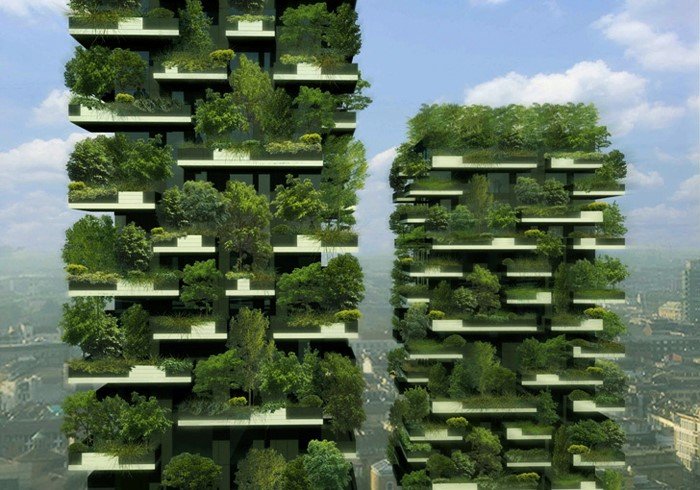
Bosco Verticale reframed the high-rise as not only a place to live, but as a vertical patch of urban forest — an emblematic proof that buildings can host biodiversity, not just people.
Cheonggyecheon Stream Restoration (Seoul, South Korea) Daylighting a river and reviving urban nature
Seoul’s Cheonggyecheon project removed an elevated highway and restored an urban stream through the city center. The restoration dramatically increased local biodiversity within years: plant, insect, bird, and fish species all rose substantially as the stream and riparian corridor returned.
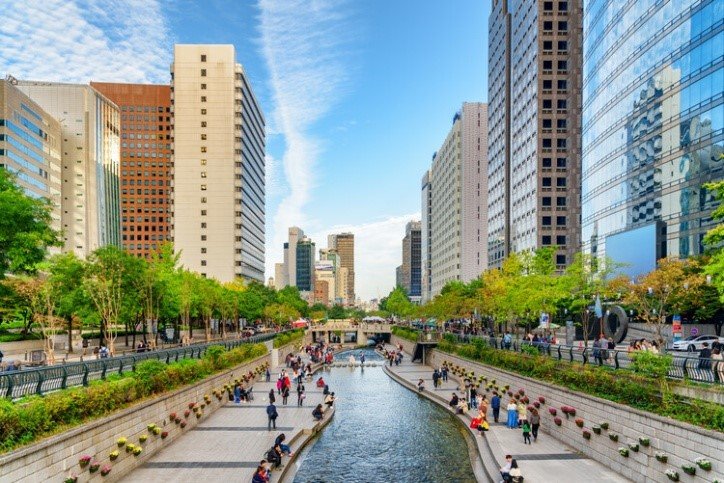
Beyond ecological gains, the project reduced local temperatures, improved air quality, and created an accessible green spine through a dense metropolis showing that daylighting buried waterways is a powerful rewilding move.
Gardens by the Bay & Super trees (Singapore) Vertical planting as public infrastructure
Gardens by the Bay is a large-scale urban park that combines conservation, horticulture, and public amenity. Its iconic Super trees are vertical planting structures that host diverse plant species, provide shade, and act as vertical gardens in the heart of the city.
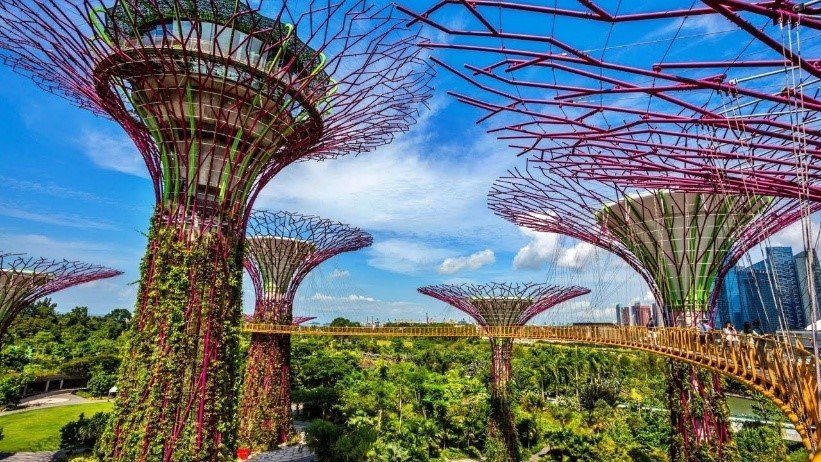
The project demonstrates how urban parks can become living laboratories for biodiversity and education, integrating native and exotic plantings across microclimates and proving that large, designed landscapes can support a surprising range of species in dense urban contexts.
The High Line (New York City, USA) Rewilding on a disused rail line
What started as a community rescue of an abandoned elevated railway turned into a celebrated linear park that deliberately embraced spontaneous vegetation as a design inspiration. The High Line preserved and curated remnant plantings, combined them with new native gardens, and produced corridors of habitat above the city.
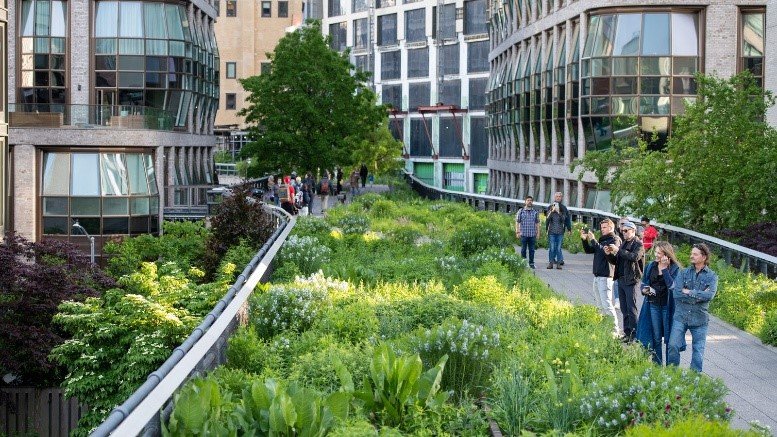
The project shows how brownfield rewilding can deliver both ecological benefit and valued public space provided planners intentionally design for biodiversity, not only aesthetics.
Namba Parks (Osaka, Japan) Multi-level rooftop park making commercial space green
Namba Parks integrates an ascending rooftop park that climbs several levels above a commercial complex, creating continuous planted terraces that function like an ascending urban canyon of greenery.
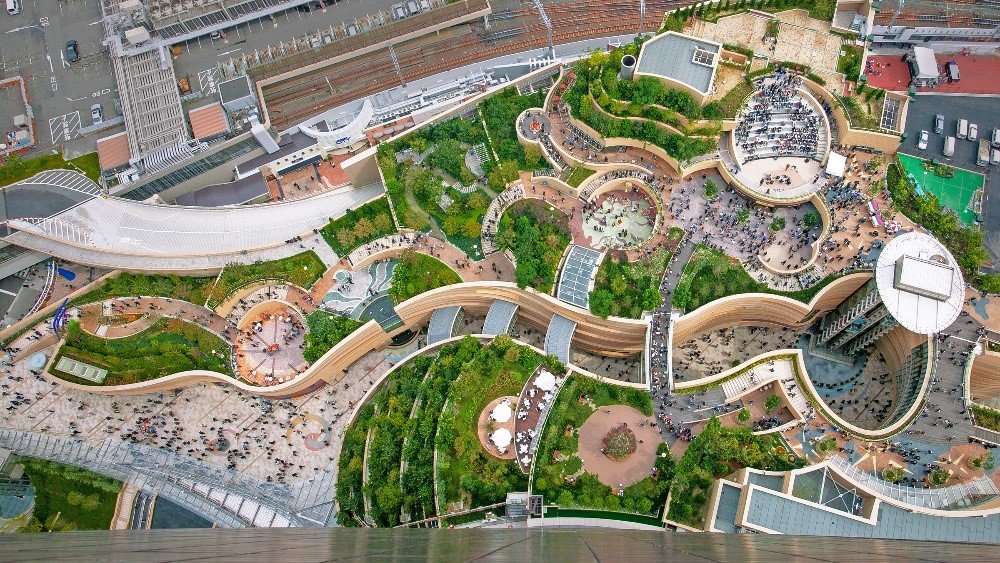
This terraced rooftop supports a surprising diversity of plants and provides habitat and foraging along its length. Namba Parks demonstrates how commercial developments can incorporate substantial public green space with ecological function, not just decorative landscaping.
PARKROYAL on Pickering (Singapore) Hotel as urban habitat
PARKROYAL on Pickering is a hotel wrapped in extensive sky gardens and planted terraces an early example of integrating habitat into hospitality design. Cantilevered sky gardens, planted shelves, and layered greenery reduce heat gain, provide habitat for birds and insects, and offer guests immediate contact with nature in a dense business district.
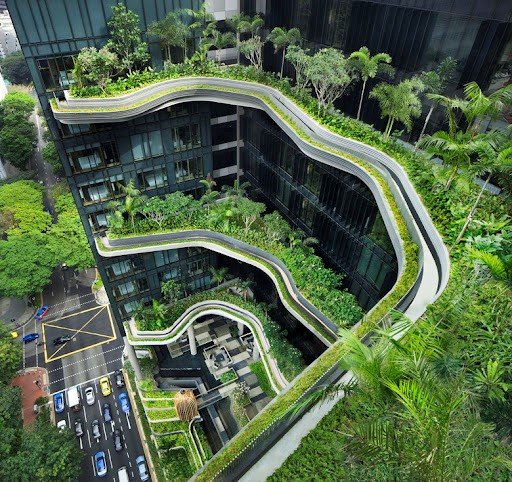
Projects like this show the commercial viability of rewilding strategies in hospitality and office developments.
Petite Ceinture & Other Rewilded Railways (Paris, France) Rugged, community-led rewilding
Disused and partly rewilded railway lines such as Paris’s Petite Ceinture have become linear wild spaces, often left semi-managed to encourage natural regeneration. These corridors are rich with spontaneous flora and fauna, acting as secret wildlife networks through dense urban fabric. Their rugged, less manicured character shows that not every urban green space needs to be curated; leaving room for wild processes can yield high biodiversity and valuable, low-cost habitat. Recent city initiatives have expanded access while preserving wild stretches for ecology and community projects.
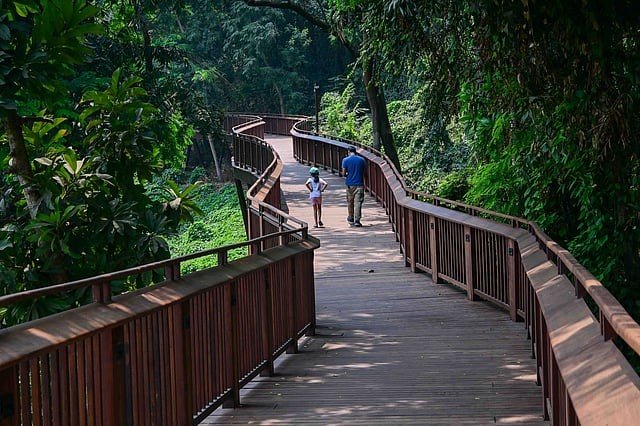
Malabar Hill Elevated Nature Trail (Mumbai, India) Rewilding remnant patches with raised trails
Newer initiatives, like the elevated nature trail in Mumbai’s Malabar Hill, repurpose remnant forest patches and make them accessible via raised walkways that limit trampling while connecting people to native trees and birdlife. Such interventions allow fragile pockets of urban nature to recover while providing educational and recreational value, balancing conservation with access.
Wildlife corridors and connectivity: the arteries of urban ecosystems
Isolated green patches are islands unless they’re connected. That’s where wildlife corridors and greenways come in linear networks that let species move, feed, and breed across the city. Examples include urban greenways, river corridors, disused railway lines, and purpose-built overpasses for fauna in peri-urban areas.
Designing effective corridors means thinking about width, native plantings, safe crossings at road junctures, and stepping stones (small habitat patches) for species that can’t traverse large gaps. Human activities can be accommodated by careful sequencing: a tree-lined bike path can sit beside a pollinator strip and a narrow woodland that supports birds and small mammals.
Green roofs and living facades: small footprint, high value
Green roofs and living facades punch above their weight ecologically. Even intensive green roofs (deep substrate, small trees) and extensive green roofs (shallow substrate, sedums, and grasses) can support pollinators, provide breeding habitat for some birds, and form thermal insulation that lowers building energy use. Living facades increase vertical habitat area and can be designed with species that flower at different times to provide continuous food sources.
When specifying green roofs and facades, prioritize native species (or regionally appropriate substitutes), substrate diversity (to provide varied microhabitats), and maintenance approaches that allow some structural “messiness” which is often where wildlife thrives.
Social co-benefits: equity, health, and local economies
Rewilding projects often deliver social wins:
- Equitable access to nature: Urban rewilding can bring nature to underserved neighborhoods, improving health outcomes.
- Education and stewardship: Community involvement in planting and monitoring builds ecological literacy and local ownership.
- Green jobs: Constructing and maintaining green infrastructure creates employment in horticulture, conservation, and landscape maintenance.
- Cultural enrichment: Rewilded spaces can celebrate local ecologies, indigenous plant knowledge, and community narratives.
Designers should couple ecological goals with social goals: biodiversity without accessibility is a lost opportunity.
Practical challenges and design responses
Rewilding is rewarding but not frictionless. Some common challenges and responses:
- Maintenance expectations vs. ecological outcomes: Clients often expect manicured lawns. Education, demonstration projects, and phased transitions (showing ecological benefits over time) help align expectations.
- Invasive species management: Intentional planting and early management prevent invasives from taking over. Favoring natives reduces long-term control costs.
- Human-wildlife conflict: Thoughtful species selection, buffer planting, and community programs reduce conflicts (e.g., managing food waste to discourage urban foxes).
- Safety and perception: Wild-looking spaces can be perceived as unsafe. Design sequencing clear sightlines near paths, thicker planting away from access, and good lighting helps balance ecology and public comfort.
- Policy and regulation: Zoning, roof load limits, and stormwater rules can be obstacles. Advocacy, incentives, and updated policy frameworks are essential to scale rewilding interventions.
How architects and planners can get started (practical checklist)
- Map existing habitat Which patches, trees, streams, and corridors already exist? Protect the best first.
- Choose native palette Start small with pollinator strips, native hedgerows, and pocket meadows.
- Design for connectivity Link parks, streets, and rooftops where possible.
- Incorporate blue-green element Bioswales, rain gardens, and daylighted channels add water-sensitive habitat.
- Engage communities Stewardship ensures long-term success and local buy-in.
- Monitor and adapt Use biodiversity monitoring to learn and adjust plant lists and management.
- Work cross-disciplinary Ecologists, engineers, maintenance teams, and social planners must co-design.
Rewilding as an attitude, not only a recipe
At its heart, rewilding is a design attitude: humility toward ecological processes, patience for slow recovery, and a readiness to design for complexity rather than sterilized order. It acknowledges that cities are ecosystems with non-human inhabitants whose needs matter.
Yes, there will be ticks, there will be leaves on paths, and sometimes a raccoon will steal your sandwich. But there will also be the delight of watching pollinators in winter, the cool relief under a canopy on a heat wave, and the quiet satisfaction of knowing your city can be more than an engineered container for people.
Closing: small actions, big ripple effects
Rewilding is scalable. The sum of many small interventions a rooftop meadow here, a daylighted stream there, a connected greenway across town produces a network effect. Species move, soil health returns, water is buffered, and residents reclaim nature in their everyday lives.
If you’re an architect, planner, developer, or curious citizen, the invitation is simple: design with life in mind. Start with one street, one roof, one pocket park. The city will thank you, quietly and enthusiastically with birdsong, cooler air, and a few extra pollinators checking out your balcony flowers.