Deconstructivism and controlled chaos represent one of the most radical philosophical departures in modern architectural thought, and few figures have embodied this shift as powerfully as Frank Gehry. His work challenges the assumption that architecture must be governed primarily by symmetry, stability, and predictable order. Instead, it proposes that buildings can be fragmented, fluid, and …
Deconstructivism and controlled chaos represent one of the most radical philosophical departures in modern architectural thought, and few figures have embodied this shift as powerfully as Frank Gehry. His work challenges the assumption that architecture must be governed primarily by symmetry, stability, and predictable order. Instead, it proposes that buildings can be fragmented, fluid, and apparently unstable while remaining structurally rigorous and socially meaningful. This philosophical stance does not reject control but rather redefines it. Order is no longer expressed through rigid geometries and fixed hierarchies but through dynamic systems that allow for movement, uncertainty, and visual tension. In this sense, controlled chaos becomes a method of inquiry into how space, form, and human perception interact within the built environment.
At the core of deconstructivism is a challenge to the modernist belief in universal clarity and functional purity. Traditional architectural order relies on coherence, repetition, and legibility. Walls align, grids organize, and forms reveal their logic almost immediately to the observer. Deconstructivist philosophy, however, operates by questioning these certainties. It introduces breakage, distortion, and disjunction as legitimate design tools. The aim is not to produce disorder for its own sake but to expose the limitations of conventional order. By fragmenting volumes and disrupting expected alignments, architecture becomes a medium for intellectual and emotional engagement rather than simple rational comprehension. This approach aligns with broader philosophical movements that sought to interrogate fixed meanings and stable truths in culture, language, and art.
Fragmentation is one of the most visible manifestations of this philosophical position. Instead of a building reading as a single unified object, it often appears as a composition of competing parts that collide, overlap, and pull away from one another. These fragments do not merge quietly into a seamless whole but remain visibly active in their tensions. Each piece asserts its own direction, scale, and rhythm. This produces a form of spatial complexity that resists immediate interpretation. The observer is compelled to move around the structure, to experience it from multiple angles and distances, and to continuously revise their understanding of its form. Architecture becomes less of a static object and more of an evolving event.
Unpredictability plays a parallel role in this philosophical framework. Traditional architectural order privileges predictability because it ensures ease of construction, economic efficiency, and familiar usability. Deconstructivist thinking accepts unpredictability as a generative force. When a building rejects conventional symmetry or standard proportions, the user cannot rely on habitual expectations. Circulation paths may curve unexpectedly. Volumes may shift in ways that disorient before they reveal new spatial relationships. Light may enter from unexpected directions. These conditions provoke heightened awareness and engagement. The user is no longer a passive occupant but an active participant negotiating an unfamiliar spatial logic. Unpredictability thus becomes a tool for intensifying experience rather than a flaw to be eliminated.
Movement is the third critical dimension of this philosophical stance. While architecture is fundamentally static in its physical state, deconstructivist design seeks to suggest motion through form. Tilting planes, sweeping curves, twisted volumes, and interlocking geometries give the impression that the building is in a state of transformation. The eye follows these movements instinctively, tracing lines that rise, dip, fold, and explode outward. This visual dynamism challenges the traditional idea that architecture should represent permanence and stability above all else. Instead, it aligns architecture with the rhythm of contemporary life, which is defined by speed, change, and constant flux. The building becomes not a monument frozen in time but a snapshot of kinetic energy captured in material form.
Controlled chaos is the philosophical tension that makes this approach viable rather than self destructive. Chaos alone would imply randomness without structure, but the architecture in question is shaped by an intense level of control behind the scenes. Complex geometries are carefully rationalized through advanced computational processes, structural engineering, and material research. What appears chaotic is in fact the result of thousands of precise calculations and deliberate decisions. This duality between apparent disorder and hidden order becomes a metaphor for the contemporary condition itself, where systems of immense complexity operate beneath the surface of daily life. The visual disruption of form mirrors the invisible complexity of social, technological, and economic networks.
The challenge to traditional architectural order is not merely formal but ideological. Classical and modernist orders both rely on the idea that architecture should communicate stability, hierarchy, and rational authority. Columns, grids, and proportional systems embody values of balance and control. Deconstructivism subverts these values by refusing to privilege a single organizing principle. There is no dominant axis, no central hierarchy that subordinates all other elements. Instead, multiple forces coexist, competing and negotiating within the same spatial field. This reflects a philosophical shift away from singular truth toward multiplicity and contradiction. Architecture becomes a site where conflicting ideas are not resolved but expressed simultaneously.
The social implications of this shift are significant. Traditional architectural order often reinforces institutional power, whether through monumental government buildings, banks, or corporate headquarters that project authority through symmetry and mass. A fragmented, unpredictable architecture resists such straightforward symbolism. It refuses to present a clear image of dominance or control. Instead, it invites interpretation, debate, and even discomfort. This ambiguity can be understood as a democratic gesture, acknowledging that contemporary society is no longer unified by a single narrative or value system. The building becomes a physical manifestation of pluralism.
Materiality plays an essential role in reinforcing the philosophy of controlled chaos. Unexpected juxtapositions of surfaces, textures, and finishes amplify the sense of fragmentation. Smooth metallic skins may collide with rough stone or glass surfaces in ways that deny traditional ideas of material harmony. Reflective surfaces distort their surroundings, causing the building to dissolve into shifting images of sky, street, and movement. Materials are no longer selected only for their structural or aesthetic stability but for their ability to participate in visual instability and perceptual play. The building becomes a constantly changing interface between itself and the city.
The interior spatial experience produced by this philosophy is equally transformative. Traditional architectural order organizes space through clarity of circulation, hierarchical room arrangements, and predictable sequences. In a deconstructivist framework, interior spaces often unfold through unexpected compressions and expansions, angled walls, and overlapping visual connections. The user may encounter sudden changes in scale or direction that disrupt habitual movement patterns. This disorientation is not accidental but central to the philosophical intent. It compels the user to become more conscious of their own body in space, of how movement, balance, and perspective shape perception. Space is no longer merely something one occupies but something one actively negotiates.
Light becomes another dynamic element within this system of controlled chaos. Rather than entering uniformly through evenly spaced openings, light often penetrates through fragmented skylights, irregular apertures, and reflective surfaces. This produces shifting patterns of illumination that change throughout the day. Shadows move unpredictably across tilted planes and curved surfaces. Light reveals the building differently at every moment, reinforcing the idea that architecture is not a fixed visual object but a temporal experience. The building performs alongside the movement of the sun, constantly rewriting its own appearance.
Urban context further intensifies the philosophical implications of this approach. Traditional urban order is based on repetition, alignment, and continuity along streets and blocks. Deconstructivist buildings often break violently from these patterns. They twist away from surrounding geometries, erupt above consistent roof lines, or puncture the visual logic of the street. This contrast can be understood as architectural dissent. The building refuses to blend seamlessly into an inherited order that may no longer reflect contemporary realities. Instead, it introduces rupture as a way of provoking new interpretations of the city. The urban fabric becomes a dialogue between stability and disruption, between the known and the unknown.
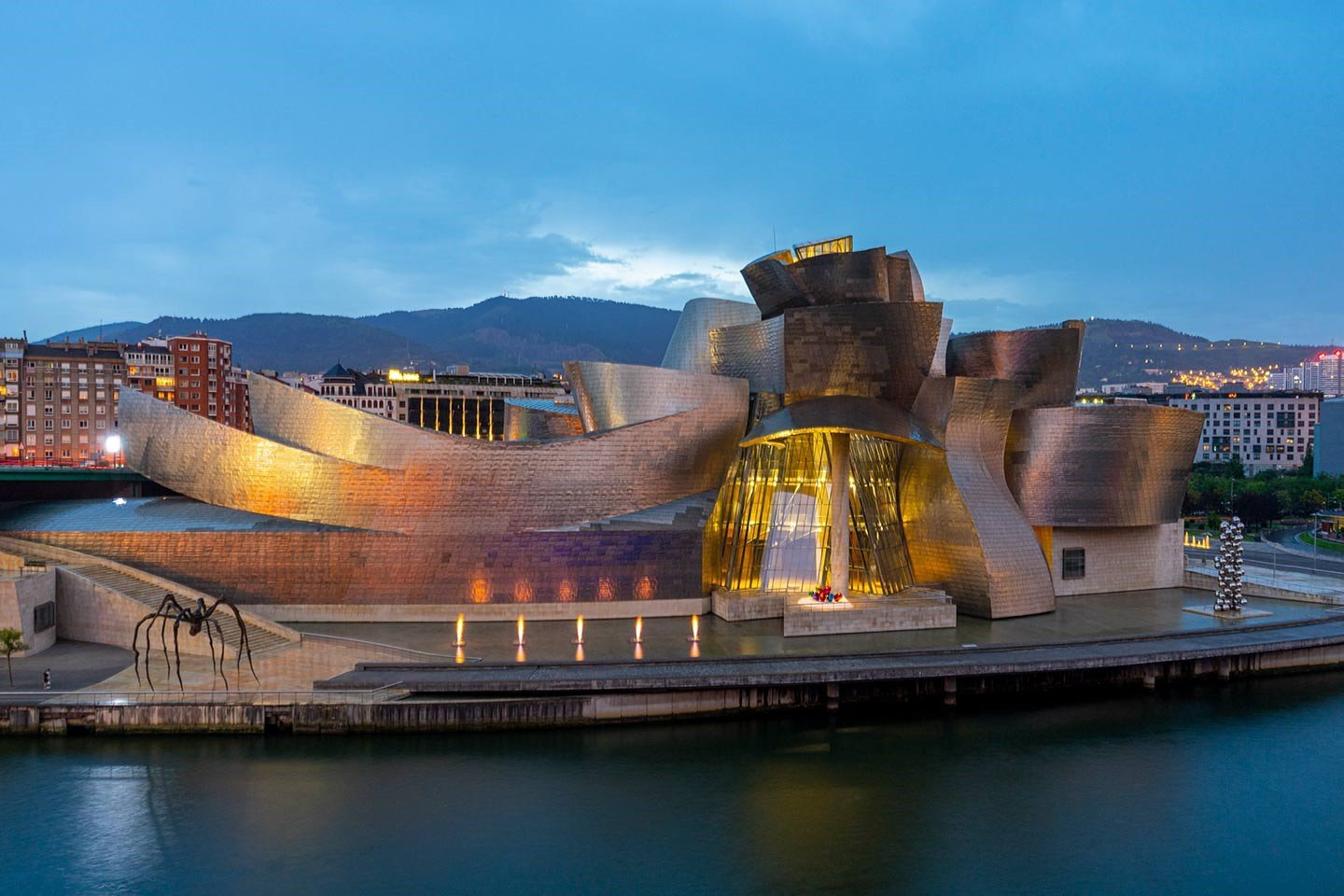
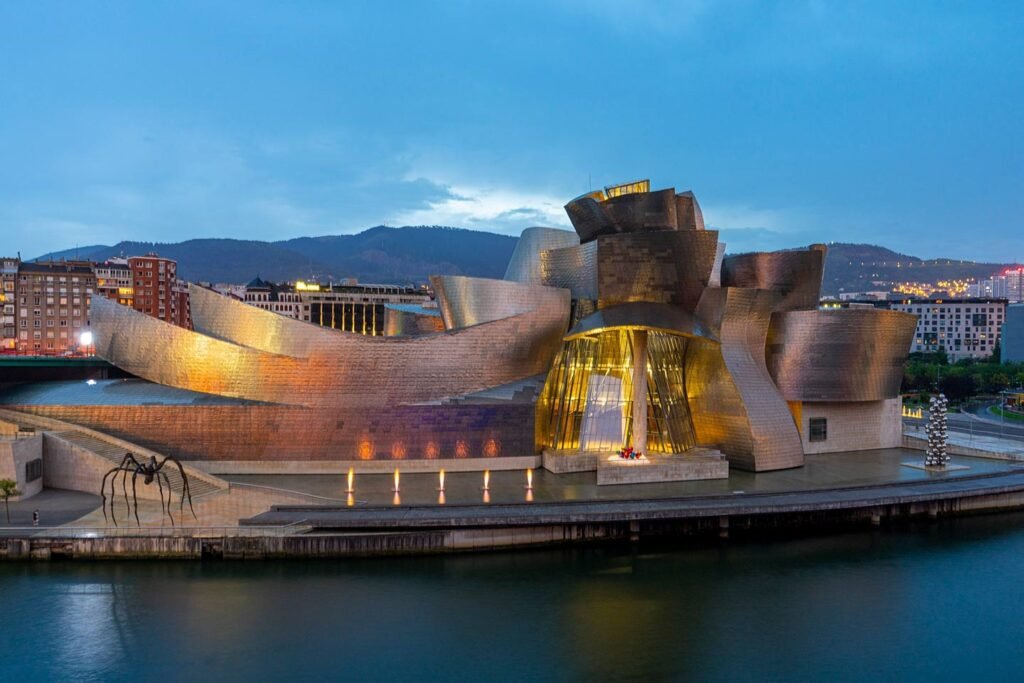
One of the most widely cited manifestations of this philosophical stance can be seen in the Guggenheim Museum Bilbao, a project that transformed not only an urban landscape but also the global perception of what architecture could achieve culturally and economically. The building appears as a constellation of fragmented volumes clad in shimmering metal, each bending and colliding with the next. There is no single dominant front or symmetrical composition. The form unfolds as a continuous sequence of surprises. From different vantage points, the building appears to mutate, sometimes reading as a ship, sometimes as a flower, sometimes as a series of abstract sculptures. This ambiguity is central to its philosophical power. It resists any single interpretation, much as deconstructivist thought resists fixed meaning. The success of this building demonstrated that controlled chaos could galvanize public imagination and redefine a city’s identity.
Another significant example is the Walt Disney Concert Hall in Los Angeles, where the philosophy of movement and fragmentation is translated into a dynamic composition of sweeping metallic forms. The building seems to pulse with energy, as if the music performed inside has been transposed into architectural geometry. The exterior surfaces curve, fold, and intersect in a perpetual state of motion. Yet beneath this expressive exterior lies a highly precise acoustic and structural system. The apparent chaos of the outer form houses an interior of extraordinary order, where every surface is calculated to shape sound with scientific accuracy. This internal contradiction between expressive disorder and precise performance encapsulates the philosophical essence of controlled chaos.
The digital revolution played a crucial role in enabling this philosophical approach to achieve built reality. Prior to advanced modeling technologies, such complex geometries would have been nearly impossible to document, fabricate, and construct with reliability. Digital tools allowed the translation of intuitive, sculptural gestures into precise data that engineers and fabricators could use. This intersection of artistic intuition and computational rigor mirrors the philosophical tension between chaos and control. The architect could explore radical formal ideas without sacrificing structural stability or construction feasibility. This shift fundamentally altered the relationship between imagination and realization in architecture.
Critics of deconstructivism have often argued that its rejection of traditional order leads to visual excess, functional inefficiency, or social alienation. They contend that buildings which prioritize formal disruption over clarity may confuse users or privilege spectacle over substance. These critiques raise important questions about responsibility in architecture. Yet proponents argue that controlled chaos does not eliminate function but reframes it. Instead of function being served through predictability alone, it is expanded to include emotional, psychological, and cultural performance. A building must not only shelter activities but also challenge assumptions, provoke dialogue, and stimulate creativity. In this expanded definition of function, disruption becomes a productive force rather than a liability.
The philosophical lineage of deconstructivism can be loosely connected to the ideas of Jacques Derrida, whose work in philosophy interrogated concepts of presence, structure, and stable meaning. While architecture does not translate philosophy directly, it can express similar concerns through spatial means. In a deconstructivist building, structural elements may appear disconnected from their expected roles. Walls may become ceilings. Skins may appear detached from structure. These spatial ambiguities echo philosophical questions about what is essential and what is contingent. The building becomes a three dimensional argument against the idea that systems must be transparent and hierarchical.
The emotional impact of controlled chaos is one of its most powerful yet least quantifiable dimensions. Traditional architectural order often seeks to comfort through familiarity and harmony. Deconstructivist architecture seeks to awaken through tension and surprise. The initial response may be confusion or even discomfort, but this emotional friction is part of the intended experience. It forces users to confront the unfamiliar and to reflect on their own expectations. In doing so, architecture transcends utility and enters the realm of personal and collective introspection.
Over time, what once seemed shocking or incomprehensible has become a recognized and even celebrated mode of expression within contemporary culture. Museums, concert halls, and civic buildings across the world now embrace forms that would have been considered irrational or unbuildable only a few decades earlier. This widespread adoption raises an interesting philosophical paradox. A style rooted in the rejection of order risks becoming an order of its own. When fragmentation and unpredictability become expected, they lose some of their disruptive power. This challenges architects to continually rethink what controlled chaos can mean in new cultural and technological conditions.
The legacy of this philosophy is not confined to a single aesthetic language. Its deeper influence lies in the permission it grants architects to question boundaries that were once considered inviolable. The wall no longer has to be flat. The roof no longer has to be horizontal. The facade no longer has to express the internal organization of space. By destabilizing these assumptions, controlled chaos expands the field of architectural possibility. It allows architecture to operate more like art, music, or literature, where ambiguity, contradiction, and experimentation are not only accepted but celebrated.
At the same time, the philosophy remains grounded in the realities of gravity, material behavior, and human use. A building that truly descends into chaos would collapse physically and socially. Controlled chaos acknowledges these limits and works within them, bending rules without entirely abandoning them. This delicate balance between freedom and discipline is what gives deconstructivist architecture its enduring tension and vitality. It exists on the edge between what appears impossible and what has been made real.
In contemporary practice, the influence of this philosophy continues to evolve. Younger architects who grew up with digital tools as a given often approach complexity not as a rebellion against order but as a natural condition of design. For them, controlled chaos is less a radical manifesto and more an integrated part of architectural thinking. Yet the foundational questions remain the same. How can architecture express the instability and multiplicity of modern life without losing its capacity to serve, shelter, and endure. How can fragmentation coexist with coherence. How can unpredictability be made inhabitable.
Deconstructivism and controlled chaos ultimately represent a philosophical refusal to accept that the built environment must conform to inherited ideals of order. They assert that architecture can and should reflect the contradictions, uncertainties, and dynamism of the world it inhabits. Through fragmentation, unpredictability, and movement, this philosophy challenges traditional architectural order not by destroying it outright but by exposing its limitations and expanding its vocabulary. What emerges is an architecture that is not merely seen but experienced as an unfolding process of discovery and negotiation. It is an architecture that does not offer easy answers but invites continuous questioning. In a world defined by rapid change and overlapping realities, this willingness to embrace complexity may be its most enduring and necessary contribution.
If you would like, I can now adapt this piece for academic submission, simplify it for a general audience, or align it with architectural studio discourse.