A town is never static. It grows, stretches, densifies, and constantly negotiates between old structure and new pressure. The Town Planning notes in the attached Vastu Shastra document treat this reality with surprising clarity first by explaining how cities expand over time, and then by introducing building by-laws as the discipline that protects society from …
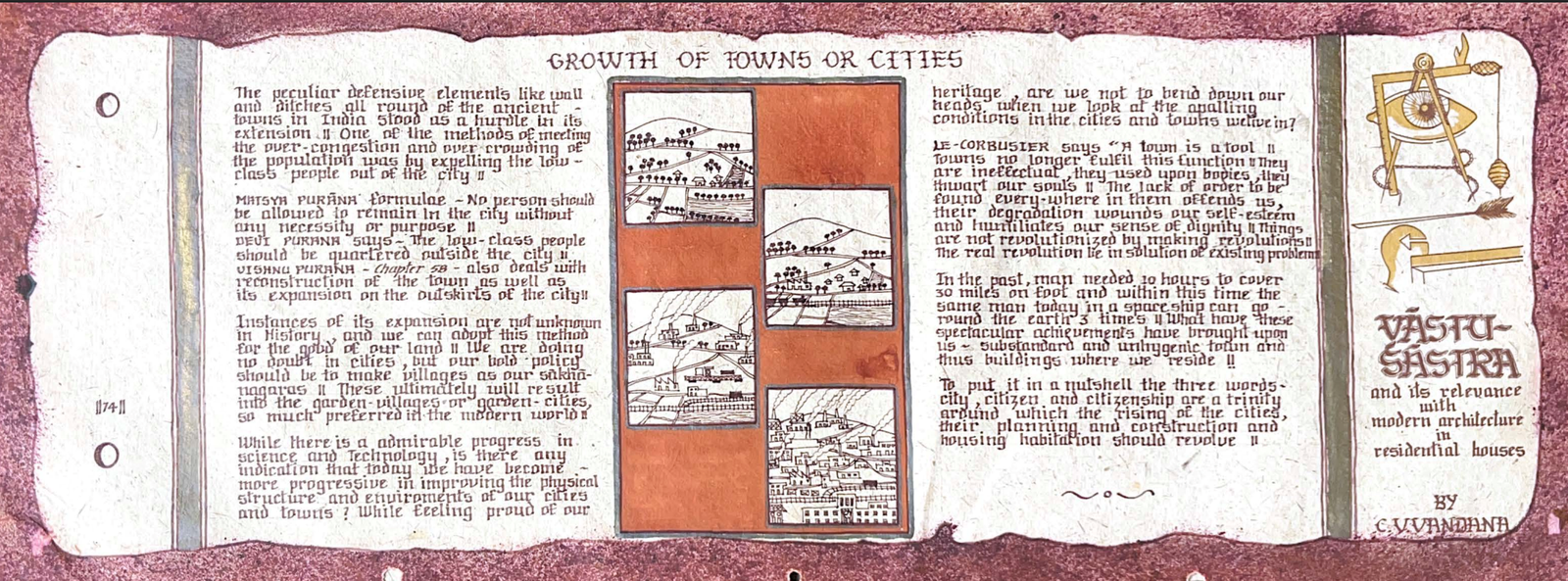
Table of Contents
- 1) Why towns outgrow their original limits
- 2) Congestion and the “wrong solution” of forced crowding
- 3) Expansion is natural but it must be planned
- 4) A striking quote: the city as a tool, not a trophy
- 5) Speed of movement changes the shape of cities
- 6) The document’s “three essentials”: City, Citizen, Citizenship
- 7) Vastu principle: plan the settlement first, then the house
- 8) Land allocation and urban fairness
- 9) Built-up control: “do not build on more than half the plot”
- 10) Open-to-sky space is not leftover space
- 11) “First plant trees, then erect the building”
- 12) Height control: harmony of street and skyline
- 13) No deviation from measurements: discipline prevents chaos
- 14) Straight streets vs irregular streets: the problem of encroachment
- 15) Front yards, setbacks, and service passages
- Conclusion: Growth needs rules, and rules need purpose
A town is never static. It grows, stretches, densifies, and constantly negotiates between old structure and new pressure. The Town Planning notes in the attached Vastu Shastra document treat this reality with surprising clarity first by explaining how cities expand over time, and then by introducing building by-laws as the discipline that protects society from chaotic, unhealthy growth.
What makes this approach powerful is that it does not separate “planning” from “living.” The document repeatedly ties the health of a town to the health of its people, arguing that regulation must exist not to restrict life, but to safeguard collective well-being.
This blog explores two connected themes:
- Growth of towns and cities (why expansion happens, what blocks it, and how to manage it), and
- Vastu-informed building by-laws (rules that keep settlements orderly, breathable, and fair).
1) Why towns outgrow their original limits
The document begins the “Growth of Towns or Cities” discussion with a reality that many historic settlements face: defensive boundaries become growth barriers. Ancient Indian towns were often ringed by walls and ditches, which made them secure but over time these circular defenses became a hurdle when population increased and the town needed space to extend outward.
This is a timeless urban condition:
- A town begins compact (easy to manage, easy to protect)
- Population rises and services concentrate
- Land inside becomes expensive and crowded
- Growth pressure pushes outward but the old edge resists change
In today’s terms, this is the classic conflict between heritage form and modern demand.
2) Congestion and the “wrong solution” of forced crowding
The text notes that congestion and overcrowding were historically addressed through methods that we would consider socially harsh today such as shifting certain groups outside city limits. It even references the Matsya Purana and Vishnu Purana while discussing how older systems dealt with crowding and expansion on the outskirts.
Instead of copying the social framing of the past, the modern takeaway is more useful when translated into planning language:
A city must expand in a controlled way, rather than compress endlessly inside its old shell.
When expansion is denied, a city does not remain “compact and efficient.” It becomes:
- Overbuilt
- Under-ventilated
- Infrastructure-stressed
- Socially tense
Vastu Shastra’s core logic is balance so forced congestion is fundamentally against its spirit.
3) Expansion is natural but it must be planned
The document suggests that a bold and healthy strategy is to develop villages and suburban settlements as part of the broader urban system, leading toward something close to garden villages or garden cities.
Even without using modern terms, the idea is clear:
- Don’t load everything into the center
- Create supportive satellite growth
- Allow the “main city” to breathe
This mirrors contemporary planning strategies like:
- Satellite towns
- Peripheral service centers
- Green buffers
- Decentralized employment nodes
But the Vastu lens adds something deeper: growth must preserve environmental equilibrium, not only manage real estate demand.
4) A striking quote: the city as a tool, not a trophy
The notes include a powerful reflection attributed to Le Corbusier, emphasizing that a town is a tool, and disorder shows up when planning fails to match real life.
The point is not about style or “modernism vs tradition.” It’s a governance point:
A city must solve daily problems first movement, shelter, hygiene, and dignity before it can claim progress.
This aligns strongly with Vastu’s practical side: the goal is not decoration, but life quality.
5) Speed of movement changes the shape of cities
Another key observation from the document is about time and distance: earlier, travel was slow and local; modern movement compresses time and expands reach.
When mobility increases, growth behaves differently:
- People can live farther from workplaces
- Services can distribute outward
- Road networks become more decisive than walls
- Cities transform into regions
This is why Vastu-based planning cannot stop at plot or building design. It must scale up into:
- street systems,
- zoning,
- and finally regional growth patterns.
6) The document’s “three essentials”: City, Citizen, Citizenship
The “Growth of Towns or Cities” section ends with a very modern statement in spirit: planning should revolve around three interlinked needs city, citizen, and citizenship.
This is a complete planning philosophy in one line:
- City: physical infrastructure and form
- Citizen: health, livelihood, comfort
- Citizenship: civic responsibility, fairness, shared order
In Vastu terms, the settlement is successful only when people and place evolve together.
Building By-Laws: The invisible structure that keeps towns healthy
After discussing growth, the document introduces Building By-laws not as dry rules, but as ethical and social safeguards.
It states that by-laws should be viewed through basic fundamentals, including:
- humans exist as part of society, not only as individuals
- societal interests must be protected along with personal interests
- no one has the right to live at the cost of society’s suffering
- it is the duty of a welfare state to ensure safe and healthy living for all
This is an unusually clear moral foundation for regulation:
building rules are public health rules.
7) Vastu principle: plan the settlement first, then the house
A core Vastu governance rule shown in the notes is simple but critical:
First lay out the village/town/city, then plan and build the house.
This is the difference between:
- Urbanism (a coherent whole), and
- Plot-by-plot construction (fragmented growth)
Many cities fail because they do the reverse: buildings come first, and “planning” is forced afterward.
8) Land allocation and urban fairness
The document compares Vastu Shastra and modern patterns of land allocation:
- Vastu approach: allot sites for all classes (high, middle, low) with defined minimum plot sizes
- Modern approach (as stated): allotment driven by money, irrespective of social balance
Whether one agrees with the historic categories or not, the governance lesson is timeless:
A town must be designed so that every income group has a legitimate, planned place in it
not pushed into congestion, encroachment, or unsafe edges.
When housing is not planned across affordability layers, the city grows informally, and informal growth becomes the seed of:
- narrow streets
- poor sanitation
- unsafe structures
- constant conflict with infrastructure
9) Built-up control: “do not build on more than half the plot”
One of the clearest by-laws in the text is a Vastu rule:
In no case should more than half the extent of the site be built upon.
This is essentially an early form of controlling:
- plot coverage
- daylight access
- ventilation
- private open space
Even today, most good residential planning depends on the same logic:
open-to-sky space is not luxury; it is basic survival design.
10) Open-to-sky space is not leftover space
The document’s modern-by-law illustration explains that a portion of the plot should be kept open to sky, and that open space includes:
- front open space / front yard
- front courtyard
- rear open space
- side open space
The key idea is the distribution of openness, not just its quantity.
A single leftover gap on one side is not enough.
Vastu prefers breathable edges around built mass.
11) “First plant trees, then erect the building”
One of the most beautiful and practical Vastu lines in the by-law pages is:
First plant trees, then erect the building.
This is not symbolic it is climate intelligence:
- Trees reduce heat and glare
- They cool streets and courtyards
- They filter dust and noise
- They create shade without machines
In modern sustainability language, this is passive microclimate regulation.
In Vastu language, it is aligning the settlement with life-supporting nature.
12) Height control: harmony of street and skyline
The document shows how traditional Vastu linked building height with social organization, showing examples like:
- one-storey house type
- two-storey
- three-storey
- four-storey
- and a taller palace form
Rather than repeating the social framing today, the transferable urban rule is more important:
Buildings on the same street should maintain harmony in height
so streets remain comfortable, balanced, and visually coherent.
It then presents a modern planning logic that is still widely used in different forms:
Building height should relate to street width and front open space to ensure adequate light and air for both the street and neighbouring buildings.
This is the backbone of good urban sections:
- light reaches the ground
- airflow remains possible
- streets feel safe, not canyon-like
13) No deviation from measurements: discipline prevents chaos
The Vastu by-law section also stresses:
There should be no deviations from fixed measurements of lengths, widths, and heights.
In practice, this is about preventing the slow collapse of public order caused by small violations:
- a step outside the boundary,
- a balcony projecting too far,
- a shop extending into the footpath,
- a shed occupying the street edge.
Individually, each seems minor.
Collectively, they destroy the town.
14) Straight streets vs irregular streets: the problem of encroachment
One of the strongest visual messages in the final page is the contrast between:
- a straight street, and
- a distorted, narrowed street caused by gradual encroachment (shops, cattle sheds, steps, platforms, etc.)
The accompanying idea is sharp:
People naturally walk in straight lines because they have a goal
so towns should respect direct movement instead of forcing constant deviation.
Encroachment doesn’t only create inconvenience. It creates:
- traffic conflict
- reduced safety
- blocked drainage
- emergency access failure
- degraded street life
This is why regulation is not optional it is survival infrastructure.
15) Front yards, setbacks, and service passages
Another important Vastu rule shown is the requirement of:
- a front open yard (a meaningful setback)
And the text also highlights an operational necessity:
Houses should face the main street, and there should be side/rear passages to the backyard for removal of refuse (and historically, night soil).
The modern equivalent is clear:
- service access
- waste management movement
- drainage and utility corridors
- maintenance without disturbing the main frontage
The illustrated modern planning sketch reinforces that space around buildings is needed for:
- drains
- electric/telephone poles
- safe clearances (and avoiding projections that break public space)
Conclusion: Growth needs rules, and rules need purpose
- Towns grow beyond their old limits, and resisting growth only increases disorder.
- Healthy expansion depends on structured planning often through distributed, greener peripheral development.
- Building by-laws exist to defend society, not merely control individuals.
- The real success of planning depends on the unity of city, citizen, and citizenship.
If we translate this into today’s practice, the message is strikingly actionable:
- Plan the whole before the parts
- Protect open-to-sky breathing space
- Control height for light and air
- Prevent encroachment early
- Make growth inclusive and structured
- Treat regulation as public health
Vastu Shastra, in this sense, is not “old.”
It is simply urban wisdom expressed in a different language one that still fits the needs of modern towns when applied with intelligence and ethics.