A community defined by what it already had Many residential developments begin with a tabula rasa mindset: level the land, draw the plots, add landscaping as a final layer. Sindhuvanam, as presented through VANZSCAPE’s public project communications, reads as the opposite. The narrative starts with an existing natural and infrastructural condition: a stormwater drain cutting …
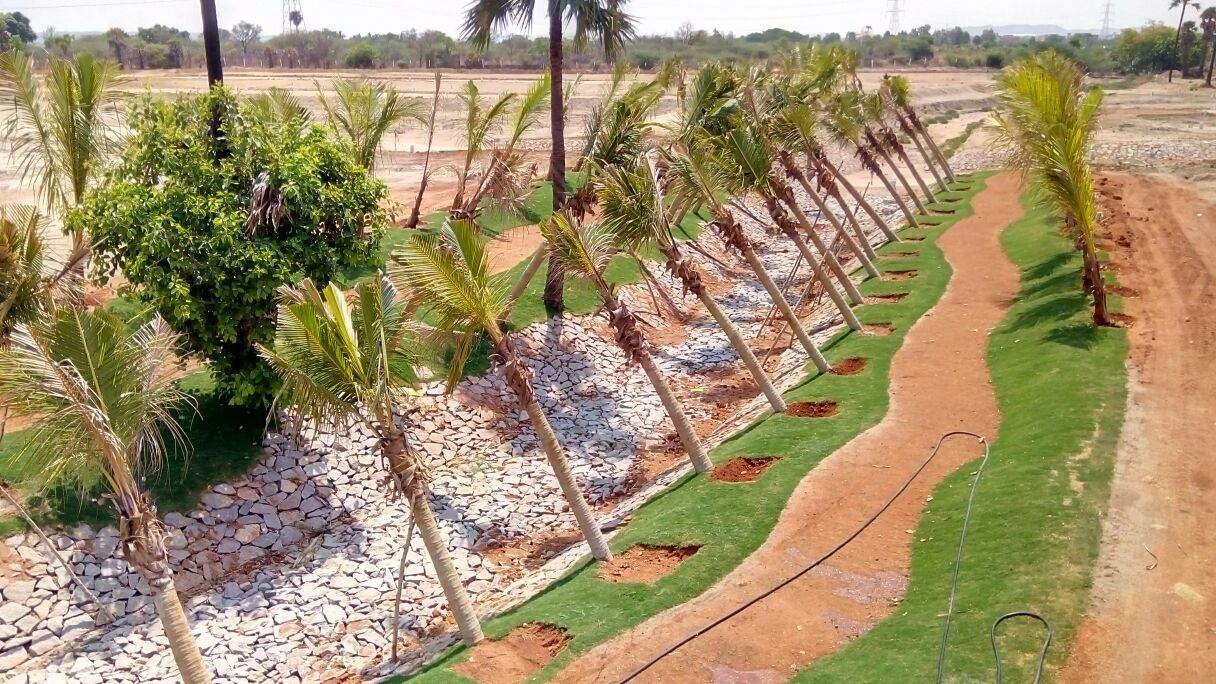
Table of Contents
- A community defined by what it already had
- Project snapshot, based on publicly shared information
- The core move: convert drainage into destination
- Why this approach fits VANZSCAPE’s broader landscape thinking
- Designing a blue green spine in a 100 acre community: what it requires
- Stormwater drain as the USP: the technical and spatial balancing act
- Hydraulic integrity
- Safety in everyday use
- Maintenance realism
- The green belt emphasis: landscape as identity, not accessory
- From drain corridor to social corridor: making public life inevitable
- A note on built form: villas, phases, and an integrated design language
- Experience design along the canal: how a memorable landscape is usually composed
- Framed views
- Alternating compression and release
- Material and texture shifts at nodes
- Water edge variety
- Sustainability beyond aesthetics: the ecological logic of canalscapes
- Groundwater recharge and infiltration
- Heat mitigation
- Biodiversity
- Reduced hardscape burden
- The real estate dimension: when landscape becomes the primary amenity
- What architects and developers can learn from Sindhuvanam Canalscape
- Closing: a blue green identity for a new kind of Hyderabad living
A community defined by what it already had
Many residential developments begin with a tabula rasa mindset: level the land, draw the plots, add landscaping as a final layer. Sindhuvanam, as presented through VANZSCAPE’s public project communications, reads as the opposite. The narrative starts with an existing natural and infrastructural condition: a stormwater drain cutting through the middle of a large gated community site, and a design decision to convert that condition into the community’s defining identity.
This is why the project name “Sindhuvanam Canalscape” matters. It frames the work not as generic landscaping, but as a canal edge transformation, where water movement, public life, and ecological performance become inseparable.
Public excerpts also point to the scale and ambition: references describe a gated community of about 100 acres, with another post indicating a precise site extent of 98.83 acres. In addition, a separate public mention places “Sindhuvanam site” in Moinabad, Hyderabad, aligning the project with the peri urban landscape where weekend homes, villas, and plotting townships are increasingly shaped by the promise of nature led living.
What emerges is a clear design thesis: do not hide the drain, do not push it to the edge, and do not treat it as a liability. Instead, turn it into the central blue green spine that organizes movement, amenities, and memory.
Project snapshot, based on publicly shared information
- Project name: Sindhuvanam Canalscape
- Context described: a gated community with a stormwater drain running through the middle, repositioned as the community’s key feature
- Location references: Hyderabad, Telangana and Moinabad, Hyderabad
- Scale references: “100 acres” and “98.83 Acres”
- Client feedback highlights: emphasis on encouraging the green belt and beautifying spaces into memorable experiences
Because the project page itself is access restricted in this environment, the discussion below elaborates on the project using these public descriptions and by interpreting what a canalscape strategy typically entails at this scale, while staying consistent with VANZSCAPE’s stated ethos around blue green infrastructure and landscape led place making.
The core move: convert drainage into destination
In VANZSCAPE’s own description, the stormwater drain is not simply beautified. It is converted into the “USB” of the community, a phrase that clearly intends “USP” or a central spine, meaning the element that gives the place its distinctive selling proposition and everyday usefulness.
This single move has several implications for how the entire township would be experienced:
- The drain corridor becomes a linear public realm, rather than leftover space.
- The community gains a continuous walking loop or spine, which is one of the most valuable amenities in large gated developments.
- The water edge becomes an organizing datum for views, microclimates, and plot premiums.
- Ecological function becomes visible, which changes how residents relate to landscape, especially in a region where water stress and heat are increasing concerns.
A canalscape is successful only when it does two things at once: it performs hydraulically and it performs socially. It must handle runoff safely and predictably, while also producing experiences that feel calm, green, and desirable.
Why this approach fits VANZSCAPE’s broader landscape thinking
VANZSCAPE’s own long form writing and practice narrative repeatedly emphasizes ecology, stormwater, and landscape as core design drivers. Their published “blue green vein” concept explicitly asks whether storm drain water can be channelled, purified, reused, used for groundwater recharge, and paired with linear gardens that connect people to a blue green spine.
Sindhuvanam Canalscape reads like a built scale application of that mindset, even if the exact technical methods differ on the ground. The underlying philosophy is the same: treat water movement as an opportunity to create public landscape that is both functional and emotionally resonant.
This also aligns with a client facing statement associated with the project: “Convert natural assets into sustainable public places.” The stormwater corridor is a natural asset in the sense that it represents an existing water path. The design task is to turn it into a sustainable public place without compromising its drainage role.
Designing a blue green spine in a 100 acre community: what it requires
At this scale, a canalscape cannot be a single continuous gesture. It needs a hierarchy of experiences, rhythms, and access points, otherwise the corridor becomes visually repetitive and underused.
A robust canalscape strategy typically breaks the spine into a sequence:
1) The main corridor
This is the continuous linear element that defines the identity of the development. It typically supports:
- A primary pedestrian path, ideally shaded for year round use
- Periodic crossings that stitch both sides together
- Safety strategies at the water edge, especially near family oriented zones
- Planting that is resilient to both wet and dry cycles
2) Nodes and pauses
People do not socialize in corridors. They socialize in nodes. A canalscape needs occasional widening points or pockets where the space can host:
- Seating and informal gathering
- Children’s activity zones
- Fitness pockets
- Viewing decks or stepped edges that allow people to sit near water safely during low flow periods
3) Micro landscapes
To avoid monotony and to respond to different soil and sunlight conditions, the planting strategy often shifts across the corridor:
- Some stretches behave like riparian edges
- Others behave like dry shade gardens
- Others become open lawns or community greens, depending on use
4) Interface with built form
In a gated community, the canal edge is also a real estate edge. Design success is partly measured by how well it creates a high quality interface between private plots and the shared landscape:
- Controlled visual permeability
- Privacy without walls that kill the landscape experience
- View corridors that feel intentional, not accidental
VANZSCAPE’s client feedback specifically notes that the design was oriented toward encouraging the green belt, and that the outcome made spaces memorable. That points to a design that likely uses planting density, shade structure, and experiential sequencing to ensure the corridor feels like a destination, not simply a drainage line.
Stormwater drain as the USP: the technical and spatial balancing act
A stormwater drain is fundamentally an infrastructure channel. Its primary job is to move water during rain events. Turning it into a place requires careful balancing:
Hydraulic integrity
The canal must retain its ability to carry peak flow safely. This usually means:
- Ensuring the main section remains clear and stable
- Avoiding obstructions that could create debris traps
- Managing erosion at bends and slopes
- Providing safe overflow paths for extreme events
Safety in everyday use
When the corridor becomes a public realm, safety becomes non negotiable:
- Edge conditions must be predictable
- Slopes must be navigable
- Barriers, planting, and level changes are used to prevent accidental falls without making the space feel fenced in
Maintenance realism
A canalscape is only as good as its maintenance plan. Planting palettes and material choices must tolerate:
- Intense monsoon bursts
- Long dry periods
- Heat and dust
- Variable water quality in runoff
This is where the “sustainable public places” phrase becomes operational. Sustainability is not only about green visuals, it is about landscapes that remain functional and attractive under real operating constraints.
The green belt emphasis: landscape as identity, not accessory
The strongest piece of direct feedback associated with Sindhuvanam is from Mr. Dhananjay, who credits the VANZSCAPE team for orienting the design toward encouraging the green belt and for beautifying the spaces into memorable environments.
This matters because “green belt” can mean very different things in township development:
- A thin plantation strip used as visual screening
- A regulatory buffer that remains unused
- A real linear park that supports daily walking and social life
- An ecological corridor that supports biodiversity and microclimate
In the context of a canalscape, the green belt can become the structure that binds the development together. It provides shade, seasonal change, and a sense of immersion, which is exactly what residents seek in villa communities and weekend home destinations.
A well-executed green belt does three things simultaneously:
- Creates comfort through shade and evapotranspiration
- Creates character through layered planting and texture
- Creates movement patterns through continuous, legible paths
The fact that the client calls the spaces “memorable” suggests the landscape is designed as a sequence of experiences, not as a uniform plantation.
From drain corridor to social corridor: making public life inevitable
One of the most practical reasons to convert a central drain into a community spine is that it gives the township a shared habit.
In many large gated communities, residents drive from gate to plot and rarely interact. A continuous linear park changes this. It creates a default routine:
- Morning walks become social encounters
- Children find consistent play territories
- Weekend evenings shift outdoors
- Neighbors begin to recognize each other
This is the difference between a plotted development and a community. The landscape becomes the social infrastructure.
The publicly shared idea behind Sindhuvanam Canalscape is precisely this repositioning: taking what could have been a hard barrier through the middle and turning it into the connector that defines the project’s identity.
A note on built form: villas, phases, and an integrated design language
Separate public posts and platform snippets indicate that Sindhuvanam is associated with villa scale residential design work, including mentions of twin villas and a shared design language, and a broader idea of luxury living in harmony with nature across the studio’s content ecosystem. While these snippets do not provide plan level detail, they reinforce an important point: the canalscape is likely not an isolated landscape exercise, but part of a cohesive architecture plus landscape narrative where outdoor space is treated as the primary value proposition.
At a conceptual level, “shared design language” between villas and landscape typically shows up as:
- Material continuity between plinths, pathways, and boundary elements
- Repetition of edge details, such as low walls, planters, and lighting logic
- Controlled sightlines from living spaces to green corridors
- A consistent vocabulary of shade, whether through trees, pergolas, or overhangs
The project’s public framing as a “weekend getaway” style destination also suggests that the landscape is curated for leisure rhythms, not only daily necessity.
Experience design along the canal: how a memorable landscape is usually composed
When a client says “spaces are very memorable,” it often points to experience design elements that create a sense of journey and discovery.
In a canalscape, memorability tends to come from these compositional techniques:
Framed views
Trees and shrubs are arranged to open and close views, so the canal reveals itself in episodes rather than all at once.
Alternating compression and release
Narrower shaded stretches feel intimate. Wider clearings feel expansive. This alternation keeps walking engaging even across long distances.
Material and texture shifts at nodes
Even if the core path remains consistent for legibility, nodes typically introduce different paving patterns, seating materials, or planting textures to signal arrival.
Water edge variety
A single uniform canal edge becomes boring. Successful canalscapes typically vary the water edge treatment, within safe and maintainable parameters, through a mix of:
- Gently sloped planted edges
- Occasional stepped seating edges where feasible
- Viewing platforms or small decks
- Reed bed style planting to soften edges
These are not claims about specific built details at Sindhuvanam, but they are the common ingredients that align with the publicly stated ambition of converting an infrastructure line into a sustainable public place that feels like a community USP.
Sustainability beyond aesthetics: the ecological logic of canalscapes
“Sustainable public places” is an important phrase because it moves the discussion away from surface greening and into performance. A canalscape can be sustainability in action if it addresses the following:
Groundwater recharge and infiltration
Instead of pushing all runoff out quickly, the landscape can slow water, spread it, and allow infiltration where soils permit. VANZSCAPE’s own published blue green writing explicitly highlights refill of the water table as a design ambition in stormwater integrated landscapes.
Heat mitigation
A planted corridor cools the development through shade and evapotranspiration, improving outdoor usability in hot months.
Biodiversity
Even in a controlled residential setting, layered planting can support birds and pollinators, making the place feel alive and seasonally dynamic.
Reduced hardscape burden
If pedestrian circulation is prioritized along the spine, reliance on internal vehicular movement can reduce, at least for short trips and daily habits.
The sustainability argument becomes strongest when these benefits are not marketed as add ons, but experienced daily as comfort and delight.
The real estate dimension: when landscape becomes the primary amenity
On a nearly 100 acre site, the largest differentiator is rarely the plot size alone. It is the quality and legibility of shared open space.
By converting a central drain into the project’s signature feature, Sindhuvanam Canalscape effectively transforms an otherwise problematic line into a premium edge condition. This has several effects:
- The township gets an identity that is easy to communicate and remember
- The best views are created internally, not dependent on external context
- The development can market walkability and nature immersion credibly
- The community gains a public realm that can absorb events and informal gatherings
This is also consistent with a separate public claim about the property offering an ideal blend of urban appeal and natural beauty. A canalscape is exactly the kind of infrastructure that helps reconcile that promise: urban in its planning clarity, natural in its daily atmosphere.
What architects and developers can learn from Sindhuvanam Canalscape
Even with limited publicly available technical detail, the core strategy is instructive and transferable.
1) Begin with constraints and reframe them as assets
A stormwater drain through the middle is typically treated as a planning headache. Here it is described as the project’s defining feature.
2) Make the green belt do real work
The client’s feedback explicitly values the orientation toward the green belt and the resulting memorability of spaces. This suggests the landscape is not ornamental, it is structuring.
3) Use a continuous spine to create community behaviour
Linear parks create habits. Habits create community. Gated developments that lack this typically struggle to feel cohesive.
4) Link ecological performance to user experience
VANZSCAPE’s own writing emphasizes stormwater purification, reuse, groundwater recharge, and linear gardens as a combined idea. When those ambitions translate into a canalscape, sustainability stops being a slogan and becomes a daily experience.
5) Treat “place making” as an operational mandate
The phrase “convert natural assets into sustainable public places” is not neutral language. It is a place making mandate, implying programming, accessibility, and social usability.
Closing: a blue green identity for a new kind of Hyderabad living
Sindhuvanam Canalscape sits within a growing typology around Hyderabad and its outskirts: large villa and plotted communities that sell a nature first lifestyle. What makes this project narrative distinct is its clarity. Instead of creating nature as a cosmetic layer, it takes an existing stormwater drain through the site and repositions it as the organizing spine and signature amenity of the development.
The emphasis on the green belt, reinforced by direct client feedback, suggests a landscape strategy that prioritizes shade, ecology, and experiential richness to produce memorable everyday spaces. And the stated ambition of converting natural assets into sustainable public places aligns with VANZSCAPE’s broader blue green thinking around stormwater, linear gardens, and urban ecological resilience.
In short, Sindhuvanam Canalscape is a compelling example of how infrastructure can become identity, and how a township can be planned around a shared landscape experience rather than only around plots and roads.