In Vastu Shastra, roads are not merely channels of movement; they are the lifelines of a settlement. The ancient town planners of India understood that the way people, goods, air, water, and energy move through a town directly affects its prosperity, health, and social order. The Town Planning document presents a remarkably detailed and methodical …
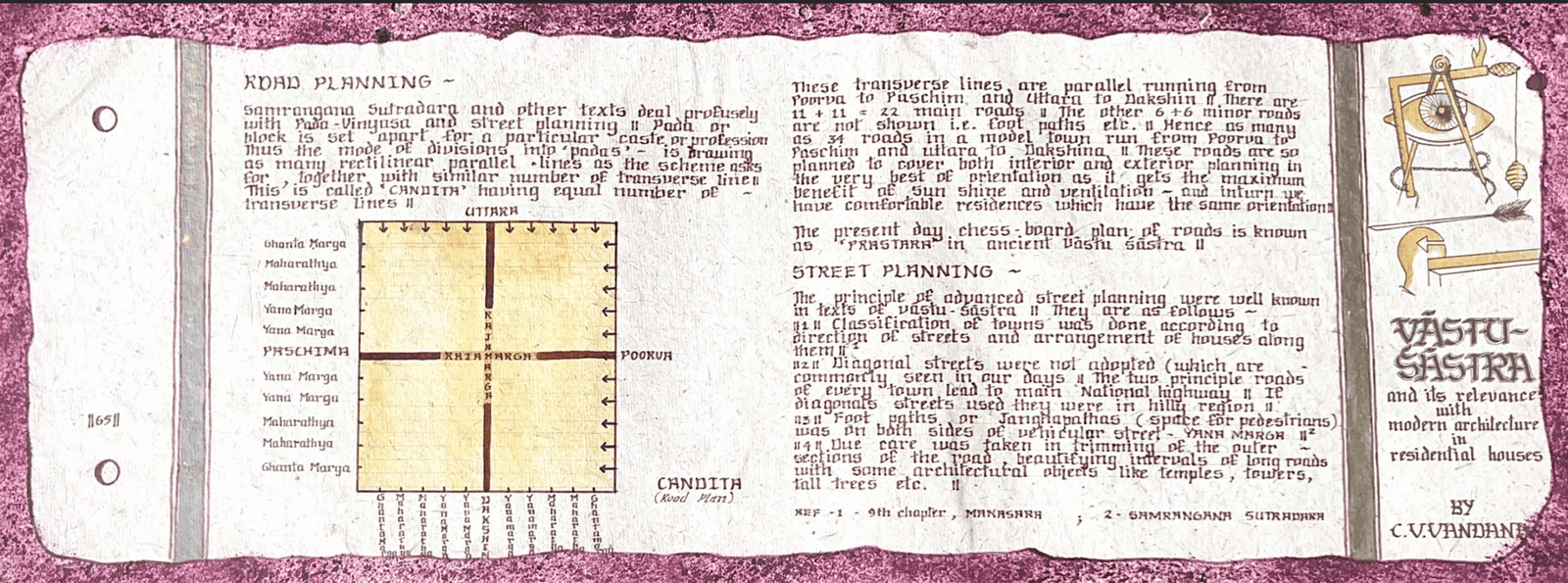
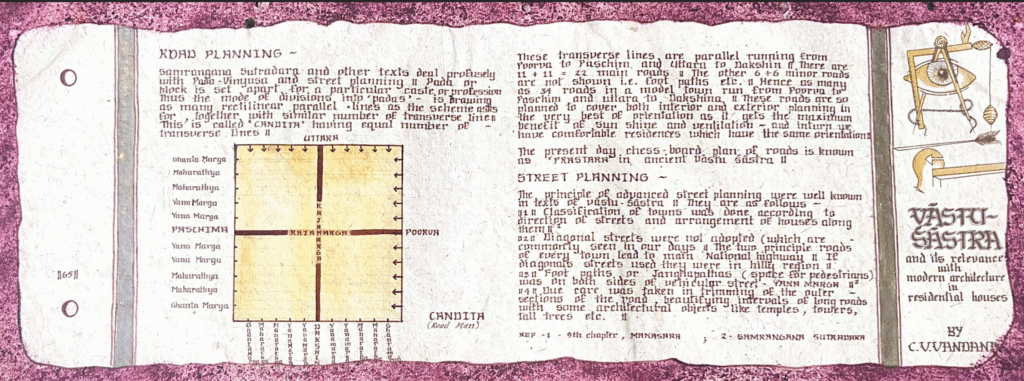
Table of Contents
- 1. Roads as Dynamic Energy Channels
- 2. Orientation and Directional Logic of Streets
- 3. Hierarchy of Roads: Order Within Movement
- 4. Street Widths and Proportions
- 5. Transport Systems: Ancient to Transitional
- 6. Street Junctions and Intersections
- 7. Residential Streets and Human Scale
- 8. Integration of Roads with Drainage and Landscape
- 9. Street Sections and Urban Cross-Sections
- 10. Roads as Social and Cultural Spaces
- 11. Flexibility and Adaptation
- 12. Contemporary Relevance
- Conclusion
In Vastu Shastra, roads are not merely channels of movement; they are the lifelines of a settlement. The ancient town planners of India understood that the way people, goods, air, water, and energy move through a town directly affects its prosperity, health, and social order. The Town Planning document presents a remarkably detailed and methodical approach to street planning, road hierarchy, and transport systems principles that remain strikingly relevant even in modern urban design.
1. Roads as Dynamic Energy Channels
Vastu Shastra considers roads as conduits of Prana (life energy). Their direction, width, alignment, and intersection patterns determine how energy circulates within a town. Poorly planned roads were believed to cause stagnation, congestion, and social imbalance, while well-planned streets enhanced flow, accessibility, and prosperity.
The document emphasizes that roads must:
- Respect cardinal directions
- Follow natural topography
- Respond to human scale
- Support both movement and social interaction
This holistic view treats mobility as both a physical and environmental phenomenon.
2. Orientation and Directional Logic of Streets
One of the most fundamental principles outlined is directional alignment. Roads running east–west and north–south are favored because they align with solar movement and prevailing winds.
Key observations include:
- East-facing streets receive balanced morning light
- North-south streets support consistent airflow
- Diagonal or irregular roads are used only when terrain demands it
The planner’s objective was not rigid geometry but energetic balance. Roads were aligned to enhance daylight penetration, thermal comfort, and visibility while minimizing harsh climatic exposure.
3. Hierarchy of Roads: Order Within Movement
The document clearly defines a hierarchical road system, ensuring that different types of movement do not conflict with each other.
The hierarchy typically includes:
- Main roads (arterial routes)
- Sub-arterial roads
- Residential streets
- Lanes and access paths
Each category has prescribed widths and functions. Main roads facilitate trade, ceremonies, and long-distance movement, while smaller streets prioritize safety, neighborhood interaction, and access to homes.
This layered structure prevented chaos and ensured that settlements could grow without losing clarity or order.
4. Street Widths and Proportions
Unlike arbitrary dimensions, Vastu-based street widths were determined by:
- Type of traffic
- Volume of movement
- Function of adjoining land use
- Human comfort
The document includes detailed illustrations showing street widths proportional to transport modes, from pedestrians and carts to animal-drawn vehicles. These proportions ensured:
- Smooth movement without congestion
- Adequate light and ventilation
- Visual harmony along streetscapes
Notably, streets were rarely oversized. Excessive width was considered wasteful and disruptive to community life.
5. Transport Systems: Ancient to Transitional
One of the most fascinating sections of the document illustrates modes of transport used in the past, along with their spatial requirements.
These include:
- Pedestrian movement
- Handcarts
- Bullock carts
- Animal-mounted transport
- Early wheeled vehicles
Each transport type is shown with its required road width and turning space. This demonstrates a deep understanding of ergonomics and logistics. Roads were designed to serve actual use patterns rather than abstract standards.
This adaptive approach allowed towns to evolve gradually as transport technology changed.
6. Street Junctions and Intersections
Intersections are treated as sensitive nodes in Vastu planning. The document cautions against:
- Excessive junction density
- Irregular intersection angles
- Dead ends in active zones
Well-planned intersections improve:
- Traffic flow
- Safety
- Visibility
- Social engagement
Major intersections often served as public nodes, markets, or gathering points, reinforcing their civic importance beyond traffic management.
7. Residential Streets and Human Scale
Residential streets receive special attention in the text. These streets are designed to:
- Slow down movement
- Encourage social interaction
- Ensure safety for children and elders
Narrower widths, shaded edges, and visual continuity create a sense of enclosure and belonging. The document’s illustrations show streets lined with trees and buildings proportioned to human height, reinforcing comfort and identity.
This approach contrasts sharply with modern car-dominated streets that often neglect human experience.
8. Integration of Roads with Drainage and Landscape
Road planning in Vastu Shastra is inseparable from water management and landscape design.
The document shows how:
- Roads follow natural slopes to assist drainage
- Side drains are integrated into street sections
- Trees are placed strategically for shade and cooling
- Open spaces interrupt dense road networks for relief
This integration ensured that streets functioned efficiently during both dry and monsoon seasons, reducing erosion, flooding, and heat buildup.
9. Street Sections and Urban Cross-Sections
Detailed street cross-sections in the document reveal a layered structure:
- Carriageway
- Pedestrian space
- Drainage
- Plantation
- Building edge
These sections demonstrate that streets were never mono-functional. They served as:
- Movement corridors
- Social spaces
- Environmental moderators
- Visual connectors
Such multi-functional streets are increasingly advocated in contemporary urban design, reaffirming the relevance of ancient wisdom.
10. Roads as Social and Cultural Spaces
Beyond movement, streets were vital social arenas. Festivals, processions, markets, and daily interactions unfolded along them. The document highlights that road widths and alignments were often influenced by cultural activities, not just traffic needs.
Main streets accommodated ceremonial movement, while smaller lanes fostered neighborhood bonds. This ensured that towns were not just efficient, but alive.
11. Flexibility and Adaptation
A key insight from the document is the flexible application of rules. While principles are clearly stated, planners were encouraged to adapt layouts based on:
- Terrain constraints
- Climate conditions
- Local customs
- Scale of settlement
This prevented rigid uniformity and allowed towns to retain unique identities while adhering to Vastu principles.
12. Contemporary Relevance
Modern urban challenges traffic congestion, unsafe streets, environmental stress mirror problems ancient planners sought to avoid. The Vastu-based approach to road planning offers valuable lessons:
- Design for people first
- Respect natural systems
- Plan hierarchies clearly
- Integrate movement with social life
The Town Planning document shows that sustainable mobility is not a new concept but a rediscovery of time-tested principles.
Conclusion
Road and street planning in Vastu Shastra reflects a profound understanding of movement as a holistic force shaping urban life. By integrating direction, hierarchy, human scale, transport needs, and environmental responsiveness, ancient planners created settlements that were efficient, adaptable, and deeply humane.
The Town Planning text demonstrates that when streets are designed with wisdom and restraint, they become more than infrastructure they become the backbone of thriving communities.