Planning is the stage where a house stops being an idea and becomes a structured system. In the Vastu tradition, planning is not treated as a drawing exercise alone. It is a method of organizing space so that daily life flows smoothly, resources are used intelligently, and the dwelling supports the occupants in practical and …

Table of Contents
- Houses as Responses to Social and Economic Conditions
- Classification of Houses and the Logic of Differentiation
- Stratification of Society and Residential Planning
- Minimum Requirements and the Discipline of Essential Planning
- Watching the Direction of the Site for House Construction
- Plot Division and the Use of Sub Divisions in Planning
- Placement of Rooms and Functional Zoning
- Planning as a Response to Daily Activities
- Planning Principles as a Bridge to Contemporary Design
- Conclusion
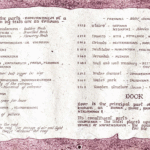
Planning is the stage where a house stops being an idea and becomes a structured system. In the Vastu tradition, planning is not treated as a drawing exercise alone. It is a method of organizing space so that daily life flows smoothly, resources are used intelligently, and the dwelling supports the occupants in practical and qualitative ways. The planning chapter establishes that residential design must respond to multiple realities at once, including family needs, economic limits, social context, site direction, and the internal logic of functional zoning.
A key point emphasized in the text is that residential houses never exist in isolation. They are part of society, part of a neighborhood, and part of a wider cultural order. For this reason, the planning process begins with understanding the nature of houses that are required by different social groups. The document introduces residential planning as a response to lifestyle, occupation, and the social structure of people, and not only as a technical response to a site. Planning, in this view, is fundamentally about suitability.

The planning discussion also clarifies that “modern” should not be mistaken as “detached from tradition.” Instead, the objective is to interpret planning principles in a way that produces comfortable and workable houses in current conditions. Therefore, the document treats planning as an applied discipline where ancient spatial logic can be evaluated and used within contemporary constraints.
Houses as Responses to Social and Economic Conditions
The text explains that houses vary widely because societies vary widely. People belong to different occupations, income levels, cultural backgrounds, and family systems. These variations create different needs for space, privacy, storage, work areas, and social interaction zones. Planning must translate those needs into built form. A house that is appropriate for one group may be unsuitable for another, even on the same site and in the same climate, because the internal life of the household differs.
Economic capacity is identified as a major factor shaping house planning. Budget affects plot size, built area, material choice, and the number of rooms. It also affects whether a house can include specialized spaces or must rely on multipurpose rooms. Planning therefore becomes a balancing act between aspirations and constraints. The text frames this not as a weakness but as the reality of residential design, where rational distribution of limited space creates a better dwelling than poorly planned abundance.
Social status and social role also influence planning. Certain households need areas for hospitality and public facing interaction, while others prioritize utility and privacy. The document highlights that planning must reflect how the family relates to the outside world. This means the designer must think about entry sequence, guest management, and internal separation, ensuring that the house supports the social habits of its occupants.

Classification of Houses and the Logic of Differentiation
To support planning decisions, the text introduces a classification of houses. This classification is presented as a way to understand variety, not as a rigid hierarchy. Houses can be categorized based on several criteria, including typology, social group, and built characteristics. The classification approach helps a planner decide what kind of spatial program is needed, what level of complexity is appropriate, and how much area should be dedicated to certain activities.
One category discussed is the distinction between houses based on the nature of occupancy and function. The text refers to common residential types and indicates that houses are shaped by whether they are intended for single families, combined families, or larger collective living conditions. The planning implications are significant. A single family house may prioritize compactness and efficiency, while a joint family house must handle a larger number of people, more simultaneous activities, and stronger requirements for privacy management.
Another classification is related to economic status. The document places emphasis on the practical need to plan differently for different income groups. The requirements of an economically constrained household differ from those of an affluent household, not only in room count but also in how spaces must serve multiple purposes. Planning for limited means requires higher efficiency, reduced circulation waste, and careful prioritization of essential spaces.
The classification approach also suggests that the planning of a house is inseparable from its intended use pattern. Some houses support home based work or craft, some support agricultural storage and processing, and others are oriented toward urban professional life. These differences influence the need for store rooms, verandahs, internal courts, or dedicated work areas. The purpose of classification is therefore to ensure that planning begins from reality and not from an abstract ideal.
Stratification of Society and Residential Planning
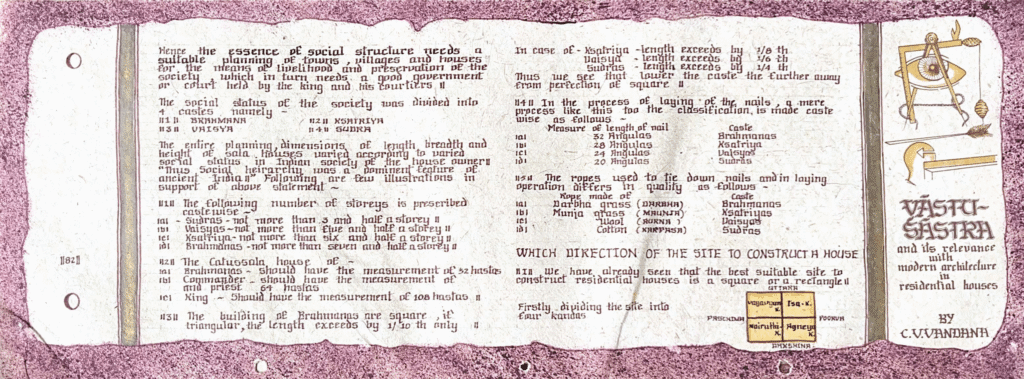
A distinctive portion of the planning chapter addresses stratification of society and its reflection in house planning. The text uses the idea that society consists of different functional groups, each with its own role and needs. It presents an understanding that housing requirements were historically interpreted through social roles, and that these roles influenced what spaces were required and how they were arranged.
The point here is not to replicate social stratification as a modern objective, but to highlight that planning has always been linked to occupation, routine, and daily demands. A household that depends on trade and transactions may need a stronger interface with the street, while a household focused on learning or ritual may seek quieter internal zones. Similarly, households engaged in service or labor may prioritize robust utility spaces and practical circulation.
From a planning perspective, this discussion reinforces that architecture is not neutral in use. Spatial planning either supports or obstructs daily life. Therefore, understanding the household’s social and occupational pattern remains essential even in modern terms, where the categories may change but the logic remains the same.
Minimum Requirements and the Discipline of Essential Planning
The text includes the idea of minimum requirements, meaning the essential spaces needed to constitute a workable house. The planning approach promotes disciplined allocation of space. Instead of adding rooms without clear purpose, the emphasis is on ensuring that the core functions of living are properly supported.
In this context, essential spaces include areas for sleeping, cooking, sanitation, storage, and social gathering. The planning question becomes how to arrange these functions so that movement is logical and privacy is respected. The text indicates that planning must avoid functional conflict, such as placing incompatible activities too close, or forcing circulation through private rooms.
This part of the planning logic is especially relevant to modern conditions, where many houses are built on small plots or within strict regulations. The discipline of minimum requirement planning ensures that even within limited area, a house can provide dignity, comfort, and order.
Watching the Direction of the Site for House Construction
The planning chapter places strong emphasis on observing the direction of the site before construction. Direction is treated as a planning input, not as decoration. It influences how spaces receive light and air, and how circulation and zoning can be organized. The text presents direction as a practical organizing tool to structure a plan.
The site’s direction affects entry placement, room orientation, and the distribution of open spaces. The document discusses the need to analyze the site in relation to cardinal and intermediate directions, and to plan accordingly. This approach aligns with earlier Vastu discussions where orientation is a major determinant of spatial quality and environmental comfort.
Direction also acts as a common reference system that allows consistent decision making. Once the directional framework is established, the planner can allocate functions systematically instead of arbitrarily. This builds order into the plan and reduces design confusion.
Plot Division and the Use of Sub Divisions in Planning
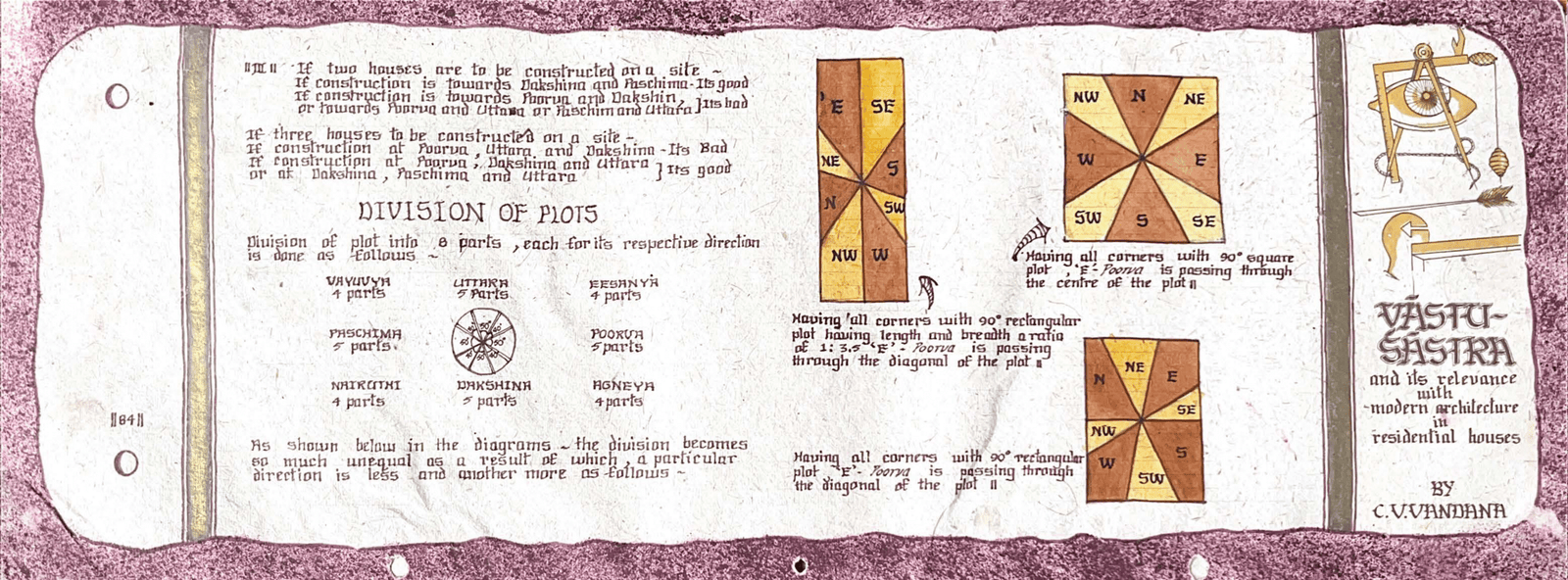
A significant planning method introduced in the document is the division of plots. The plot is not treated as a blank rectangle but as a field that can be subdivided into zones. These zones serve as planning guides for placing different functions and components of a house.
The text presents division in a structured way, showing that plots can be divided into a set of parts that correspond to directional zones. This approach allows a planner to create a logical map of the site and then assign spaces based on suitability. It also supports consistency across different projects, because the same zoning logic can be applied regardless of plot size, provided proportions are respected.
Plot division is also used to interpret irregular plots. Even when a plot is not perfectly rectangular, the idea of zoning allows the planner to recover functional order by identifying zones and assigning uses carefully. This is presented as a practical planning tool, not merely a theoretical diagram.
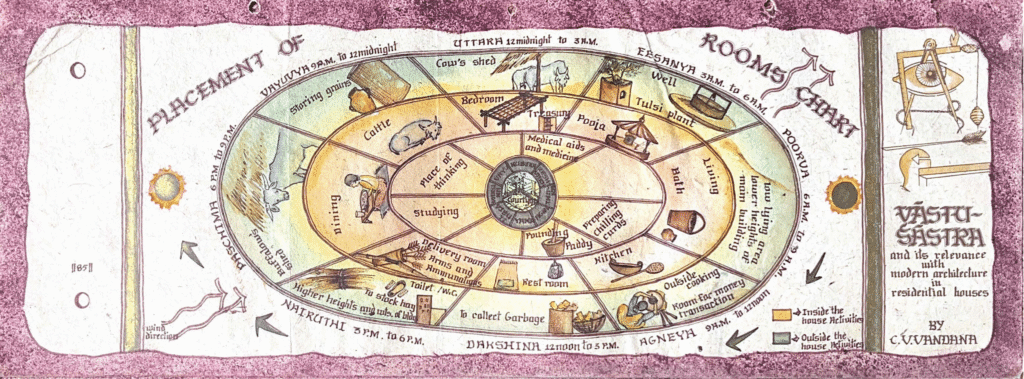
Placement of Rooms and Functional Zoning
The document provides strong guidance on placement of rooms, presenting planning as the art of assigning functions to zones. This includes identifying where the kitchen, sleeping spaces, living areas, storage, and sanitation should be placed relative to each other and relative to directional zones.
The logic is grounded in the idea that certain functions require more light, ventilation, or calmness. Spaces that are active, such as cooking and gathering, need supportive environmental conditions and convenient access. Spaces that require rest need quieter zones. Services must be placed so that they remain functional without disrupting the dignity of primary spaces.
The planning emphasis is also on sequence. How one enters the house, how one moves from public to private zones, and how service circulation is managed are all treated as essential planning concerns. This is consistent with the broader architectural idea that a house is experienced through movement, not just seen as a plan.
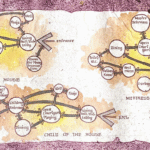
The room placement diagrams in the document reinforce the planning approach as systematic. Rather than relying on taste alone, the planner uses a framework to decide adjacency and orientation. This helps avoid common problems such as kitchens placed too far from dining, toilets placed too close to cooking zones, or bedrooms opening directly into public spaces.
Planning as a Response to Daily Activities
The text explicitly connects planning to daily activities. It recognizes that a house is a stage for routines such as waking, washing, cooking, eating, working, resting, and socializing. Good planning supports these routines with minimum friction. Poor planning creates conflict, stress, and inefficiency.
Therefore, the document frames planning as a predictive exercise. The planner must anticipate how a family will use spaces at different times of the day and in different seasons. This includes understanding peak activity periods, privacy needs, and the rhythm of household operations.
This approach aligns with the practical spirit of Vastu based planning. The objective is not to create abstract symmetry but to create livable order. Planning is successful when it reduces waste, supports comfort, and makes the house easier to manage.
Planning Principles as a Bridge to Contemporary Design
Even in the planning chapter, the document suggests that these principles remain relevant to modern architectural problems. Modern constraints such as smaller plots, denser contexts, and changing family structures do not eliminate the need for sound planning. Instead, they increase the importance of systematic thinking.
The value of Vastu planning principles, as presented here, lies in their ability to provide a structured method. Directional analysis, zoning through plot division, and functional placement logic can be applied in contemporary designs as long as they are interpreted intelligently.
Planning, in this framing, becomes a bridge between traditional spatial wisdom and modern architectural practice. It emphasizes that the ultimate goal is a house that works well for its occupants, stays coherent over time, and responds appropriately to site conditions.
Conclusion
The first half of the document establishes planning as the core discipline that shapes residential architecture. It highlights that housing varies because society varies, and that planning must respond to social structure, economic limits, and functional needs. It introduces classification as a way to understand housing diversity, and it links planning directly to the practical demands of daily life.
It then moves into the structured tools of Vastu planning, including directional observation, plot division, and systematic placement of rooms. The outcome is a planning methodology that seeks order, comfort, and suitability, and that can be evaluated and used even in contemporary conditions when applied with judgment.