As architects in India, we often grapple with the paradox of our cities: their density and dynamism are unparalleled, yet their public spaces are increasingly fragile. In the relentless growth of concrete, traffic, and private enclaves, what breathes life into our cities are the landscapes and public spaces those rare commons where people gather, rest, …
As architects in India, we often grapple with the paradox of our cities: their density and dynamism are unparalleled, yet their public spaces are increasingly fragile. In the relentless growth of concrete, traffic, and private enclaves, what breathes life into our cities are the landscapes and public spaces those rare commons where people gather, rest, celebrate, and simply be.
In urban India, public space is never empty; it is always alive with chai stalls, laughter, cricket matches, lovers on benches, and vendors weaving through crowds. And at the heart of these spaces, historically and symbolically, lies water. From temple tanks to ghats on rivers, from stepwells of Gujarat to lakes of Udaipur, water has always been the magnet around which Indian life congregates. In the modern city, however, water has been neglected often reduced to drains, encroached lakes, or ornamental fountains in gated parks.
As I reflect on landscape public spaces in urban India, three dimensions emerge as inseparable: water, people, and place. Together, they can transform not just the look of a city, but the way it is lived.
Water as Memory, Water as Future
In India, water is not merely a utility it is cultural memory. Step into the Chand Baori stepwell in Rajasthan, and you see how architecture once celebrated water as sacred. Visit the ghats of Varanasi, and you feel the city’s soul is tied to its river. Historically, our public life unfolded around ponds, tanks, and riversides. Water cooled the air, nourished trees, and symbolized abundance.
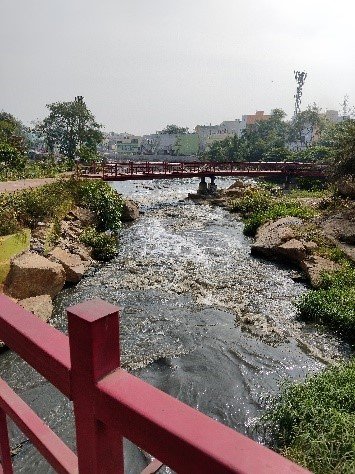
Yet in contemporary urban India, water has lost this role. Our lakes have been encroached, our rivers polluted, and our stormwater channels paved over. Instead of treating water as an ally, our cities treat it as a problem something to be drained, channelled, or hidden. This alienation has cost us dearly: waterlogging during monsoons, heat islands in summers, and a profound loss of connection to nature.
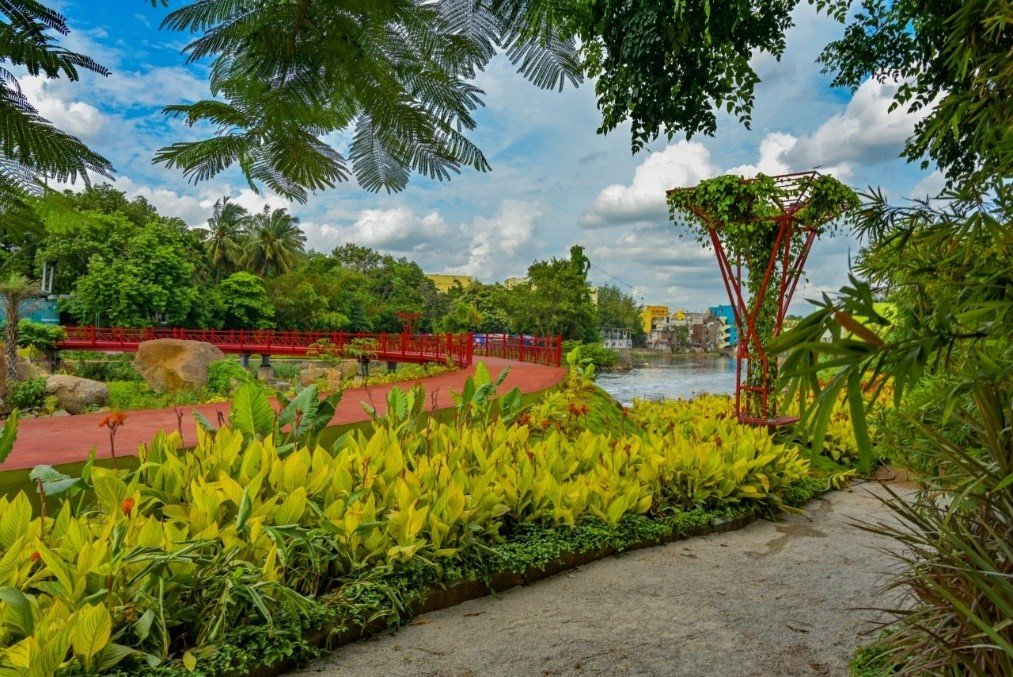
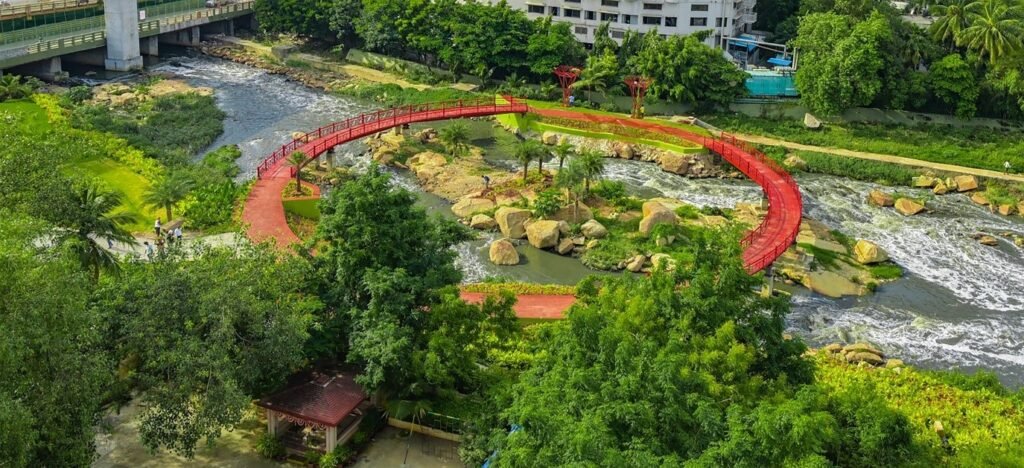
One standout example of a rain garden in Hyderabad is the Rain Garden underneath the Begumpet Flyover a transformative project implemented by the Hyderabad Metropolitan Development Authority (HMDA) in 2018. Spanning roughly 2 hectares and stretching over 400 meters along the intersection of the Kukatpally and Yousufguda nalas, this initiative set a precedent for nature-based solutions in Indian cities.
Goals & Objectives:
- Stormwater management: Enhance infiltration and prevent stagnation in a typically polluted drain (“nala”).
- Ecological restoration: Introduce a wetland ecosystem using native water-loving plants.
- Public amenity creation: Transform a neglected space into a green refuge with walking paths, seating areas, bridges, and night lighting.
Key Design Features:
- Clean-up first: The site was cleared of decades of debris and garbage buildup.
- Wetland vegetation: Plants like vetiver, typha latifolia, canna, Cyperus alterniflorus, and Ipomea carnea were strategically planted to filter water and support biodiversity
- Public amenities: A 10-foot-wide shaded walking track lined with coconut palms, stepped lawns for informal gathering, pedestrian crossover bridges, and LED lighting were added to enhance usability and safety.
Impacts & Recognition:
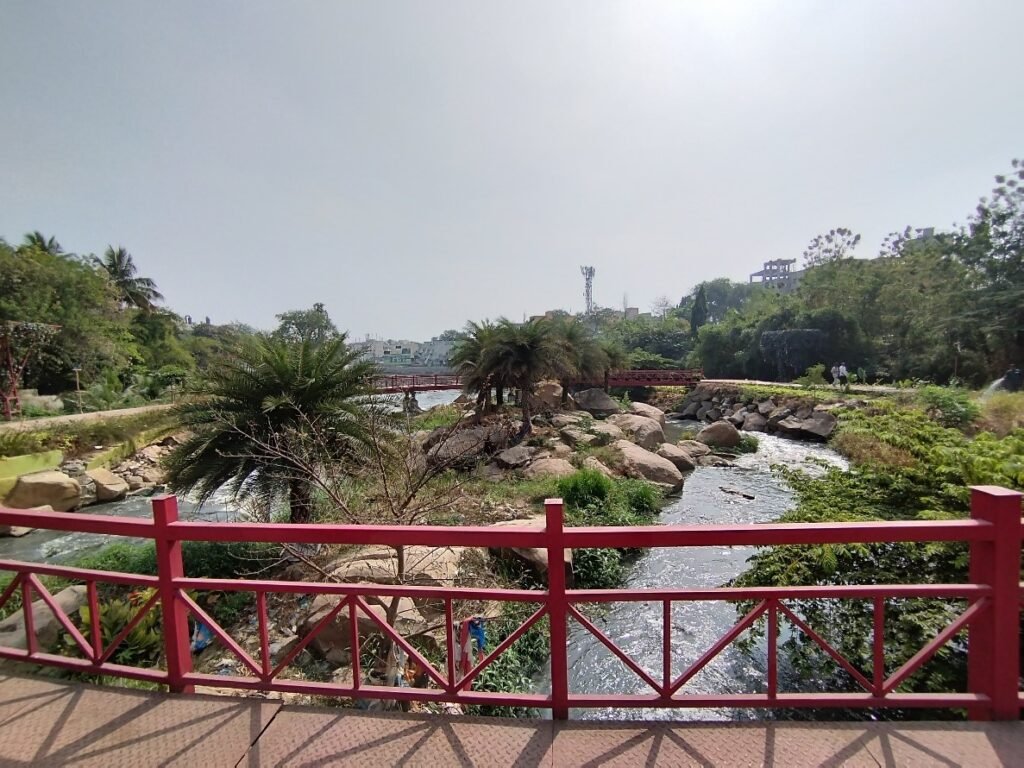
- Landscape uplift: A once-stagnant drain was reborn as a green, visually pleasing corridor, becoming “a feast for the eye.”
- Health and hygiene improvements: The design curtailed mosquito breeding and helped reduce sanitation-related risks Una City.
- Scaling up: Inspired by its success, HMDA launched additional rain garden projects at locations like Malakpet, Khairatabad, Attapur, and more.
- Award-winning model: The project earned recognition under the Smart Cities India (SCI) Awards for green and clean infrastructure.
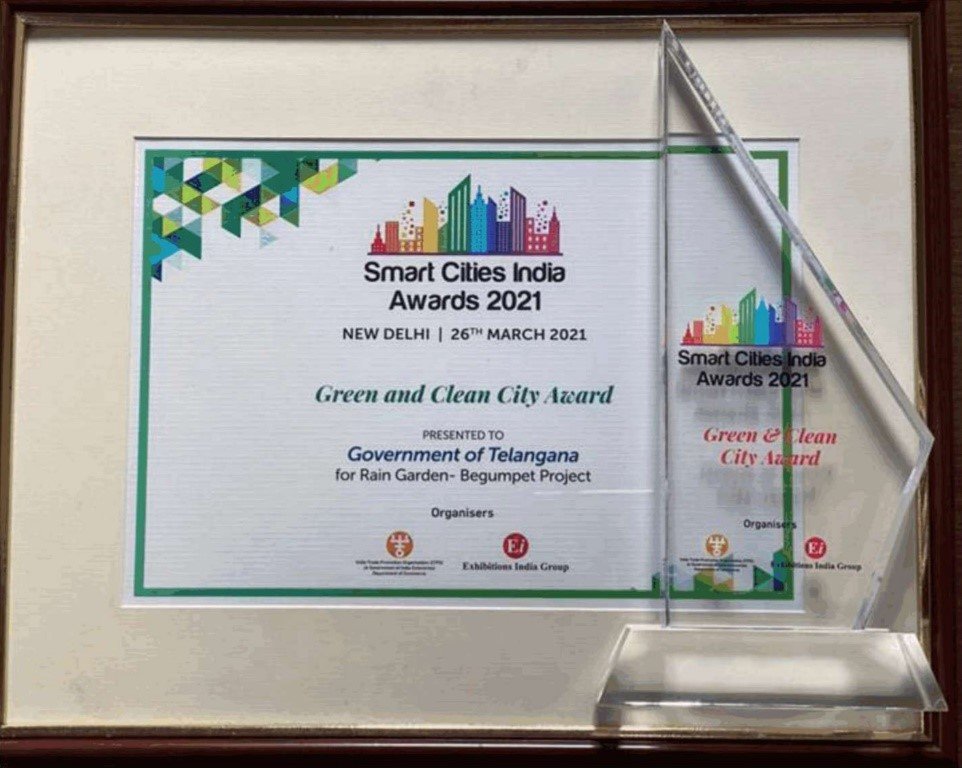
As an architect, the Begumpet rain garden exemplifies how ecological interventions can seamlessly blend water management, public amenity, and aesthetic value. It demonstrates that even small-scale projects beneath flyovers or along drains can be powerful urban commons, reintroducing blue-green infrastructure that serves both environmental and social ends.
This model inspires a vision of Indian cities where neglected waterways are not just functional drains but underwater gardens, civic promenades, and ecological habitats.
But there are glimmers of renewal. The Sabarmati Riverfront in Ahmedabad is one such project where water was reimagined as a civic spine.
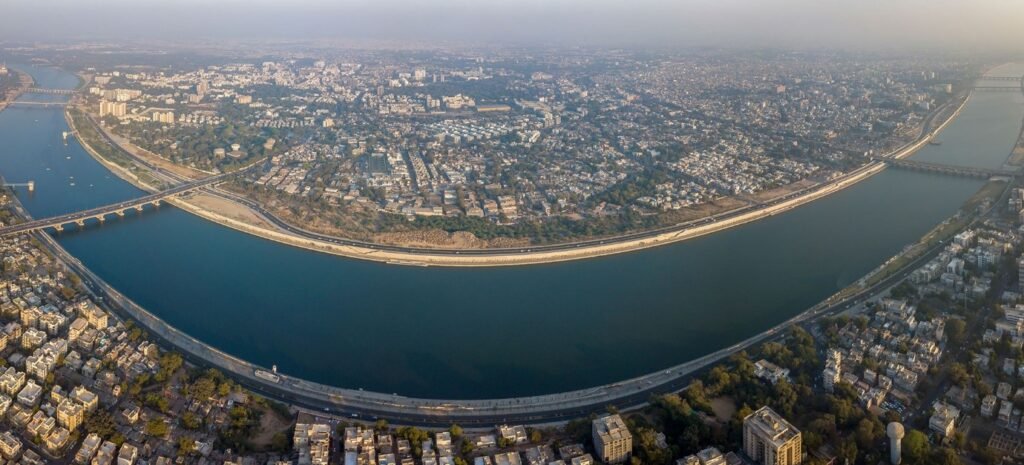
Once a neglected, polluted riverbank, it has been transformed into promenades, parks, and cultural grounds. While critics argue about ecological trade-offs, one cannot deny its role in giving Ahmedabad’s citizens a new public realm sunset walks, cycling paths, and festivals by the river.
As an architect, I believe every Indian city must reclaim water as a civic anchor. Not through ornamental fountains in gated parks, but through living landscapes rain gardens, bio-swales, restored lakes, and accessible waterfronts where people can gather.
Public Space as Theatre of Life
If water is memory, people are the energy that animates our landscapes. In India, public spaces are never passive lawns with “do not walk on grass” signs. They are theatres of everyday life.
At India Gate lawns in Delhi, families picnic late into the night, vendors sell ice creams, and children fly kites. At Marine Drive in Mumbai, the promenade becomes a democratic platform: office-goers, couples, street performers, and elderly walkers share the same sea-facing edge. In Bengaluru’s Cubbon Park, mornings are alive with joggers and dog-walkers, while afternoons invite quiet naps under banyan trees.
What strikes me as an architect is how Indians appropriate public space with astonishing creativity. A shaded corner becomes a chess table. A flight of steps becomes a stage. A lawn becomes a cricket pitch. Unlike Western urban parks, which often follow a programmed script, Indian public spaces thrive in improvisation.
Our job, then, is not to over-design but to allow flexibility. To create edges that invite sitting, trees that invite shade, steps that invite gathering. The most successful public spaces in India are not the ones with the most expensive materials, but the ones with the greatest generosity of spirit.
Landscape as Climate Infrastructure
Urban India today faces extreme climate stress: floods, heatwaves, water scarcity. Landscape architecture can no longer be just “aesthetic greening” it must be climate infrastructure.
Water bodies must double as flood buffers. Trees must function as carbon sinks and natural air-conditioners. Open grounds must become sponges for rain. This is not idealism but survival.
Consider Eco Park in Kolkata, one of the largest urban parks in India. Built around a central lake, it cools its surrounding microclimate and provides ecological relief to one of the densest metros. Or take Jal Mahal’s lakefront restoration in Jaipur, which revived both a historic palace and its urban ecology, turning it into a vibrant public realm.
The lesson here is clear: when we design landscapes that work with natural systems, they give back to the city many times over cooler air, cleaner water, healthier communities.
The Challenges of Public Space in India
Yet as architects, we must confront uncomfortable truths. Urban public spaces in India are under threat.
- Encroachment: Lakes filled up for real estate, footpaths overtaken by parking.
- Privatization: Malls replacing bazaars, gated parks accessible only by tickets.
- Neglect: Broken benches, dry fountains, overgrown parks with no maintenance.
- Pollution: Rivers turned into sewers, lakes frothing with chemical foam.
The tragedy is that while India’s cities are expanding, their public spaces are shrinking. This not only reduces ecological resilience but also erodes the democratic fabric of the city. Public space is where strangers meet, where differences dissolve, where cities find their collective pulse. Without it, we risk building only fragmented enclaves.
Designing for People, Designing for Joy
So, what must we do, as architects and planners?
First, listen to people. Observe how they already use space. In Lodhi Gardens, the informal gatherings are as important as the manicured lawns. In Sabarmati Riverfront, it is the evening stroll, not the monumental plazas, that creates belonging.
Second, design with water. Every Indian city has a memory of lakes, tanks, or rivers. Reviving them is not nostalgia it is ecological necessity. Imagine if Bengaluru restored its interconnected tank system, if Delhi revitalized its stormwater nullahs, if Chennai’s Buckingham Canal became a linear park.
Third, celebrate shade and trees. In our hot climate, a tree is worth more than a steel canopy. Banyans, neem, and peepal are not just landscape elements they are civic anchors.
Fourth, embrace informality. Do not fear the street vendor, the chai stall, or the spontaneous cricket match. They are not intrusions; they are the lifeblood of Indian public space.
Finally, ensure accessibility. A public space is not truly public if it requires tickets, gated entry, or exclusionary zoning. True democracy in design is when the rickshaw puller, the software engineer, and the street child can all sit on the same bench by the same lake.
Toward a New Urban Imagination
As I think of the future of urban India, I am convinced that the success of our cities will not be measured by skyscrapers or highways, but by the quality of our public spaces. Do our lakes invite us to sit by them? Do our parks cool us in summer? Do our rivers belong to people, or only to industry?
The challenge is immense, but so is the opportunity. India’s urban population is young, dynamic, and eager for spaces to breathe. If we, as architects, planners, and citizens, can reimagine our landscapes around water, people, and openness, we can build cities that are not just habitable, but joyful.
The Lotus Temple in Delhi reminds us how water and landscape can create serenity. The ghats of Banaras remind us how rivers anchor community. The chowks of small towns remind us how public space becomes social glue. Urban India must draw from these lessons, not to replicate the past, but to invent a future where landscape is not leftover space, but the very heart of the city.
Conclusion
Landscape public spaces in India are not luxuries they are lifelines. They cool our cities, heal our ecologies, and unite our people. In the theatre of Indian urbanism, where chaos is the script, landscapes are the pauses, the breaths, the stages for everyday democracy.
As an architect, I dream of Indian cities where rivers are clean, lakes are alive, parks are generous, and streets belong to people before cars. It is a dream that requires not just design, but political will, community participation, and above all, a recognition that the soul of a city lies not in its buildings, but in its open spaces.
Water, people, and place this triad is our greatest design challenge, and our greatest hope.