In an age where cities stretch ever upward and the planet strains under the weight of urban expansion, a handful of architects have dared to imagine a new kind of skyscraper one that doesn’t just pierce the sky, but breathes with it. Among them, Malaysian architect Ken Yeang stands as a pioneer, a visionary who …
In an age where cities stretch ever upward and the planet strains under the weight of urban expansion, a handful of architects have dared to imagine a new kind of skyscraper one that doesn’t just pierce the sky, but breathes with it. Among them, Malaysian architect Ken Yeang stands as a pioneer, a visionary who has spent decades transforming the way we think about tall buildings and their relationship with nature. His work proposes a simple yet revolutionary idea: what if skyscrapers could function not as isolated machines for living, but as vertical ecosystems vibrant habitats where architecture and ecology intertwine?
For Yeang, this is not a futuristic fantasy. It is a practical, deeply researched response to the crises of urbanization, climate change, and environmental degradation. Through projects such as the Menara Mesiniaga in Malaysia, the National Library of Singapore, and the Spire Edge Tower in India, he has demonstrated that ecological principles can be woven seamlessly into high-rise design. His approach is not about adding a few green roofs or decorative plants to steel and glass boxes. It is about rethinking the very DNA of buildings their systems, materials, and relationships to the environment so that they operate like living organisms.
A Pioneer of Eco-Architecture
Ken Yeang was born in 1948 in Penang, Malaysia, a region where the lush tropical environment left a lasting imprint on his imagination. After studying architecture at the Architectural Association School in London in the 1970s, he returned to Southeast Asia with a bold ambition: to develop a sustainable design language appropriate to the equatorial climate, rather than simply importing Western modernism. This ambition would later evolve into his life’s work what he calls eco-architecture or bioclimatic design.
At a time when sustainability was little more than an afterthought in architectural discourse, Yeang was already articulating a comprehensive ecological theory. He argued that buildings must function as extensions of the natural environment, not intrusions upon it. They should be designed in harmony with local climate patterns, ecological processes, and the psychological needs of their occupants. He envisioned architecture as a living system that interacts dynamically with the environment absorbing energy, exchanging air, filtering light, supporting biodiversity, and regenerating itself.
This holistic vision became the foundation of his lifelong pursuit: to create vertical cities in harmony with nature. Yeang saw the skyscraper not as a symbol of dominance but as an opportunity for coexistence. In dense urban areas where land is scarce, verticality was inevitable. But rather than replicating the horizontal sprawl in vertical form, he sought to reinvent the skyscraper as a microcosm of nature complete with its own habitats, energy cycles, and ecosystems.
The Theory of Vertical Ecology
Yeang’s central concept of “vertical ecology” transforms the skyscraper from a stack of repetitive floors into a living, breathing organism. It’s an architectural ecosystem that integrates vegetation, water, natural ventilation, daylight, and biodiversity across multiple levels. Each component of the building contributes to an interdependent network much like species in an ecological web.
At the heart of this approach is the belief that ecology is not an aesthetic, but a structural and systemic logic. The placement of every atrium, balcony, and facade responds to environmental forces: wind direction, solar gain, humidity, and temperature. The goal is to minimize energy consumption by aligning the building’s form and systems with natural processes rather than fighting against them.
Yeang emphasizes bioclimatic design as the starting point. This means designing buildings that adapt to their climate reducing reliance on artificial cooling, heating, and lighting. In tropical regions, for instance, this involves orienting structures to maximize cross-ventilation, providing deep overhangs and sunshades, using light materials that dissipate heat, and incorporating vegetation to create microclimates.
However, Yeang’s innovation goes beyond passive design. He envisions tall buildings as three-dimensional landscapes where green terraces, sky gardens, and natural corridors form continuous ecological networks from ground to sky. This creates habitats for birds, insects, and plants effectively restoring biodiversity in the heart of the city. These vertical landscapes are not mere decoration; they are functioning ecosystems that clean air, moderate temperatures, and support life.
In Yeang’s words, “The skyscraper should not be seen as an isolated object in the city but as a living part of a larger ecosystem.” His designs thus aim to reconnect the built and the natural, to blur the line between the artificial and the organic.
Menara Mesiniaga: The Prototype of Vertical Ecology
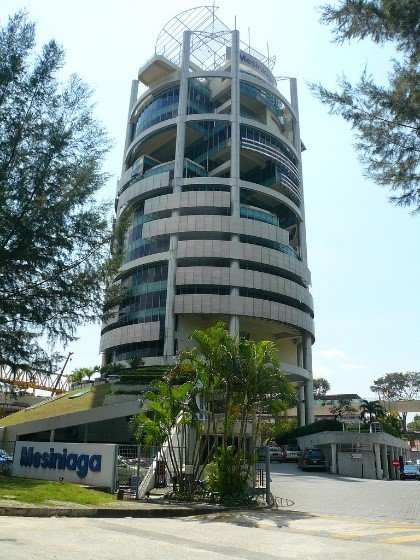
Nowhere is Yeang’s philosophy more vividly realized than in his early masterpiece, the Menara Mesiniaga (IBM Tower) in Subang Jaya, Malaysia, completed in 1992. Long before the term “green building” became fashionable, Yeang created a high-rise that embodied the principles of vertical ecology in both form and function.
Menara Mesiniaga rises gracefully from its suburban context, its spiraling form wrapped in vegetation and open terraces. Unlike typical office towers that rely heavily on sealed glass façades and mechanical air conditioning, this building embraces the tropical climate. Its cylindrical core and external structure are carefully oriented to optimize natural ventilation and reduce solar heat gain. The façade features adjustable sun-shading devices that respond to the sun’s path, reducing glare while allowing daylight to flood the interiors.
But what truly sets the Menara Mesiniaga apart is its integration of greenery and communal spaces throughout its height. Yeang introduced a vertical sequence of sky courts open-air terraces planted with lush vegetation. These serve as breakout areas for occupants, but also as natural air filters and temperature regulators. Each sky court functions as a node in the building’s ecological system, linking indoor and outdoor environments. The greenery provides shade, absorbs carbon dioxide, and creates habitats for birds and insects.
The building’s spiral ramp, wrapping upward around its core, is not merely a circulation device but an ecological corridor a continuous green spine that connects the sky gardens vertically. This feature makes the tower feel more like a living organism than a static structure. It breathes, filters, and regenerates an early precursor to what we now call the “living building.”
Menara Mesiniaga remains a landmark not just for its aesthetics, but for its foresight. Decades later, as sustainability became mainstream, the building’s strategies still feel ahead of their time. It demonstrates that ecological design need not compromise modernity or functionality; it can enhance both. It shows that even in the dense urban fabric, nature can be invited upward integrated, not relegated.
Architecture as an Ecological System
Yeang’s ecological vision extends beyond individual buildings to encompass entire urban systems. He argues that architecture should function like an ecosystem a network of interacting components that maintain balance and resilience. In his view, the urban environment can be understood as a complex organism, composed of built structures, infrastructure, natural elements, and human activities, all interlinked through flows of energy, materials, and information.
In such a system, sustainability is not achieved through isolated green features but through synergy. Buildings should be designed to work with the environment harvesting rainwater, generating renewable energy, recycling waste, and supporting natural habitats. Yeang’s designs often incorporate bioclimatic features such as wind scoops, double-skin façades, and passive cooling systems, but always as part of a larger ecological narrative.
For example, in his design for the Spire Edge Tower in Gurgaon, India, Yeang reimagines the office tower as a porous, green structure.
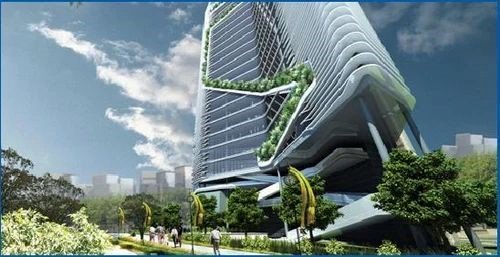
Its façade integrates vertical gardens, and its orientation maximizes natural airflow. The building incorporates an eco-cell system vertical shaft that facilitate natural ventilation and allow light to penetrate deep into the interior. These eco-cells function like lungs, ensuring that the tower breathes naturally, reducing dependence on mechanical systems.
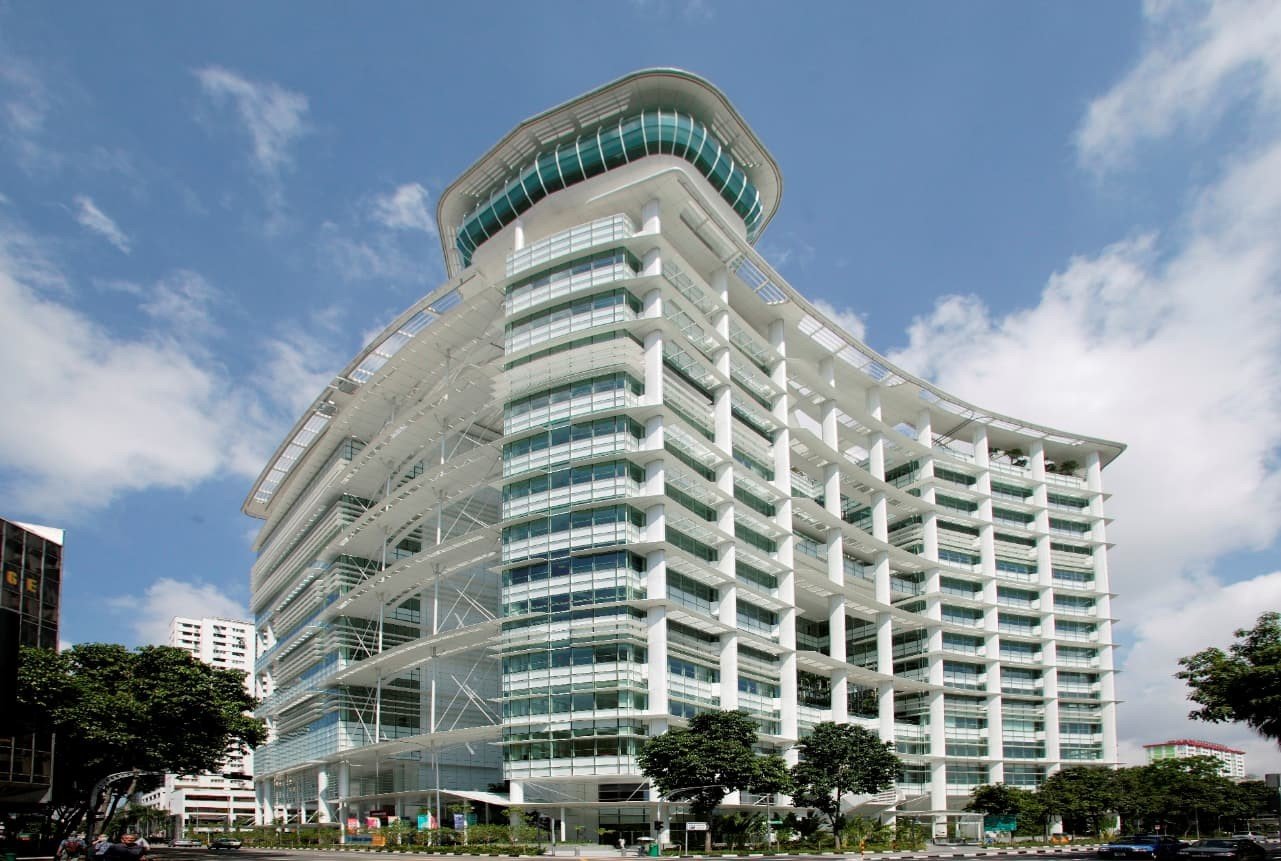
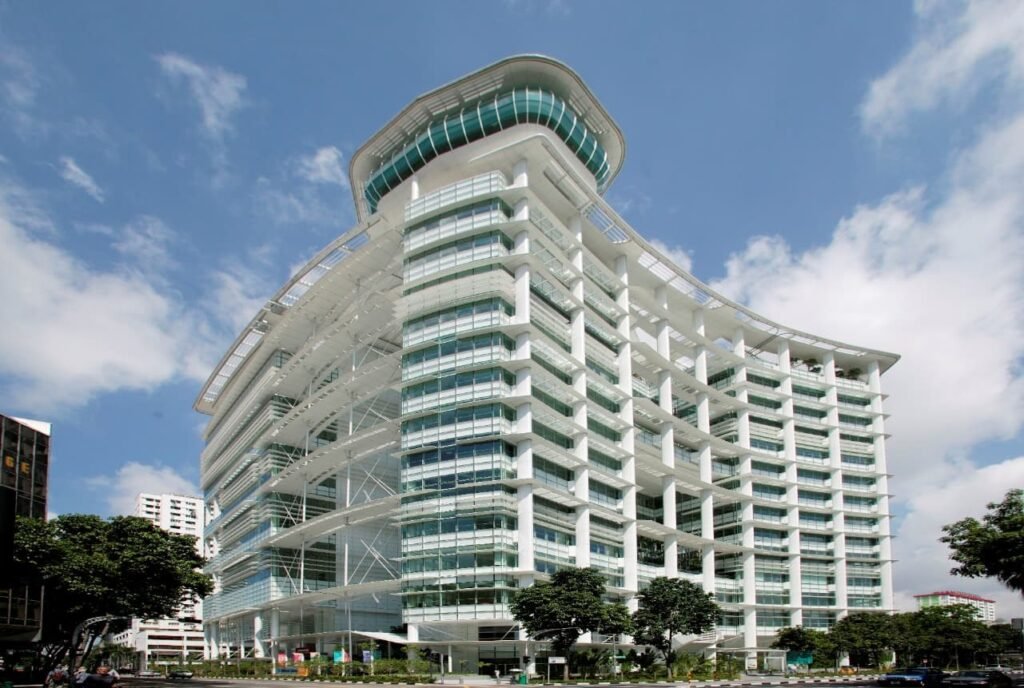
Similarly, the National Library of Singapore demonstrates how vertical ecology can enrich public buildings. The library’s design features extensive sky gardens that provide natural cooling and outdoor reading areas, while also creating habitats for flora and fauna. Its atriums and terraces allow air to circulate freely, reducing the need for air-conditioning in a tropical climate. The building becomes a civic ecosystem not just a container of books, but a living, breathing space for people and nature.
The Aesthetics of Ecology
While Yeang’s architecture is driven primarily by environmental logic, it has also produced a unique aesthetic one that contrasts sharply with the sealed, mirrored facades of conventional high-rises. His buildings often appear asymmetrical, layered, and porous. Green terraces spiral upward, sunshades jut out at odd angles, and vegetation cascades over façades. The result is an architecture that feels alive, constantly changing with the growth of plants and the movement of light.
Yeang’s aesthetic arises naturally from his ecological principles. The irregularity of his forms reflects the complexity of natural systems. The transparency and permeability of his façades mirror the openness of ecosystems. Instead of sleek, hermetically sealed towers, he gives us structures that breathe, grow, and adapt architecture as organism rather than monument.
This aesthetic also has a powerful psychological dimension. By integrating greenery and open-air spaces, Yeang creates environments that nurture well-being. Numerous studies have shown that proximity to nature reduces stress, improves focus, and enhances creativity. In Yeang’s buildings, workers and residents experience this biophilic connection daily stepping into sky gardens, feeling the breeze, watching birds flit between plants. In this way, vertical ecology becomes not only an environmental strategy but also a humanistic one.
Challenges and Critiques
Despite his visionary contributions, Yeang’s approach has not been without challenges. Integrating vegetation into tall buildings presents complex technical issues from irrigation and drainage to maintenance and structural loading. Moreover, developers often hesitate to invest in ecological features that do not immediately translate into financial returns. Yeang has faced these realities throughout his career, frequently balancing environmental ideals with economic and practical constraints.
Some critics argue that his buildings, while conceptually groundbreaking, can be difficult to replicate at scale due to cost and climate-specific design. Others suggest that the presence of greenery sometimes serves symbolic rather than fully functional ecological purposes. Yet, these critiques often underestimate the experimental nature of his work. For Yeang, each project is a prototype a step toward refining the model of ecological urbanism.
In recent years, as technology has advanced and environmental awareness has grown, many of Yeang’s once-radical ideas have become mainstream. Green roofs, vertical gardens, passive cooling, and mixed-use vertical planning are now standard considerations in sustainable design. In that sense, his legacy is profound: he helped lay the intellectual and practical groundwork for a generation of eco-conscious architects.
Toward an Ecological Urbanism
Yeang’s vision extends beyond individual buildings to the urban scale. He argues that cities must be conceived as integrated ecological systems, where buildings, infrastructure, and landscapes work together to support environmental balance. This requires a shift from object-centered architecture to systems thinking a move from designing isolated masterpieces to designing living networks.
In Yeang’s imagined future, cities are vertical forests not in the metaphorical sense, but literally. Towers are interconnected by sky bridges and green terraces, creating corridors for wildlife and people alike. Rainwater is collected and reused throughout the urban ecosystem. Waste is composted, and energy is generated from renewable sources. Each building contributes to the health of the larger organism the city itself.
This is not utopian rhetoric. Yeang’s research and built projects have demonstrated the feasibility of such systems when approached with scientific rigor and ecological sensitivity. He often describes his process as “designing with nature” rather than “designing against it.” This echoes the principles of ecological science: cooperation, adaptation, and interdependence.
A Living Legacy
Ken Yeang’s influence reaches far beyond architecture. His writings, such as Designing with Nature and The Green Skyscraper, have inspired urban planners, engineers, and environmentalists around the world. He has shown that sustainability is not merely about energy efficiency or certification systems but about a profound rethinking of how humans inhabit the Earth.
What distinguishes Yeang from many contemporary “green architects” is his intellectual depth and consistency. For him, ecology is not a marketing label but a worldview. He does not treat sustainability as an add-on but as the organizing principle of design. His architecture is rooted in science yet expressed through poetry a rare balance between technical precision and imaginative vision.
As global cities continue to grapple with issues of density, pollution, and climate resilience, Yeang’s ideas feel more urgent than ever. The skyscraper, once a symbol of industrial ambition and environmental indifference, can be reimagined as a symbol of coexistence a new type of urban nature that supports life rather than suffocates it.
Conclusion: Breathing Cities
Ken Yeang’s architecture offers a powerful lesson: that our buildings, like ourselves, are part of nature’s continuum. They inhale and exhale, absorb and release, grow and decay. By embracing this reality, we can transform our cities from inert machines into living ecosystems.
In the shimmering heat of Kuala Lumpur or the dense skyline of Singapore, Yeang’s towers stand as quiet but radical statements. They remind us that the future of architecture is not just taller, smarter, or more digital it is more alive. His skyscrapers are not monuments to human ego but collaborations with the planet. They suggest that progress does not mean conquering nature, but learning to live gracefully within it.
In the end, Ken Yeang’s “vertical ecology” is not only about buildings. It is a philosophy of coexistence an invitation to rediscover our role within the natural order. It calls for an architecture that breathes, that heals, that connects. And in that breath that gentle exchange between glass, leaf, wind, and light we can glimpse a new vision for the twenty-first-century city: not a forest of steel, but a living, vertical garden of life.