From material choices to energy systems what it actually takes to design buildings that give back as much as they take Introduction As the world faces the twin urgency of climate change and resource constraints, the concept of net-zero and carbon-neutral buildings has moved from idealistic vision to practical imperative. Architects, engineers and developers are …
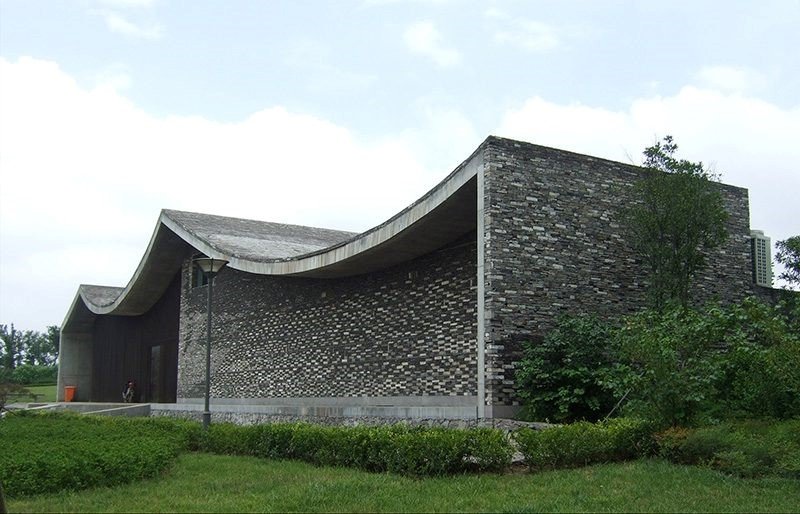
Table of Contents
From material choices to energy systems what it actually takes to design buildings that give back as much as they take
Introduction
As the world faces the twin urgency of climate change and resource constraints, the concept of net-zero and carbon-neutral buildings has moved from idealistic vision to practical imperative. Architects, engineers and developers are under increasing pressure not just to reduce operational energy, but to consider embodied carbon, life-cycle impacts, and to create buildings that give back to the environment rather than merely consume.
In this blog we will explore what it takes—from material selection to energy systems, from design strategies to operational feedback to bring a building into a state of net-zero or carbon-neutrality. Then we will focus on a noteworthy Chinese architect, Wang Shu, whose work shows sensitivity to materials, craft, local context and embodies many sustainable principles (even if not always labeled “net-zero”). By examining his projects, we glean relevant lessons for designing buildings that are not just low-carbon, but regenerative in spirit.
What do “net-zero” and “carbon-neutral” mean in the building context?
Before diving into strategies, it is important to clarify what these terms mean:
- Net-zero energy (NZE): A building whose annual delivered energy (electricity, heating/cooling, etc) is offset by on-site or off-site renewable generation, so that the net energy consumption is zero or less.
- Net-zero carbon (NZC) / carbon-neutral building: Goes further by accounting for carbon emissions operational (energy used in running the building) plus often embodied (carbon in materials, construction, transport, demolition). A carbon-neutral building offsets or avoids the carbon emissions so that the net carbon impact over a defined period is zero.
- Life-cycle approach: Achieving real net-zero or carbon-neutrality requires thinking across the entire life cycle: materials extraction, manufacture, transport, construction, use, maintenance, and end-of-life as well as operational energy.
- Regenerative ambition: The highest bar is a building that actually gives back for example by generating more clean energy than it uses, sequestering carbon, improving biodiversity, or restoring local ecology.
These goals matter because buildings worldwide account for a large share of energy consumption and carbon emissions. Especially in rapidly urbanizing countries, scaling net-zero building becomes essential rather than optional.
Key strategies for achieving net-zero/carbon-neutral buildings
Here are the pillars and major strategies, showing how the conceptual goal becomes concrete design and engineering moves.
1. Minimize energy demand upfront
The first step is reducing how much energy the building needs before thinking about generation. This includes:
- High-performance envelope: thermal insulation, high-quality glazing, airtightness, thermal breaks.
- Passive design: orientation, daylighting, natural ventilation, shading devices, thermal mass.
- Smart building form: minimizing wasted space, optimizing floor-to-volume ratios and layouts so that energy loads (heating/cooling) are reduced.
- Service efficiency: using efficient HVAC, lighting and controls; demand-response systems; efficient appliances.
- Monitoring and feedback: using sensors and building automation to track performance and optimize use.
By starting with demand minimization, the size of renewable generation or offset required becomes smaller and more cost-effective.
2. Select low-carbon materials and construction practices
To move towards carbon-neutrality (not just net-zero energy), material choices and construction practices matter:
- Use materials with low embodied carbon: recycled content, salvaged materials, locally sourced materials (reducing transport).
- Optimize structural form to reduce material quantities without compromising safety or durability.
- Choose long-life, durable building components so that maintenance, replacement and demolition emissions are minimized.
- Reuse or up-cycle existing buildings or components when possible (adaptive reuse).
- Track and assess life-cycle carbon emissions (LCA) for materials and components to inform procurement.
3. On-site (or off-site) renewable generation
Once demand is reduced and materials carbon are managed, the next step is generating clean energy:
- Photovoltaic (PV) panels on roofs, façades or nearby land.
- Wind turbines (where site conditions permit).
- Geothermal, ground-source heat pumps, or other renewable heating/cooling technologies.
- Heat recovery systems, cogeneration, district renewable systems.
- Smart control and storage: batteries, thermal storage, demand shifting to align with renewable generation.
4. Offsets and embodied carbon accounting
Because it is often difficult or expensive to eliminate all operational and embodied carbon, many net-zero projects include offsets:
- Purchase or generation of renewable energy credits.
- On-site or nearby carbon sequestration (e.g., trees, soils).
- Lifecycle carbon accounting frameworks to quantify embodied carbon and set reduction targets.
- Procurement processes requiring Environmental Product Declarations (EPDs) and carbon-footprint reports for materials and contractors.
5. Monitoring, commissioning and occupant behaviour
A building designed for net-zero is only as good as how it is used:
- Commissioning of systems (ensuring they perform as designed).
- Real-time monitoring of energy use, generation, carbon emissions, indoor environmental quality.
- Occupant education and engagement: making sure building users understand how to operate natural ventilation, shading, blinds, controls, etc.
- Continuous optimization: tuning building performance based on actual data, adjusting controls and user guidance.
6. Integrating the site, ecology and the neighbourhood
Net-zero design also benefits from thinking beyond the individual building:
- Site orientation, shading by trees, reflecting surfaces, water features, landscaping to reduce heat island effect.
- Integration into district-scale energy systems or sharing renewable generation among buildings.
- Designing for resilience: ability to cope with climate change, heat waves, storms, and to maintain comfort and function with limited energy or external systems.
Why net-zero in China matters & the national context
In China, rapid urbanization, large construction volumes and evolving responsible-building norms make net-zero strategies especially critical. For example:
- China has set a target to reach carbon neutrality by 2060, which puts pressure on the building sector to decarbonize.
- Forums organised by the China Exploration & Design Association have explicitly established “Zero Net Carbon (ZNC)” development as necessary.
- The emphasis is shifting from green building certification alone to whole life-cycle carbon assessments, procurement transparency, and systemic change.
- Given the scale of construction in China (billions of square metres annually), designing and building net-zero buildings can have outsized impact on global building-emissions reduction.
In short: in a country doing large volumes of construction and facing severe energy/ environmental constraints, net-zero building strategies are not niche they’re essential.
Introducing Wang Shu context, approach and relevance
Wang Shu is a Chinese architect based in Hangzhou, Zhejiang Province, and co-founder (with Lu Wenyu) of the firm Amateur Architecture Studio. While his work is not explicitly labelled “net-zero” in every instance, many of his projects demonstrate sustainable material thinking, local-craft engagement, reuse of materials, and sensitivity to embodied carbon and contextual value.
A few key points about Wang Shu’s approach which make him relevant in this discussion:
- Use of recycled bricks in his facades (for example at the Ningbo Museum) exemplifies attention to material reuse and embodied carbon reduction.
- Emphasis on local craft, hand-made components and traditional techniques means less reliance on heavy embodied energy factory processes.
- His architecture often engages with existing urban fabric and vernacular context rather than starting with large blank-slate demolition.
- Although his works may not always claim full net-zero operational energy, the material decisions and craft-based detailing align with carbon-conscious building practices.
Therefore, exploring Wang Shu’s work helps illustrate how an architect in China can embed sustainable building strategies—especially at the material and construction level even while moving toward broader net-zero goals.
Case Study A: Ningbo Museum, Ningbo, China
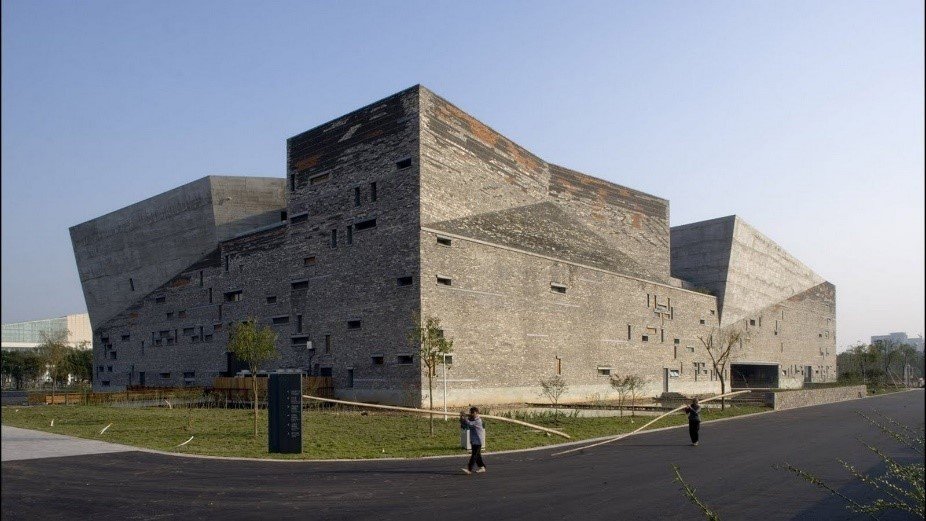
One of Wang Shu’s most widely recognized projects is the Ningbo Museum, completed in the late 2000s. The building’s façade is constructed entirely of recycled bricks salvaged from demolished buildings. This decision reduced waste, reused existing materials, and created a distinctive massing and texture.
Key sustainability features:
- Material reuse and embodied carbon reduction: Salvaging bricks means less new material extraction and fabrication energy.
- Local sourcing: The bricks were mostly local, reducing transportation energy and making use of local labour and craftsmanship.
- Form and massing that responds to the surrounding topography, and uses the brick façade as a thick thermal mass buffer.
- Scale and craft: Instead of a large-scale glazed high-rise, the museum engages with urban scale and local craft traditions, reducing the tendency to over-engineer.
Design lessons from this case:
- Material reuse is a powerful tool in carbon-neutral strategies one that is often overlooked compared to renewables.
- Craft-based architecture, while sometimes seen as slower or more expensive, can yield buildings with longer lifespans and less need for energy-intensive servicing.
- Even if operational energy is not zero, reducing embodied carbon and applying passive design elements moves the building significantly in the right direction.
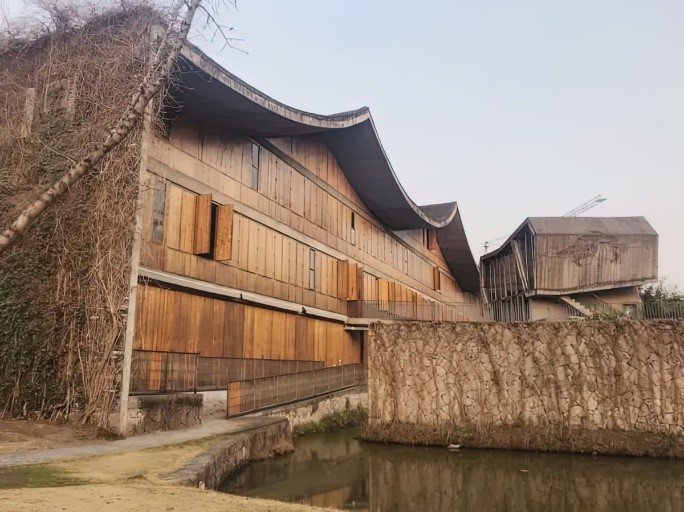
Case Study B: Five Scattered Houses, Ningbo
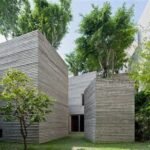
Another important project is the Five Scattered Houses (circa 2003-06) in Ningbo. This residential work uses reclaimed masonry, salvaged materials and a composition of small volumes rather than a monolithic block.
Key sustainable features:
- Use of reclaimed bricks and local construction labour.
- Small-scale volumes that allow natural ventilation, human scale, and less energy intensity per occupant.
- Integration with the existing urban grain and thoughtful siting rather than wholesale demolition and replacement.
Design lessons from this case:
- For smaller residential work (as in your context as an architect) these principles scale well: reclaimed materials, human-scale volumes, natural ventilation, passive design.
- Net-zero ambitions can start with ordinary building types, not only showpiece projects.
- Reduction in embodied carbon and operational demand are both important even if the full net-zero energy generation is not achieved yet, the process builds towards it.
Translating the approach into net-zero/carbon-neutral strategies
Using the above as inspiration, here’s how you (as an architect) can integrate the full spectrum of net-zero/carbon-neutral strategies in practice.
Material and embodied carbon tactics
- At project inception, request or produce life-cycle assessments (LCA) for major materials (structural frame, façade, floors, roofs).
- Prioritise reused or salvaged materials: bricks, timber, structural steel, local stone.
- Use modular or demountable design so that future reuse is feasible (extend life-span).
- Use local materials and local labour where possible: reduces transport emissions, supports craft, and often adapts better to local climate.
- Optimize structural spans and materials: more efficient structural design means less material and hence less carbon.
- Choose finishes and components with long life, low maintenance, and high durability: reducing replacement cycles lowers lifetime carbon.
Demand minimisation and passive strategies
- Start with good orientation, envelope design, passive ventilation, natural daylighting, shading strategy: these reduce mechanical loads.
- Use thermal mass where appropriate to buffer thermal swings.
- Design for flexibility of use, so that future changes don’t force major retrofits or high energy use.
- Integrate monitoring from the start: building automation, sensors, performance feedback.
- Engage occupants in the design (controls, shading devices, operable windows) so behaviour aligns with passive strategy.
Renewable generation and systems
- After demand is minimized, size renewable generation accordingly. Roof-integrated PV, façade PV, perhaps ground-source heat pumps.
- Storage or smart controls to shift loads to when generation is highest.
- Where on-site generation is limited, consider off-site renewable purchase or participation in a shared renewable micro-grid with neighbouring buildings.
- Check local rules about grid-connect and feed-in tariffs: in some regions you may generate but not feed back, so design accordingly.
Carbon-offsets & procurement processes
- Develop a procurement strategy: require EPDs for major materials, contractors to report carbon footprints, tender returns to include carbon metric.
- For the portion of embodied or operational carbon you cannot eliminate, plan credible offsets (e.g., renewable energy credits, reforestation, community energy projects) and document them.
- Use whole-life carbon accounting: track not only first costs but lifetime operational energy, maintenance carbon, and end-of-life.
- Embed contingency for future verification: commissioning, performance reviews at 1 year, 5 years, etc.
Monitoring, optimisation, occupant engagement
- Install submeters and dashboards that visibly show generation vs consumption, carbon avoided.
- Provide occupant training or simple interfaces so users understand shading, ventilation, lighting controls and how to use them.
- Undertake post-occupancy evaluation: what works, what doesn’t, how energy use compares to modelled performance.
- Use the data to adjust building controls, shading behaviour, ventilation schedules. Continuous improvement is key.
Site & neighbourhood integration
- Consider site microclimate: leverage natural shading (trees, water), wind paths, reflective pavements, green roofs to mitigate urban heat island.
- Explore district-scale strategies: shared chillers, renewable districts, communal energy storage.
- Plan for climate resilience: ability to maintain comfort and function in extreme weather, power outages, or grid disruption.
What stands in the way common pitfalls & how to overcome them
Designing net-zero or carbon-neutral buildings is challenging; here are common obstacles and how your practice can navigate them.
- Focus only on operations, neglect embodied carbon. Many projects reduce energy use but ignore the carbon cost of materials. Solution: model embodied carbon early and set targets.
- “Greenwashing” certifications without real performance. Especially in contexts where certification is the goal rather than performance. Solution: insist on measured performance, not just design intent.
- Lack of procurement transparency. Contractors and suppliers often don’t provide carbon data. Solution: build carbon-reporting clauses into contracts, require EPDs, and make carbon metrics part of tender evaluation.
- Poor occupant engagement or behavioural assumptions. A building may be designed as net-zero but if shading is blocked, windows are kept closed, or systems are misused, performance drops. Solution: incorporate user needs early, provide intuitive controls and education.
- Technology-heavy solutions without appropriate context. Installing large PV systems is good, but if building demand remains high or orientation is poor, generation will not offset. Solution: prioritise demand reduction, passive design, simple robust systems before high-tech measures.
- Grid and regulatory constraints. In some regions feeding energy back to the grid or getting credits is difficult. Solution: design with local regulatory context in mind; if feed-in is not allowed, think about storage or off-site renewables.
- Maintenance and lifecycle considerations overlooked. Systems that require constant servicing or materials that degrade quickly become carbon-intensive over time. Solution: design for durability, ease of maintenance, replaceable parts, monitoring.
Bringing it all together a hypothetical design workflow
As an architect (like you Snehal) envisioning a net-zero/carbon-neutral building in a local context (let’s say a commercial-office building in an Indian city with hot climate), here’s a workflow you might follow, inspired by the strategies above:
- Set targets early
At project kickoff, set quantifiable targets: e.g., operational energy use ≤ 40 kWh /m²·yr, embodied carbon ≤ 300 kg CO₂e /m², on-site renewable supply ≥ 70% of annual load, full life-cycle carbon ≤ 0 kg CO₂e.
- Site and orientation analysis
Undertake sun-path, wind-path studies for the site. Orient the building to minimize east/west exposures, maximize daylighting with north glazing (in northern hemisphere) or appropriate orientation in southern hemisphere, and capture prevailing breezes.
- Form & massing for performance
Design a compact mass with careful glazing ratios, shading devices, high-insulation envelope, natural ventilation where feasible. Use modelling tools early (energy simulation, daylighting, CFD for ventilation) to compare options.
- Material and structural strategy
Choose structural and façade systems with low embodied carbon: reuse or locally-salvaged bricks or timber (if available locally), minimise heavy steel/concrete where possible, select materials with EPDs. For example, you might adopt a brick-clad volume inspired by Wang Shu’s integration of local materials and craft.
- Systems design
After demand reduction, size the mechanical and electrical systems: high-efficiency HVAC, LED lighting with occupancy sensors, natural ventilation/stack effect where climate allows, PV on roof or façade, energy storage. Design for future adaptability (e.g., ability to add batteries).
- Procurement & contractor selection
Include carbon criteria in the RFP: require suppliers to provide EPDs, require contractors to supply carbon-footprint data. Set evaluation criteria that include embodied carbon, durability, and maintenance burden.
- Renewable generation & offset strategy
Install PV sized to match expected annual demand (after demand reduction). If on-site generation is insufficient (or grid feed-in is not allowed or economic), secure off-site wind/solar contracts or purchase renewable energy certificates.
- Commissioning & monitoring plan
At hand-over, ensure building systems are commissioned. Install sub-meters, real-time dashboards, occupant interface. Plan for post-occupancy evaluation at 6 months, 1 year, 3 years. Provide occupant orientation and easy control interfaces.
- Operational feedback loop
Track actual energy use, renewable generation, occupant comfort. Compare with modelled values. Adjust controls, shading, ventilation schedules. Use data to refine future projects.
- Communication & storytelling
A building that is net-zero or carbon-neutral is an asset: document its performance, share lessons, engage occupants and visitors, report metrics annually. This helps build the case for future work and raises awareness.
By following a structured workflow and embedding carbon-thinking at every step, the aspiration to design buildings that “give back as much as they take” becomes manageable not just idealistic.
Lessons from Wang Shu for net-zero/carbon-neutral practice
From Wang Shu’s work we can extract several design-oriented lessons that align well with net-zero/carbon-neutral strategies:
- Respect for materials and craft: By using reclaimed bricks and engaging local craft, Wang Shu reduces embodied carbon and creates buildings with character and longevity. In your work that means prioritising durable, locally-crafted materials and thinking beyond generic façade systems.
- Local context over novelty: Many net-zero buildings fall into “technology showcase” traps; Wang Shu emphasizes context, place, and modest scale. Net-zero design should not sacrifice human scale or local identity in favor of gadgets.
- Reuse over new build: While not all his work is retrofit, the emphasis on using existing materials hints at reuse ethos. In a net-zero agenda, adaptive reuse is often more carbon-efficient than new build.
- Longevity and maintenance: Craft-based detailing means buildings age well. A building designed for 50+ years amortises its embodied carbon better than one needing replacement in 20 years.
- Visible, emotional architecture: Sustainable buildings often succeed socially when people feel connected to them. Wang Shu’s architecture evokes memory, place and craft this human connection supports occupancy satisfaction and proper use, which in turn supports performance.
Conclusion
Designing net-zero and carbon-neutral buildings is no longer a fringe exercise it is central to responsible architecture and environmental stewardship. The path involves holistic thinking: reducing energy demand, selecting low-carbon materials, generating clean energy, accounting for carbon across life cycles, engaging occupants, and embedding monitoring and optimisation.
The work of Wang Shu provides a useful lens: while not every building can claim full net-zero certification yet, the strategies of material reuse, local craft, context-sensitive design and durability align strongly with the ethos of carbon-neutral architecture.
As you move forward in your practice as an architect, consider this mantra: first reduce, then renew, then monitor and optimise. Start with demand-minimisation and materials, then layer in the renewables, then design the feedback loop. The result won’t just be a low-energy building it will be a building that gives back: to its occupants, to its city, and to the planet.