Green infrastructure is not a gardening trend with good PR it’s the city’s future air-conditioning, sponge, and lungs all rolled into one. As extreme weather becomes a recurring event rather than a headline, designers must stop treating landscape as leftover space. Instead, living roofs, bioswales, permeable paving, urban forests and rain gardens should be central …
Green infrastructure is not a gardening trend with good PR it’s the city’s future air-conditioning, sponge, and lungs all rolled into one. As extreme weather becomes a recurring event rather than a headline, designers must stop treating landscape as leftover space. Instead, living roofs, bioswales, permeable paving, urban forests and rain gardens should be central to the way cities are planned, detailed, and maintained. This blog explores the why, the how, and the real-world what and it follows the work of a Vietnamese architect, Vo Trong Nghia, whose practice repeatedly demonstrates that green infrastructure can be elegant, affordable, and profoundly urban in ambition. If you like evidence, craft and a little bamboo poetry, read on: there’s a lot to steal, adapt and improve for your next project.
Cities fail at water and heat for two simple architecture problems: we cover the ground and we trap heat. Rain that used to soak into soil now runs off impermeable surfaces into overwhelmed drains; solar radiation that photosynthetic surfaces would otherwise absorb gets stored in concrete and asphalt and radiates heat back at night. The result is hotter, flash-flood-prone, less breathable urban environments and the impacts fall hardest on people with the least access to cooling and the most exposure to storm surges. Green infrastructure addresses both problems by reintroducing porous, living systems into the built fabric. Living roofs absorb and slow rainfall; bioswales slow and filter runoff; permeable pavements let water return to the aquifer; urban trees shade and evapotranspire, cooling nearby air. These measures are not decorative add-ons they alter hydrology and microclimate in measurable ways.
But successful green infrastructure is more than a checklist of components. It requires careful integration into the life of a building or neighbourhood: sizing soil depth for target species, anticipating maintenance regimes, routing water to where it helps most, and designing for multiple co-benefits biodiversity, play, food production, social amenity, and thermal comfort. Done poorly, green roofs become dead weight; swales become mosquito habitats; permeable paving clogs. Done thoughtfully, they become civic infrastructure the difference between a system that needs constant repair and one that provides value continuously, whether by cooling a plaza in summer or reducing floods in a storm.
Vo Trong Nghia’s architecture is a great study in how green infrastructure can be woven into the DNA of buildings and neighbourhoods rather than clipped onto them as decoration. Working in Vietnam’s hot and humid climate, his firm repeatedly explores rooftop landscapes, integrated planting pockets, and porous building skins as functional devicesnot just visual gestures. Vo Trong Nghia’s work is famous for championing bamboo as a structural and symbolic material, and for embedding vegetation into his buildings in ways that improve thermal comfort and urban ecology while keeping form and craft central to the design. His projects show how straightforward ecological interventions green roofs, terraces, planted boxes and connected gardens can be scaled across typologies from kindergartens to restaurants to dense housing.
Let’s begin with the clear, almost pedagogical example: the Farming Kindergarten. This project wraps program around a continuous spiralling green roof that is more than a playground it’s a living classroom, a food garden, and a stormwater sponge. Designed for 500 children adjacent to large industrial development, the green roof is conceived both as agricultural infrastructure and as a thermal device. Vegetation and soil catch and retain rainwater, reducing runoff and smoothing peak flows; the planted surface shades the building below and reduces solar gain; and the roof’s terraced geometry creates microclimates for different crops and activities. Importantly, the project links site infrastructure with social goals: kids learn to grow food; water reuse systems (where provided) feed irrigation; shaded outdoor corridors reduce reliance on air conditioning. The result is a building that is pedagogical and resilient without being didactic. That combination ecological utility together with programmatic intelligence is what makes the Farming Kindergarten more than a pretty rooftop.
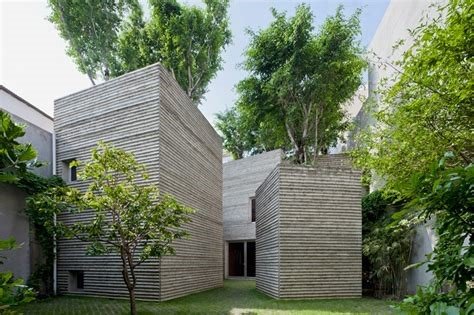
Another brilliant, compact argument for urban greening is House for Trees. In dense Ho Chi Minh City plots, Vo Trong Nghia proposed a simple but radical move: instead of pushing greenery to a distant park, bring full-sized trees into the household by making planters part of the roof and strategy of the house. The house is arranged as stacked concrete volumes with deep planted “pots” on their tops. These rooftop trees become thermal machines and social anchors. Leaves and soil intercept solar radiation and reduce heat transfer into habitable rooms; canopy shade cools terraces and courtyards; roots anchor soil that thermally buffers daily temperature swings. Beyond thermal performance, the presence of full trees not just rooftop grass reconnects the interior life of the house to the larger urban ecology and provides privacy and pollutant filtration. The design is also instructive: green infrastructure can exist in tiny urban footprints if it’s designed integrally from the start, where planters and soil depth are treated as primary structural and programmatic requirements rather than afterthoughts.
If the Farming Kindergarten is about pedagogy and House for Trees is about inserting nature into tight urban parcels, then the Vedana Resort bamboo pavilion demonstrates green infrastructure at the scale of place-making and microclimate design.
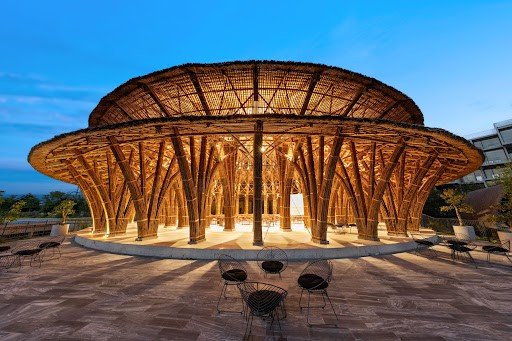
The Vedana project features a large bamboo dome set above a lake and, in effect, uses water and vegetation together as a cooling strategy. A body of water adjacent to an open building increases evaporative cooling; combined with the ventilated bamboo structure, it reduces radiant heat load and encourages convective cooling. This combination of porous structure, shading, and water is a lesson in hybrid strategies: rarely does a single device suffice in a tropical climate. Using water and vegetation in tandem multiplies benefits cooling, biodiversity, regenerative aesthetics and produces a social space that’s comfortable without heavy mechanical cooling.
What do these projects teach us about principles of green infrastructure design? First, integrate early. Green infrastructure should be a driver of form, not a layer that gets squeezed at the end. Soil depth requirements, routes for stormwater, root barriers, load capacities and irrigation should influence structural decisions and massing. In the Farming Kindergarten, the spiral roof was designed with agricultural function in mind; the living roof demanded circulation and edge conditions that are useful for play and learning. In House for Trees, planter volumes are structural and determine the sequence of interior spaces. Early integration avoids awkward retrofits where green features are shallow and fragile.
Second, design for hydrology and storage, not just beauty. A living roof that is merely decorative will fail to reduce runoff appreciably unless its soil depth and detention capacity are sized correctly. Bioswales and rain gardens need calculated capacity and overflow routes for extreme events. Permeable paving should be specified with maintenance access in mind trap basins and sediment chambers reduce clogging; maintenance schedules must be budgeted. In urban projects where drainage networks are strained, distributed green infrastructure (numerous small planters, dozens of green roofs) often outperforms a single centralized tank because it reduces peak runoff across the catchment and provides more evenly distributed co-benefits.
Third, choose species and soil systems with climate and maintenance in mind. Tropical climates allow for dense, fast-growing vegetation; temperate climates require plants tolerant of seasonal drought and freeze-thaw cycles. Soil media must be lightweight yet retentive on roofs; tree pits must include root volume that sustains mature trees without damaging structures. Vo Trong Nghia’s projects tend to use native or locally adapted species where possible a simple but crucial step. Native plants are more drought-tolerant, help biodiversity, and often require less fertilization and irrigation.
Fourth, use green infrastructure to bring social value. A planted rooftop that’s also a playground, a rain-garden that’s a parklet, a bioswale that doubles as an educational trail those are the designs that communities steward and defend. The Farming Kindergarten’s green roof as a classroom is an excellent example: children learn food cycles and water cycles simultaneously, and that hands-on connection builds long-term stewardship and reduces vandalism. Social programming turns infrastructure into civic amenity.
From a technical standpoint, there are specific devices and tactics that should be on every designer’s short list: living roofs with layered waterproofing and root barriers; bioswales sized by storm-event runoff calculations; permeable pavements with adequate subbase for infiltration and maintenance; rainwater harvesting systems sized both for irrigation and for emergency uses; urban tree trenches with connected soil volumes to nourish larger canopies; vegetated facades that reduce solar gain and increase habitat; retention basins designed as aesthetic wetlands that hold stormwater longer and filter it before slow release. Each device needs a maintenance plan and a lifecycle cost analysis the cheapest initial installation is often the most expensive over time if clogging, collapse, or plant failure is probable.
Maintenance is the unglamorous soul of green infrastructure. Too often projects neglect who will water, pick up litter, monitor sediment, and prune. Public projects need municipal budgets and community stewardship; private developments need O&M funding, clear responsibilities and accessible design details (is the green roof accessible for servicing? where are overflow drains located?). Vo Trong Nghia’s work, by being read as both architecture and garden, often encourages ownership because users experience the greenery directly they’re more likely to care for what they can touch and use, which is why social programming and design readability are critical.
Another common misstep is to treat green infrastructure as a purely local device. Scaling impact requires a systems view: green roofs across a neighbourhood reduce heat island and surface runoff more than a single flagship building. Policy levers incentives, stormwater fee credits, zoning bonuses for green roofs and permeable surfaces multiply adoption. Designers should therefore think about replicability and policy: design templates that are easy to copy, cost data that shows payback, and case studies that can be used in municipal advocacy. Vo Trong Nghia’s House for Trees idea is the kind of repeatable prototype that could be adapted across many lots in a city to create a network of mini-canopies.
Climate change also raises new design imperatives: more frequent intense storms, prolonged droughts, and urban heat extremes. Green infrastructure must therefore be resilient and flexible. Swales and rain gardens should be designed with overflow channels and emergency bypasses. Plant palettes must include species tolerant of hotter, drier conditions in the future. Water harvesting systems should have multiple uses irrigation, toilet flushing, and emergency supply. And green infrastructure must be part of a layered resilience plan that includes strong building envelopes, shaded public spaces, cooling centers, and integrated energy and water systems.
Let’s return briefly to Vo Trong Nghia’s more recent residential explorations such as the Stepping Park House which translate the lessons above into compact urban living. Stepping Park House uses terraced voids and planted balconies to stitch the adjacent park into the home. Here the green strategy is about permeability: visual, ecological and hydrologic. Ivy and shrubs on the façade soften the boundary between park and private space, invite birds and insects, and provide evaporative cooling at the building edge. The architectural detail carefully sized planters, integrated water routing, and accessible planting zones shows how green infrastructure can be both elegant and spare. Small projects like this are convincing because they show that even a single house can become a micro-ecology that benefits street life and reduces local heat.
A core idea that runs through these projects is multiplicity of benefits. The most successful green infrastructure is multifunctional: it deals with water, cools the air, stores carbon, creates habitat, provides food, and becomes social space. This is the design ethic we should aim for. For example, a rain garden on a school site can be a teaching tool, a filtration device, and a stormwater pond; a green promenade can cool adjacent interiors while supporting local pollinators; a permeable plaza can supply groundwater recharge and host markets.
Of course, green infrastructure is not a silver bullet. It must be combined with other measures shade trees alone won’t prevent flooding downstream if impervious expanses remain dominant; bioswales require upstream retention to be effective at large storms. Moreover, financial thinking matters: while green solutions can reduce long-term costs associated with flood damage and heat mitigation, their upfront costs and perceived risk can hamper adoption without incentives or proof points. That’s why demonstration projects and low-risk pilot installations are so valuable: they create local data, build contractor experience, and reduce perceived risk for larger investments.
For designers and students, the actionable steps are clear. Start every site analysis with hydrology and microclimate as primary considerations. Ask where water wants to go, where heat concentrates, and where people gather. Use simple modelling tools to estimate runoff volumes and peak flow reductions from distributed green interventions. Detail planters, roof membranes and overflow routes as if they were primary structural elements. Work with landscape engineers on soil profiles and infiltration. And don’t forget maintenance: write it into the budget, the contract, and the user manual.
Vo Trong Nghia’s work gives us both inspiration and discipline. He shows that green infrastructure can be beautiful without being performative theatre; it can be social while tackling serious urban challenges; and it can be rooted in local craft and materials while scaling to civic impact. The Farming Kindergarten, House for Trees, Vedana pavilion and Stepping Park House are not isolated artworks they are repeatable lessons in how to stitch ecology back into cities, one roof, one swale, and one tree at a time.
If you’re an architect, planner or urban designer wanting to apply these ideas, here’s a compact checklist to get you from concept to reality: size green roofs and swales to local rainfall events (use local IDF data), calculate soil depth based on the plant sizes you want to sustain, plan for irrigation only as backup (use harvested water first), design maintenance access and schedule, engage local communities early so the spaces are used and cared for, and always integrate green infrastructure into the building’s structural and drainage systems instead of treating them as add-ons.
Finally, there’s an ethical point. Green infrastructure built only for wealthy enclaves rooftop gardens on luxury towers behind security gates misses the point. The real resilience dividend comes from distributing these benefits: tree-lined streets in low-income neighbourhoods, public school gardens, green median strips that double as flood control, and small-lot designs that allow every household to be a contributor to urban ecology. Vo Trong Nghia’s work resonates because it’s accessible: a kindergarten for factory workers, houses that fit tight lots, community pavilions that use local materials. It’s a reminder that resilience is civic and equitable by design.
Green infrastructure is technical, social, and aesthetic at the same time. It requires engineers who can think like gardeners and landscape architects who can talk to hydrologists. It needs clients who see value beyond immediate ROI and municipalities that support long-term stewardship. But the payoff is huge: cooler streets, fewer floods, better air, more biodiversity and, perhaps most importantly, cities that feel like systems worth living in. If you walk the city and begin to see roofs as potential meadows and gutters as potential blue-green corridors, you’ll have passed the first test. The rest is design, courage, and a little bamboo intuition.