Adaptive and kinetic façades represent a significant evolution in architectural envelope design, shifting the façade from a static boundary into a responsive environmental system that can actively adjust to changing climatic conditions and user needs. In the context of accelerating climate variability, rising energy costs, and heightened expectations for occupant comfort, the façade has emerged …
Adaptive and kinetic façades represent a significant evolution in architectural envelope design, shifting the façade from a static boundary into a responsive environmental system that can actively adjust to changing climatic conditions and user needs. In the context of accelerating climate variability, rising energy costs, and heightened expectations for occupant comfort, the façade has emerged as a critical mediator between interior and exterior environments. Unlike conventional façades that rely solely on fixed materials and passive resistance, adaptive façades are designed to sense, respond, and recalibrate in real time to solar radiation, temperature fluctuations, wind patterns, and daylight levels. This responsiveness allows buildings to operate more efficiently across seasonal and daily cycles while maintaining comfort and reducing dependence on mechanical systems. The core premise of adaptive and kinetic façades is that environmental conditions are not static and that building envelopes must therefore be capable of dynamic adjustment if they are to perform optimally over time. As architecture increasingly embraces performance driven design, adaptive façades offer a compelling synthesis of environmental intelligence, material innovation, and architectural expression.
At the most fundamental level, adaptive façades function as regulators of energy exchange. Solar radiation is both a resource and a liability, providing daylight and passive heat in cooler conditions while generating excessive heat and glare in warmer periods. Temperature differentials drive heat flow through the envelope and influence thermal comfort and energy demand. Wind exerts pressure on building surfaces and can be harnessed for ventilation or must be mitigated to avoid discomfort and infiltration. Adaptive façades respond to these forces through movement, transformation, or material change, modulating transparency, porosity, and thermal resistance in response to real time conditions. This capacity to respond transforms the façade into a performative system rather than a fixed assembly, enabling a more nuanced and efficient relationship between building and climate.
Kinetic façades are a prominent subset of adaptive systems and are defined by their use of mechanical movement to alter façade geometry or configuration. These systems may include rotating panels, sliding screens, folding elements, or expanding and contracting assemblies that change the façade’s surface characteristics. Movement allows kinetic façades to control solar exposure with precision, opening to admit daylight and views when conditions are favorable and closing to provide shading and insulation when conditions become extreme. The visual impact of kinetic façades is often striking, but their primary value lies in their ability to align environmental performance with temporal change. A façade that can adapt hour by hour is inherently more efficient than one designed for a single worst case condition. However, movement introduces complexity and raises questions about durability, maintenance, and control, making the integration of kinetic systems a multidisciplinary challenge that requires close collaboration between architects, engineers, and façade specialists.
Sensor driven systems are central to the operation of adaptive façades. Sensors embedded within or adjacent to the façade monitor environmental variables such as solar intensity, exterior and interior temperature, wind speed and direction, humidity, and daylight levels. This data is processed through building management systems or dedicated façade control algorithms that determine the optimal configuration of façade elements at any given moment. For example, shading devices may respond to direct sunlight by adjusting their angle to block glare while preserving diffuse daylight. Ventilation openings may respond to favorable outdoor temperatures and air quality by opening to allow natural airflow. In advanced systems, occupant behavior and preferences can also be incorporated, allowing manual overrides or adaptive learning that aligns façade operation with actual patterns of use. The effectiveness of sensor driven façades depends not only on the accuracy of sensors but also on the sophistication of control logic and the reliability of actuators that translate digital commands into physical movement.
Smart materials represent another important dimension of adaptive façade design. Unlike kinetic systems that rely on mechanical components, smart materials respond to environmental stimuli through intrinsic physical or chemical properties. Thermochromic materials change color or opacity in response to temperature, reducing solar heat gain when surfaces warm. Photochromic materials respond to light intensity, darkening under strong sunlight to reduce glare. Electrochromic glazing allows controlled variation of transparency through the application of a small electrical current, enabling façades to modulate daylight and solar gain without moving parts. Shape memory alloys and polymers can change form in response to temperature or electrical input, offering opportunities for passive or low energy movement in façade components. These materials reduce mechanical complexity and can enhance durability, but they often present challenges related to cost, scalability, and long term performance stability. Their integration into façade systems requires careful consideration of lifecycle impacts and replacement strategies.
The environmental benefits of adaptive and kinetic façades are closely tied to energy performance outcomes. By responding dynamically to climate conditions, these façades can significantly reduce cooling loads by limiting unwanted solar gain during peak periods. They can also reduce heating demand by allowing greater solar access during cooler conditions and by increasing thermal resistance when temperatures drop. Daylighting performance is improved through controlled admission of natural light, reducing reliance on artificial lighting and associated electrical loads. Natural ventilation strategies can be enhanced through operable façade elements that respond to wind and temperature differentials, further reducing mechanical cooling and improving indoor air quality. The cumulative effect of these strategies can lead to substantial reductions in annual energy use intensity and peak demand, which in turn supports smaller mechanical systems and lower operational carbon emissions.
However, the promise of adaptive façades must be balanced against the realities of technological complexity and long term maintenance. Moving parts and electronic components are subject to wear, environmental exposure, and potential failure. Dust, sand, moisture, and pollution can impair sensors and actuators, particularly in harsh climates. Maintenance regimes must therefore be carefully planned and adequately funded to ensure that adaptive systems continue to perform as intended over the life of the building. Design decisions that simplify mechanisms, protect critical components, and allow for easy access and replacement can significantly improve reliability. Redundancy in control systems and the ability to default to safe static configurations in the event of failure are also important considerations. Without a clear maintenance strategy, even the most innovative adaptive façade risks becoming a static liability rather than a dynamic asset.
The balance between technological innovation and robustness is a recurring theme in adaptive façade design. While advanced systems can deliver impressive performance gains, simpler adaptive strategies may achieve comparable benefits with lower risk. For example, manually operable shading devices supported by clear user guidance can be highly effective in certain contexts, particularly in buildings with engaged occupants. Hybrid systems that combine passive design principles with selective automation often offer a pragmatic balance, using technology to enhance rather than replace fundamental climatic responsiveness. The choice of strategy should be informed by climate, building typology, occupancy patterns, and the client’s capacity for long term operation and maintenance.
One of the most widely cited examples of a successful kinetic façade is the Al Bahar Towers in Abu Dhabi designed by Aedas. The towers feature a dynamic shading system inspired by traditional Islamic mashrabiya screens, composed of a series of geometric units that open and close in response to solar exposure. Each unit operates independently, controlled by a central system that tracks the sun’s movement across the sky. When solar radiation is high, the units close to provide shading and reduce heat gain. When conditions are less intense, they open to allow daylight and views. This responsive system significantly reduces solar heat gain on the glazed façade, lowering cooling loads in a climate characterized by extreme heat and intense sunlight. Beyond its technical performance, the façade demonstrates how adaptive technology can be integrated with cultural expression, creating an architectural identity that is both contextually rooted and technologically advanced. The project also highlights the importance of rigorous testing and commissioning, as the reliability of thousands of moving components is essential to long term success.
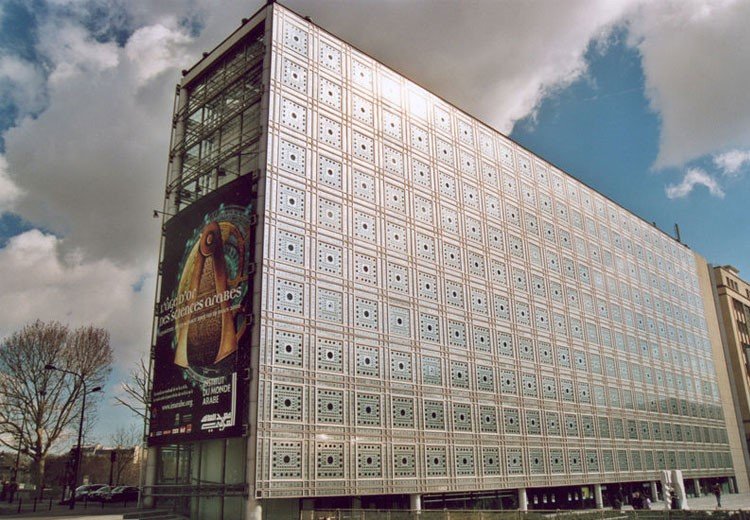
Another landmark example is the Institut du Monde Arabe in Paris designed by Jean Nouvel. Although completed decades earlier than many contemporary adaptive façades, the building remains a seminal reference for kinetic envelope design. Its south façade incorporates a series of camera like diaphragms that open and close to regulate daylight entering the interior spaces. These mechanical apertures respond to light levels, reducing glare and controlling solar gain while creating a constantly shifting façade pattern. While the system encountered maintenance challenges over time, its conceptual clarity and ambition established a foundation for subsequent generations of adaptive façades. The project illustrates both the potential and the risks of kinetic systems, underscoring the need for durable detailing, accessible maintenance, and realistic operational planning. Despite its challenges, the Institut du Monde Arabe remains an influential example of how façades can actively mediate environmental conditions and shape architectural experience.
Adaptive façades must also be evaluated through the lens of resilience and future climate uncertainty. As climate patterns become less predictable, buildings designed for historical averages may struggle to maintain comfort and efficiency. Adaptive systems offer a degree of resilience by allowing buildings to respond to unexpected conditions such as heat waves, unseasonal temperature swings, or changing wind patterns. This adaptability can extend the useful life of buildings and reduce the need for energy intensive retrofits. However, resilience also depends on simplicity and reliability. Systems that are too complex may fail under stress or become obsolete as technologies evolve. Designing adaptive façades with modular components and open control architectures can help ensure that systems can be upgraded or modified over time.
From a design process perspective, adaptive façades require early and continuous integration into the architectural concept. Performance objectives must be clearly defined at the outset, and façade strategies should be developed in parallel with massing, orientation, and spatial planning. Computational modeling and simulation play a critical role in evaluating the performance of adaptive systems under a range of scenarios. These tools allow designers to test control strategies, predict energy savings, and identify potential failure modes before construction. Prototyping and mock ups are equally important, providing opportunities to assess movement, durability, acoustics, and visual impact at a human scale. Collaboration with manufacturers and fabricators can inform realistic detailing and cost estimates, ensuring that innovation remains grounded in buildable solutions.
The economic dimension of adaptive façades is complex and must consider both initial investment and lifecycle value. Adaptive systems often entail higher upfront costs due to specialized components, controls, and integration efforts. However, these costs can be offset by operational savings from reduced energy consumption and by intangible benefits such as improved occupant comfort, productivity, and architectural distinction. In some cases, adaptive façades can enable downsizing of mechanical systems, providing capital cost savings that partially offset façade expenditures. A comprehensive lifecycle cost analysis that includes maintenance, replacement, and energy savings is essential for informed decision making. Without such analysis, adaptive façades risk being perceived as aesthetic luxuries rather than strategic investments.
Occupant interaction is another critical factor in the success of adaptive façades. Systems that operate entirely autonomously may conflict with user expectations or preferences, leading to dissatisfaction or manual overrides that undermine performance. Conversely, systems that rely too heavily on occupant control may not achieve consistent energy savings. Effective adaptive façades often strike a balance by providing automated baseline operation with opportunities for occupant input within defined parameters. Clear communication and user education are essential so that occupants understand the purpose and benefits of adaptive behavior and feel empowered rather than constrained by automated systems.
As sustainability discourse increasingly emphasizes embodied carbon and resource efficiency, adaptive façades must also be evaluated beyond operational energy performance. The materials and components used in kinetic and smart systems often involve higher embodied energy and more complex supply chains than conventional façades. Designers must therefore consider whether operational savings justify embodied impacts over the building’s lifespan. Strategies such as using lightweight components, selecting materials with recycled content, and designing for disassembly and reuse can improve the overall sustainability profile of adaptive façades. Transparency in reporting both operational and embodied performance will be increasingly important as regulatory frameworks evolve.
Looking ahead, the future of adaptive and kinetic façades is likely to be shaped by advances in digital technology, materials science, and data analytics. Improved sensors, more reliable actuators, and advanced control algorithms will enhance performance and reduce maintenance demands. Integration with renewable energy systems such as building integrated photovoltaics may allow façades not only to manage energy flows but also to generate power. Machine learning techniques could enable façades to anticipate conditions based on weather forecasts and historical data, optimizing performance proactively rather than reactively. At the same time, there is likely to be a renewed appreciation for low tech adaptability, where simple responsive strategies grounded in climate logic complement more advanced systems.
In conclusion, adaptive and kinetic façades represent a powerful approach to designing responsive envelopes capable of addressing the challenges of a changing climate. By actively responding to solar radiation, temperature, and wind, these façades enhance energy efficiency, occupant comfort, and environmental resilience. Sensor driven systems and smart materials enable precise control and reduce reliance on mechanical conditioning, while kinetic elements offer dynamic modulation of the building envelope. Exemplary projects such as the Al Bahar Towers and the Institut du Monde Arabe demonstrate both the potential and the complexity of adaptive façades, highlighting the importance of integrating technology with cultural expression, maintenance planning, and lifecycle thinking. As the architectural profession continues to grapple with sustainability imperatives, adaptive façades will remain a critical area of exploration, offering a pathway toward buildings that are not only efficient but also intelligent, resilient, and deeply attuned to their environmental context.