~ Renzo Piano Introduction: The Beautiful Danger of Building Architects live in a strange paradox: we build for permanence in a world that constantly changes. Every line we draw can alter a skyline, define a neighborhood, or shape the way strangers experience light, sound, and belonging. Renzo Piano captured this burden perfectly architecture is dangerous. …
~ Renzo Piano
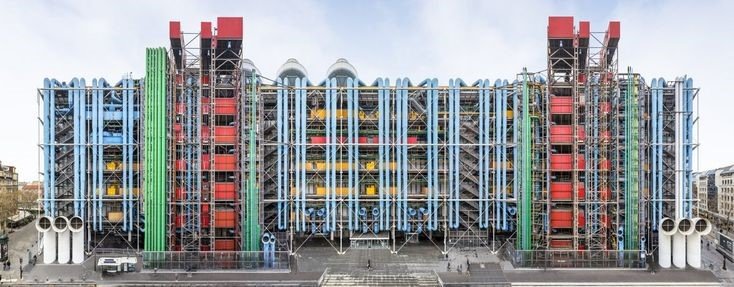
Table of Contents
- Introduction: The Beautiful Danger of Building
- The Competition That Shook Paris
- The Birth of the “Inside-Out” Building
- The Architect’s Burden: Permanence as Risk
- Anatomy of a Radical
- Structural Transparency
- Color as Code
- Movement as Experience
- The Building That Became a Neighborhood
- Time: The Ultimate Judge
- The Ethics of Risk
- The Architect’s Dilemma: Expression vs. Responsibility
- From Mockery to Masterpiece: The Danger That Paid Off
- The Broader Lesson: What Makes Architecture Truly Dangerous
- Conclusion: Building with Care, Risking with Purpose
Introduction: The Beautiful Danger of Building
Architects live in a strange paradox: we build for permanence in a world that constantly changes. Every line we draw can alter a skyline, define a neighborhood, or shape the way strangers experience light, sound, and belonging. Renzo Piano captured this burden perfectly architecture is dangerous.
It’s not dangerous because we wield hammers or climb scaffolds (though occasionally, we do). It’s dangerous because what we create outlives us. A writer’s poor sentence disappears in the next edition. A bad movie fades after opening weekend. But a bad building? It sits there, stubbornly permanent, a concrete reminder of poor judgment and unchecked ego.
As architects, we aren’t merely designing structures. We’re designing futures for people we may never meet and for cities that will evolve beyond us. And nowhere is that danger, that thrilling and terrifying responsibility, more evident than in the story of the Centre Georges Pompidou in Paris the so-called “ugly exhibition centre” that dared to turn itself inside out.
The Competition That Shook Paris
The year was 1971. Paris, with its stately boulevards and polite façades, decided it needed a new cultural heart a place for art, music, literature, and public gathering. The French government announced an international competition for a new Centre Beaubourg, later named the Centre Pompidou after President Georges Pompidou, who championed the idea of modernizing the cultural landscape of France.
More than 600 entries poured in. Among them, a proposal from two young, relatively unknown architects: Renzo Piano, an Italian, and Richard Rogers, a Briton. Their design was a rebellious act a defiance of everything Parisian architecture stood for.
While others presented dignified stone façades and measured symmetry, Piano and Rogers submitted what looked like an industrial lung a glass box wrapped in a tangle of pipes, ducts, and escalators. The judges, to everyone’s surprise (including theirs), picked it.
When asked why, one jury member reportedly said, “Because this one will make trouble.”
They were right.
The Birth of the “Inside-Out” Building
The concept was both radical and deceptively simple: liberate the interior.
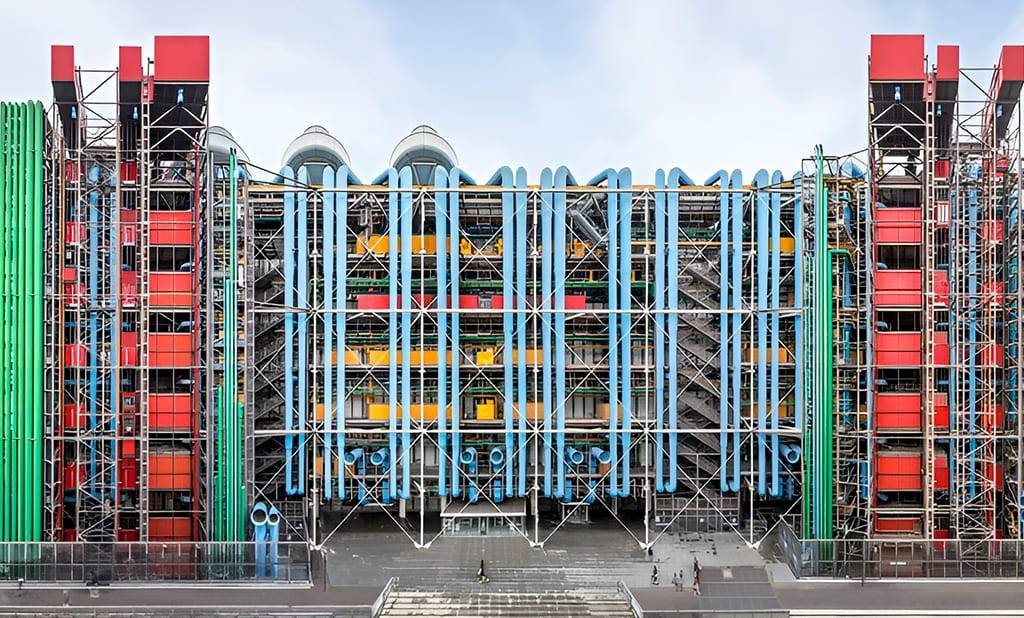
Instead of stuffing all the mechanical systems, circulation, and structural supports inside, Piano and Rogers pushed them outward.
What emerged was the world’s first true “inside-out” building:
- Blue pipes for air conditioning
- Green for water
- Yellow for electricity
- Red for circulation (stairs, elevators, escalators)
All of it proudly visible a rainbow anatomy lesson in how a building breathes and functions.
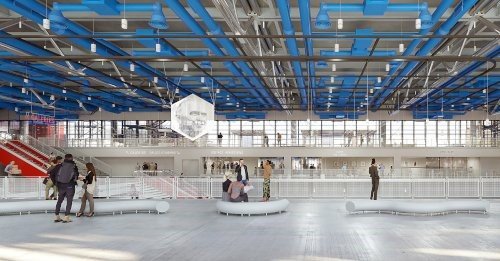
Inside, the result was revolutionary: completely free, open floor plates, adaptable for exhibitions, performances, and public use. The structure wasn’t a static museum it was a living, breathing urban organism.
But Paris wasn’t impressed.
“An Oil Refinery in the Heart of Paris”
When construction began, public outrage followed. The media mocked it. Critics labeled it “a shipwreck,” “a factory,” and most famously, “an oil refinery in the middle of historic Paris.”
Citizens demanded to know how such a mechanical monster had invaded their elegant city.
The backlash was ferocious. The Beaubourg district, once a quiet area, became the site of architectural warfare. The project’s defenders argued it was the physical manifestation of democratic culture: transparent, accessible, open. Detractors called it a blight on beauty.
Even President Pompidou, who supported the project until his death, faced criticism for sponsoring something so alien to French tradition. But Renzo Piano remained calm. Years later, he would say:
“When you do something new, people don’t like it. That’s normal. If they loved it immediately, it wouldn’t be new.”
That’s the real danger of architecture not failure, but misunderstanding. True innovation always arrives dressed as ugliness.
The Architect’s Burden: Permanence as Risk
Piano’s quote that architects “impose ugliness on a place for a hundred years” reveals a hard truth about our profession. Unlike most creative fields, we don’t get do-overs. Once a building exists, it shapes lives daily the way light hits a kitchen counter, how people gather in a plaza, or whether a neighborhood feels safe and human.
When we err, our mistakes become public monuments. They cannot be easily edited, revised, or hidden.
And yet, that’s what makes architecture thrilling. It’s an art form made of consequences.
The Pompidou embodies this perfectly. Its designers took the risk of being hated and in doing so, redefined what public architecture could be. Had Piano and Rogers sought safety, they might have created another politely modernist building. Instead, they created something that shouted, argued, and eventually, inspired.

Anatomy of a Radical
Let’s step inside metaphorically and literally to understand what makes the Centre Pompidou such a daring feat of design.
Structural Transparency
The Pompidou’s structure is an exoskeleton a steel megaframe of colossal beams and trusses spanning across eight floors. By shifting the load-bearing system to the exterior, the architects liberated the interior, creating column-free spaces that can be endlessly rearranged.
The result? A kind of architectural breathing room where culture can change and adapt without demolition.
Color as Code
Every visible element serves a function, and every function is color-coded. The chromatic scheme a concept both aesthetic and didactic turns engineering into visual poetry.
Where most architects conceal the mechanics of a building, Piano and Rogers made them the architecture itself. They transformed ducts and pipes into ornaments, giving the building an honest, industrial beauty.
Movement as Experience
Perhaps the most iconic feature is the exterior escalator, encased in a transparent tube crawling up the façade. It’s not just circulation it’s theater. As you ascend, the city unfolds in panoramic views, turning a mundane act into an urban ritual.
Even those who don’t enter the museum can interact with it the plaza below, open and generous, became a beloved gathering spot for performers, students, and tourists alike.
The Building That Became a Neighborhood
When the Pompidou opened in 1977, critics were still skeptical. But something remarkable happened: the public claimed it.
The surrounding Beaubourg district, once neglected, sprang to life. Cafés, bookstores, and galleries bloomed. Street performers animated the plaza. The Centre became not just a museum, but a civic engine, breathing life into its urban context.
That’s the true measure of architecture’s success: not its façade, but its social ripple.
The “ugly” building made Paris fall in love with modernity. It redefined how architecture could interact with the city not as an object, but as an event.
Time: The Ultimate Judge
Renzo Piano’s quote about “a hundred years of ugliness” cuts both ways. Time, after all, is the ultimate critic.
When the Pompidou first opened, the verdict was harsh. But decades later, it’s one of Paris’s most beloved landmarks a place where locals and tourists coexist, where art and life overlap effortlessly.
This evolution teaches us something vital: architecture must endure misunderstanding.
Every visionary project looks wrong before it looks right.
What’s dangerous about architecture isn’t only the risk of ugliness it’s the risk of being ahead of your time.
The Ethics of Risk
Architecture’s danger isn’t simply aesthetic it’s ethical. Every decision we make has moral weight. The choice to preserve or demolish, to use sustainable materials or wasteful ones, to prioritize human comfort or corporate spectacle these are ethical lines drawn in steel and glass.
The Pompidou was ethical in its radical openness. It gave art to the people. It erased the elitism of traditional museums and invited everyone families, students, wanderers to enter freely. The transparency of its structure became a metaphor for the transparency of culture itself.
But ethical architecture doesn’t always look polite. It challenges complacency. It forces dialogue.
In that sense, Piano’s quote is a call to courage. We must dare to risk aesthetic disapproval in the pursuit of social good.
The Architect’s Dilemma: Expression vs. Responsibility
Piano often says that if you want pure self-expression, you should be a painter or a poet. Architecture, he insists, is an act of service a balance between personal vision and collective need.
This tension defines the profession:
- Express too much, and you impose ego.
- Serve too much, and you lose soul.
The Centre Pompidou walks that line with grace. It’s unapologetically expressive — a mechanical cathedral glowing with color yet profoundly public in purpose. It redefined the architect not as an aloof genius but as a facilitator of experience.
For young architects, this is the enduring lesson: creativity is nothing without empathy.
From Mockery to Masterpiece: The Danger That Paid Off
It’s hard to imagine now, but the Pompidou could easily have been a career-ending failure. Had the public rejected it permanently, Piano and Rogers might have become footnotes in architectural history. Instead, their boldness propelled them to global prominence.
Rogers went on to design the Lloyd’s Building in London another “inside-out” structure that celebrated functional beauty. Piano evolved toward a more refined humanism, designing the Kansai Airport, The Shard, and countless cultural institutions infused with lightness and care.
Both careers began with a dangerous idea one that almost nobody liked at first.
That’s the strange reward of architectural danger: survival transforms scandal into legacy.
The Broader Lesson: What Makes Architecture Truly Dangerous
So, what exactly makes architecture “dangerous”? Let’s distill it.
It’s Permanent
Buildings shape human behavior long after their designers are gone. A bad design can suffocate joy; a good one can nurture it. That permanence gives architecture its gravity and its peril.
It’s Public
You can’t hide a building. It exists in the collective space, affecting everyone. Architects operate on a stage larger than any other artist the city itself.
It’s Political
Every project negotiates with power developers, governments, regulations, budgets.
Compromise is inevitable, but so is responsibility.
It’s Emotional
People don’t just see buildings; they feel them. A poorly designed space can alienate; a well-designed one can heal. That emotional impact is both beautiful and dangerous.
Looking Back as an Architect
Standing before the Pompidou today, I can’t help but feel a strange mix of admiration and caution. It’s exuberant, almost reckless yet it works. It’s a reminder that great architecture requires bravery, not perfection.
As architects, we all have our “Pompidou moments” those projects that test our courage, that invite criticism before understanding. The danger Piano speaks of isn’t a warning to play safe. It’s a challenge to risk meaning over mediocrity.
Because the greater danger in architecture isn’t ugliness it’s indifference.
A dull building offends no one but inspires no one either. The Pompidou, for all its pipes and provocation, refuses to be ignored. It changed how Paris breathes. It changed how we think about museums. It even changed how we draw.
Time, Redemption, and the Long View
In the end, Renzo Piano’s quote isn’t pessimistic it’s humble. It reminds us that architecture’s real power lies in stewardship, not self-expression. We borrow from the future when we build, and our work becomes part of someone else’s everyday life.
Piano’s own career proves this humility. After the Pompidou’s industrial chaos, his later works evolved toward calm elegance light, proportion, and craft. Yet, he never abandoned that spirit of risk.
He learned as we all must that the goal isn’t to avoid danger, but to manage it wisely.
Conclusion: Building with Care, Risking with Purpose
“Architecture is a dangerous job,” Piano said and thank goodness it is. Because without danger, there is no discovery. Without risk, no revolution.
The Centre Pompidou stands as proof that danger and beauty are often the same thing seen from different decades. What was once ugly became iconic. What was once scandalous became sacred.
So, yes architecture is dangerous.
But danger is where meaning lives.
Our job is to face it, to build not just for the moment, but for the century with courage, humility, and the quiet understanding that someday, someone will walk beneath our work and decide whether we made the world better or worse.
That’s the risk.
That’s the privilege.
That’s architecture.