Patrick Schumacher has become one of the most influential and controversial voices in contemporary architecture, largely because of his advocacy for parametricism as a coherent style and methodological paradigm capable of reshaping the urban environments of the twenty-first century. As the principal of Zaha Hadid Architects and the intellectual force behind the firm’s computational evolution, …
Patrick Schumacher has become one of the most influential and controversial voices in contemporary architecture, largely because of his advocacy for parametricism as a coherent style and methodological paradigm capable of reshaping the urban environments of the twenty-first century. As the principal of Zaha Hadid Architects and the intellectual force behind the firm’s computational evolution, Schumacher has positioned parametric design not simply as a tool for generating complex forms but as a new cultural logic for organizing cities, infrastructures, and social interactions. His writing, teaching, and built work foreground an idea of “digital craft,” where algorithms, scripts, and continuous geometric systems replace the rigid typologies and static compositions of modernist and postmodernist design. According to Schumacher, architecture must evolve in parallel with advanced computational technologies, absorbing digital thinking into every level of its workflow from conceptualization to fabrication to urban strategy. But far from being a purely technological agenda, his concept of parametric urbanism is deeply cultural, seeking to produce environments with legible identities, responsive behaviors, and organizational coherence derived from principles of variation and correlation. Through the projects developed at Zaha Hadid Architects and through his wider theoretical contributions, Schumacher demonstrates how computational design can create new forms of urban order rooted in fluid geometry and dynamic relationships, offering a radically different model of how cities might grow, adapt, and express contemporary cultural conditions.
Underlying Schumacher’s parametric agenda is the belief that architecture should operate as a complex adaptive system one that responds to countless variables such as programmatic requirements, circulation patterns, density, environmental performance, and cultural expression. In this sense, digital craft is not about decorative complexity but about the ability of algorithms to coordinate and differentiate large sets of elements in relation to each other. Rather than relying on traditional modular repetition, parametric urbanism encourages the continuous modulation of geometry so that buildings, streets, and public spaces reflect subtle variations that correspond to functional or contextual differences. This thinking marks a fundamental shift from conventional urban planning, which often relies on standardized grids and rigid zoning frameworks. For Schumacher, these old models are inadequate for the dynamic societal and economic networks of contemporary life. Digital craft, by contrast, enables the creation of urban tissues where spatial forms are generated through relational logic, producing environments that are coherent yet differentiated, unified yet adaptable. This approach has influenced many of Zaha Hadid Architects’ projects, where flowing geometries and interconnected spatial systems express a new paradigm of urban experience rooted in computational thinking.
One of the earliest and most significant manifestations of Schumacher’s parametric principles can be seen in the design of the MAXXI Museum in Rome. While the project predates the full articulation of parametricism as an architectural doctrine, its organization reveals many features of Schumacher’s vision. The museum’s galleries flow into one another through continuous trajectories rather than discrete rooms, producing an urban-like field of movement shaped by layered paths, bridges, and voids. This fluidity reflects an early form of digital craft that explores how circulation patterns can influence geometry, creating spaces that unfold organically rather than following predetermined layouts. The MAXXI demonstrates how parametric thinking dissolves the boundaries between interior and urban movement systems: visitors navigate the building much like they would navigate a city, guided by gradients, visual connections, and spatial rhythms rather than rigid corridors. Schumacher’s theoretical reflections on the project emphasize how such complexity can produce more engaging and intuitive environments. In his view, parametric design is not about complexity for its own sake but about generating spatial systems capable of enhancing human interaction and cultural experience.
The concept of cultural geometry becomes clearer in projects like the Guangzhou Opera House, where the building is conceived as a landscape of intersecting parametric surfaces shaped by environmental flows, structural requirements, and public circulation. The geometry is not arbitrary; it emerges from a series of relational inputs that include acoustic performance, audience movement patterns, structural load paths, and urban context. Schumacher has often described such projects as embodying a new form of urban order, where buildings behave as nodes within a continuous spatial network rather than isolated objects. The opera house’s pebble-like forms, although visually striking, function as attractors within the surrounding urban field, drawing visitors through plazas, slopes, and interstitial spaces shaped by parametric gradients. This relationship between form and movement reflects a central idea in Schumacher’s theory: that architecture must coordinate social behaviors through spatial differentiation, guiding users intuitively through environments that respond to their needs and actions. In this sense, parametric urbanism becomes a tool for shaping public life, using geometry as a communicative medium.
A more direct exploration of parametric urbanism can be found in the design of Galaxy SOHO in Beijing, a project that exemplifies Schumacher’s interest in continuous urban geometries. Instead of traditional block typologies, Galaxy SOHO is composed of interconnected volumes that flow into one another through bridges, voids, and curving surfaces. The project eschews orthogonal planning in favor of a smooth, integrated urban fabric where boundaries blur between building and public space, interior and exterior. This approach reflects Schumacher’s belief that cities should be designed as complex systems of relationships rather than rigid hierarchies of zones. The parametric principles guiding Galaxy SOHO allowed the design team to modulate geometry in response to sunlight, circulation, program distribution, and urban scale, producing a development that adapts dynamically to its context. Schumacher argues that such fluid systems better reflect the interconnected nature of contemporary urban life, where work, leisure, mobility, and social interaction overlap continuously rather than occurring in strictly separated domains. Galaxy SOHO thus acts as a prototype for parametric urban districts in which geometry becomes a mediator of social patterns.
Another essential example is the Morpheus Hotel in Macau, where Schumacher’s parametric thinking influences both the structural and spatial strategies of the building. The hotel features a free-form exoskeleton that wraps around voids carved through the building, creating dramatic interior experiences while also distributing structural loads efficiently. The exoskeleton was generated through computational processes that analyzed stress patterns and optimized the geometry accordingly. For Schumacher, this integration of structure and form exemplifies digital craft: a design process in which performance criteria and aesthetic expression are intertwined rather than separated. The Morpheus Hotel’s internal voids connected by bridges and varying spatial sequences reflect an urban condition within the building itself. Visitors move through a network of interconnected spaces that resemble the parametric logics of city systems at a smaller scale. Schumacher has emphasized that such approaches allow architecture to become more legible, more differentiated, and more responsive to user interaction, fulfilling the promise of parametric urbanism as a tool for enhancing spatial experience.
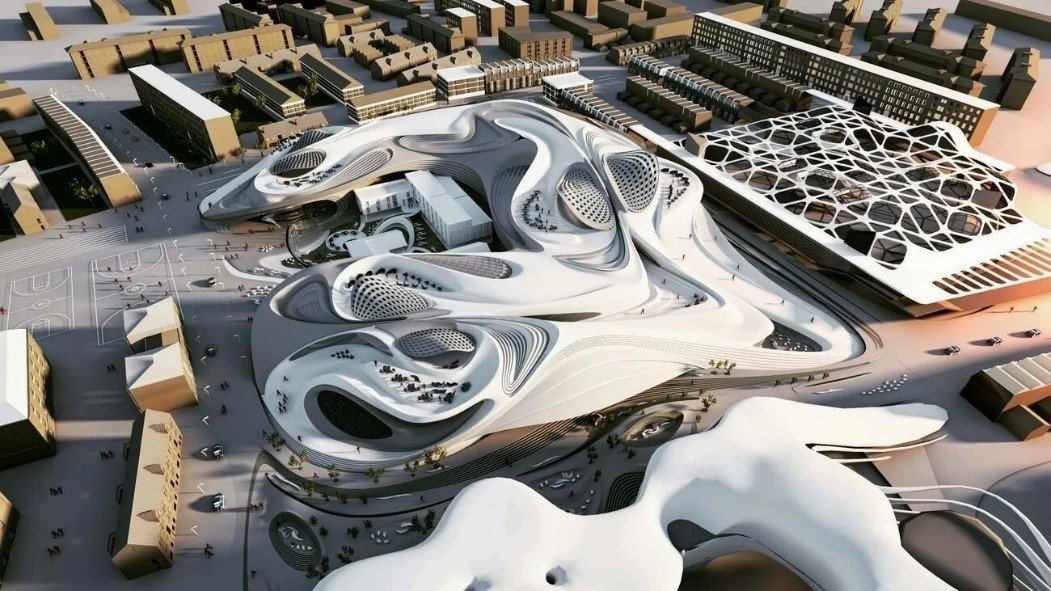
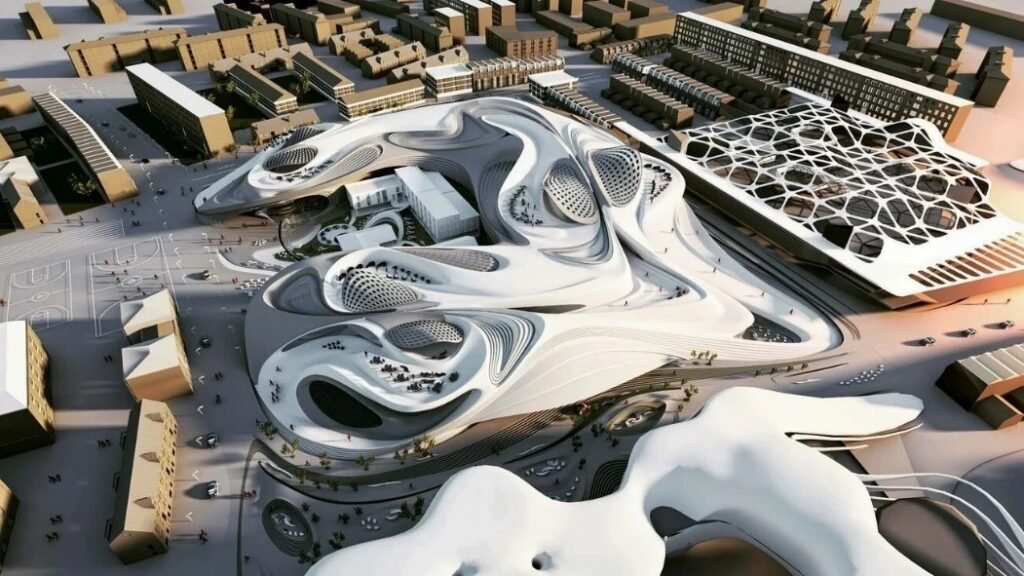
One of the clearest representations of Schumacher’s theoretical ambitions came with the competition entry for the Kartal-Pendik Masterplan in Istanbul. Although unbuilt, the project remains one of the most influential examples of parametric urbanism as a comprehensive strategy. Instead of imposing a rigid grid, the proposal used a field-based system of curvilinear lines that adapted to topographic features, existing infrastructural networks, sunlight conditions, and density requirements. The result was a dynamic urban morphology where building heights, street widths, and public space configurations varied continuously across the site. Schumacher described this project as a demonstration of how parametricism could operate at the scale of the city, generating coherent yet differentiated urban environments that respond to a complex set of variables. This approach stands in stark contrast to conventional planning methods that rely on zoning categories and repeated typologies. In Schumacher’s model, urbanism becomes a generative process where digital craft allows planners to analyze, simulate, and optimize interactions between multiple urban elements. The Kartal-Pendik proposal continues to influence academic discourse, suggesting that parametric tools can help cities achieve adaptability and resilience through geometric intelligence rather than rigid prescriptions.
The cultural dimension of Schumacher’s work becomes especially relevant when examining how parametric geometry communicates meaning and identity. Unlike postmodernism, which relied on symbols and references, parametricism expresses cultural logic through patterns of continuity, differentiation, and correlation. In Schumacher’s view, contemporary society is characterized by complex networks economic, technological, social, and digital. Parametric geometry, with its capacity for variation and relational organization, is uniquely suited to represent this cultural condition. Buildings and cities designed through parametric processes thus become legible expressions of the information-rich, interconnected world we inhabit. This is evident in projects like the King Abdullah Petroleum Studies and Research Center in Riyadh, where tessellated geometric systems reflect both environmental performance and cultural motifs. While not designed personally by Schumacher, such projects embody the principles he advocates: a synthesis of tradition and innovation filtered through computational logic. The hexagonal patterns and continuous surfaces reinterpret local cultural geometries through a parametric lens, demonstrating how digital craft can serve as a bridge between past and present, translating cultural identity into adaptive, sustainable architecture.
Schumacher’s contributions extend beyond built projects into his extensive theoretical writing, most notably in his multi-volume work “The Autopoiesis of Architecture.” In this text, he argues that parametricism represents the next great epochal style after modernism, capable of reorganizing the built environment through the systemic use of computational tools. His concept of autopoiesis—borrowed from systems theory suggests that architecture is a self-referential, self-evolving discipline that continually absorbs and generates knowledge. Parametricism, under this model, becomes a means of advancing architectural intelligence by formalizing the digital and algorithmic processes emerging within the profession. Schumacher frames parametricism not simply as an aesthetic but as a cultural necessity, aligned with the increasingly complex nature of contemporary life. Cities must evolve, he argues, to accommodate new patterns of communication, movement, and interaction. Parametric tools provide the flexibility and adaptability required to meet these demands. Through this theoretical framework, Schumacher positions architecture as an evolving computational system capable of organizing complexity through digital craft and adaptive geometry.
Many critics challenge Schumacher’s assertion that parametricism should be the dominant style of contemporary architecture, arguing that it prioritizes formal complexity or relies too heavily on digital tools. However, such critiques often misunderstand the functional logic underlying parametric urbanism. Schumacher consistently emphasizes that the aim of parametric design is not complexity but legibility and coherence. In complex societies, he argues, the built environment must help users navigate and understand their surroundings through differentiated yet interconnected spatial systems. Parametric geometries, with their capacity for variation and correlation, provide visual cues and organizational patterns that support orientation and interaction. In contrast, uniform grids and repetitive modernist typologies flatten differences and fail to express the diversity of contemporary urban contexts. For Schumacher, parametric urbanism thus becomes a form of cultural expression, representing the pluralistic and dynamic nature of modern life. This vision challenges architects and planners to rethink the relationship between architecture and society, suggesting that digital craft can help create environments more attuned to human needs.
One of the most important implications of Schumacher’s work is its influence on the next generation of architects who increasingly rely on computational tools as an integral part of their design practice. His writings and built projects have contributed to the global spread of parametric design education, inspiring students and practitioners to explore algorithmic modelling, performance-based design, and digital fabrication. Workshops, studios, and research labs dedicated to parametric urbanism continue to draw from his principles, examining how geometry can mediate social, environmental, and cultural conditions. While some use these tools for expressive form-making, others adopt Schumacher’s emphasis on urban systems, exploring how parametric methods can optimize street networks, density gradients, façade performance, and public space integration. This academic influence ensures that parametric urbanism remains a significant force in architectural discourse, shaping how architects think about cities and their future development.
Schumacher’s work also intersects with sustainability in meaningful ways, though often in ways less overt than traditional green architecture. Parametric systems allow designers to integrate environmental variables sun paths, wind patterns, thermal loads into geometric logic, producing buildings that respond naturally to climate conditions. For Schumacher, sustainability is maximized when form and performance are integrated rather than treated as separate layers. The computational tools he advocates enable real-time simulation and optimization, allowing architects to generate climatesensitive geometries without relying solely on mechanical systems. Projects such as the London Aquatics Centre demonstrate this, where the curvature of the roof responds to structural and environmental performance while shaping interior spatial experience. This synergy between form, function, and sustainability exemplifies digital craft at its most effective: a holistic approach where cultural geometry and environmental intelligence operate as one system.
Ultimately, Patrick Schumacher’s contributions to parametric urbanism combine theoretical rigor, computational innovation, and cultural ambition. His work positions geometry as a medium through which architecture can engage with the complexities of contemporary life, producing environments that are adaptive, communicative, and richly interconnected. Whether through the curving galleries of MAXXI, the urban landscape of Galaxy SOHO, the dynamic voids of the Morpheus Hotel, or the expansive vision of the Kartal-Pendik Masterplan, Schumacher demonstrates that parametric design can serve as a powerful tool for shaping both buildings and cities. His concept of digital craft challenges architects to think beyond isolated objects and toward continuous systems of spatial relationships. His exploration of cultural geometry suggests that computation can deepen architectural meaning rather than diminish it. And his advocacy for parametric urbanism offers a provocative vision of how architecture might evolve in response to the networked and fluid nature of modern society. Whether one agrees with his theoretical claims or not, Schumacher’s influence is undeniable: he has reshaped the discourse of computational architecture and opened new pathways for envisioning how cities of the future might be crafted. In this sense, his work continues to advance parametric urbanism as both a design methodology and a cultural project, inviting architects to explore new geometric languages capable of expressing the dynamic, interconnected realities of our time.