Digital technology as a design philosophy tool represents one of the most transformative dimensions of Frank Gehry’s architectural practice, redefining not only how buildings are shaped but how imagination itself is translated into physical reality. In Gehry’s work, advanced digital modeling is not merely a technical aid used after a concept is formed. It is …
Digital technology as a design philosophy tool represents one of the most transformative dimensions of Frank Gehry’s architectural practice, redefining not only how buildings are shaped but how imagination itself is translated into physical reality. In Gehry’s work, advanced digital modeling is not merely a technical aid used after a concept is formed. It is an active philosophical instrument that allows intuition, artistic risk, and formal complexity to coexist with precision, constructability, and economic feasibility. Nowhere is this more evident than in his pioneering adoption of CATIA, a computational platform originally developed for the aerospace industry. By integrating such tools into the heart of architectural thinking, Gehry fundamentally altered the relationship between design vision and material execution. Digital technology became the bridge between sculptural freedom and structural discipline, enabling an architecture that defies traditional limits of form without descending into impractical fantasy.
Before the widespread use of advanced computational modeling, architecture was largely constrained by the logic of manual drawing, physical models, and standardized construction methods. Complex curves, irregular geometries, and continuously varying surfaces were extremely difficult to document accurately, let alone fabricate and assemble on a building scale. As a result, architectural imagination was often shaped by what could reasonably be drawn, measured, and built using conventional techniques. Gehry’s early sculptural tendencies, evident even in his pre digital work, pushed constantly against these constraints. However, it was only through the integration of digital modeling that his most radical formal ambitions could be realized fully and reliably. The philosophical shift here is profound. Digital tools did not simply make Gehry’s architecture easier to build. They became instruments that expanded what architecture could be, allowing form, complexity, and constructability to evolve together rather than in opposition.
The adoption of CATIA marked a turning point in Gehry’s practice because it allowed irregular, curving, and non repetitive forms to be described with the same mathematical precision used in designing aircraft fuselages. This precision meant that every unique surface could be rationalized into data that engineers, fabricators, and contractors could interpret without ambiguity. What had once existed only as sketches and physical models could now be translated into a fully integrated digital system that controlled geometry, structure, material behavior, and fabrication logic simultaneously. This integration transformed digital technology from a representational tool into a philosophical engine of design. The architect was no longer limited to imagining only what could be easily drawn or conventionally built. Instead, imagination could operate at the scale of pure form, confident that digital systems could later mediate between vision and construction.
One of the most significant philosophical implications of this shift is the collapse of the traditional divide between design and production. In conventional practice, the architect would generate drawings, which engineers would then interpret structurally, and fabricators would finally translate into physical components. Each step involved a degree of abstraction, approximation, and interpretation. With digital modeling, particularly in Gehry’s practice, these stages became tightly integrated into a continuous workflow. A change in form affected structural analysis, material quantities, and fabrication data simultaneously. This integration reinforced Gehry’s belief that architecture should function as a holistic sculptural system rather than as a collection of separate technical problems. Form, structure, and material performance ceased to be sequential considerations and became concurrent drivers of design. This philosophical unity between idea and execution is one of the defining characteristics of Gehry’s digital era.
The Guggenheim Museum Bilbao offers one of the earliest and most influential demonstrations of how digital technology could operate as a philosophical design tool rather than a mere drafting aid. The building’s complex arrangement of interlocking titanium clad volumes, each with continuously varying curvature, would have been nearly impossible to realize with traditional documentation methods. Through digital modeling, every surface was defined precisely and coordinated with structural framing, support systems, and cladding fabrication. The titanium panels, each unique in shape and orientation, could be manufactured directly from digital data with extraordinary accuracy. This process allowed the sculptural vision to be executed with a level of fidelity that preserved its expressive intent rather than diluting it through simplification. Philosophically, this marked a decisive moment where digital technology proved that the most intuitive and expressive architectural forms could be realized with industrial precision. The apparent freedom of the building’s form is thus underwritten by an invisible regime of digital control. Chaos and rigor coexist not as contradictions but as complementary forces.
The role of digital technology in pushing the limits of complexity is equally significant. In Gehry’s work, complexity is not merely an accumulation of parts but a continuous variation of form across space. Surfaces bend, twist, and merge in ways that resist standardization. In a non digital context, such complexity would require labor intensive customization at every stage, driving costs and risks beyond feasible limits. Digital modeling transforms this condition by allowing mass customization to become a manageable reality. Each unique component is generated from the same parametric logic that governs the entire form. In this way, complexity becomes systematic rather than chaotic. What appears visually intricate is, at a deeper level, organized through mathematical relationships embedded in the digital model. This philosophical inversion is crucial. Complexity is no longer synonymous with inefficiency. Instead, it becomes a new form of order rooted in computational logic rather than classical geometry.
The Walt Disney Concert Hall in Los Angeles provides another powerful example of how digital technology functions as a philosophical driver of form and constructability. The building’s flowing stainless steel surfaces appear to defy conventional structural reasoning, unfolding in sweeping, almost musical gestures. Yet beneath this expressive exterior lies a highly disciplined digital framework that governs every panel, joint, and structural rib. The curvature of each surface was digitally analyzed for structural stability, acoustic reflection, and constructability long before fabrication began. This allowed the design to evolve through iterative refinement rather than through compromise and simplification. Digital technology enabled a feedback loop in which expressive intention and technical performance informed each other continuously. The result is a building that achieves both sculptural freedom and acoustic excellence without sacrificing one for the other. From a philosophical standpoint, this demonstrates how digital tools allow architecture to transcend the old dichotomy between art and engineering.
Beyond individual buildings, Gehry’s integration of digital technology reshaped the organizational culture of architectural practice itself. His firm developed proprietary digital workflows that aligned designers, engineers, and fabricators within a shared computational environment. This collaborative model challenged the traditional hierarchical separation between creative and technical disciplines. Designers were no longer isolated from construction realities, and engineers were no longer confined to post design problem solving. Instead, digital models became shared intellectual territory where artistic intention and technical necessity negotiated in real time. This collaborative philosophy reflects Gehry’s broader belief that architecture is not the product of isolated genius but of coordinated creativity across multiple domains. Digital technology thus becomes not only a design tool but a social instrument that reshapes how architectural knowledge is produced and shared.
The philosophical significance of digital modeling in Gehry’s work is also evident in how it redefines authorship. In a traditional context, the architect’s authorship is tied closely to drawings and formal decisions that can be visually traced to individual intent. In a digitally mediated environment, authorship becomes more distributed. The fabricator who writes scripts for panelization, the engineer who optimizes complex geometries for structural efficiency, and the computational designer who refines parametric relationships all contribute actively to the final form. Yet this diffusion of authorship does not diminish Gehry’s artistic identity. Instead, it reframes the architect as a conductor of computational and human intelligence rather than as a solitary creator. The philosophical authority of the architect shifts from manual control to conceptual orchestration.
Digital technology also allows Gehry to challenge traditional notions of constructability. In conventional practice, constructability is often defined by adherence to standardized components, right angles, and repetitive systems that minimize risk and cost. Gehry’s digital approach redefines constructability as the ability to fabricate complexity with precision rather than the obligation to simplify form. This does not mean that cost and feasibility are ignored. On the contrary, digital modeling allows more accurate prediction of material quantities, tolerances, and assembly sequences, often reducing waste and uncertainty. In this sense, digital constructability becomes an expanded concept that includes non standardized geometries as legitimate and controllable building conditions. Philosophically, this evolution dissolves the historical opposition between architectural ambition and construction pragmatism.
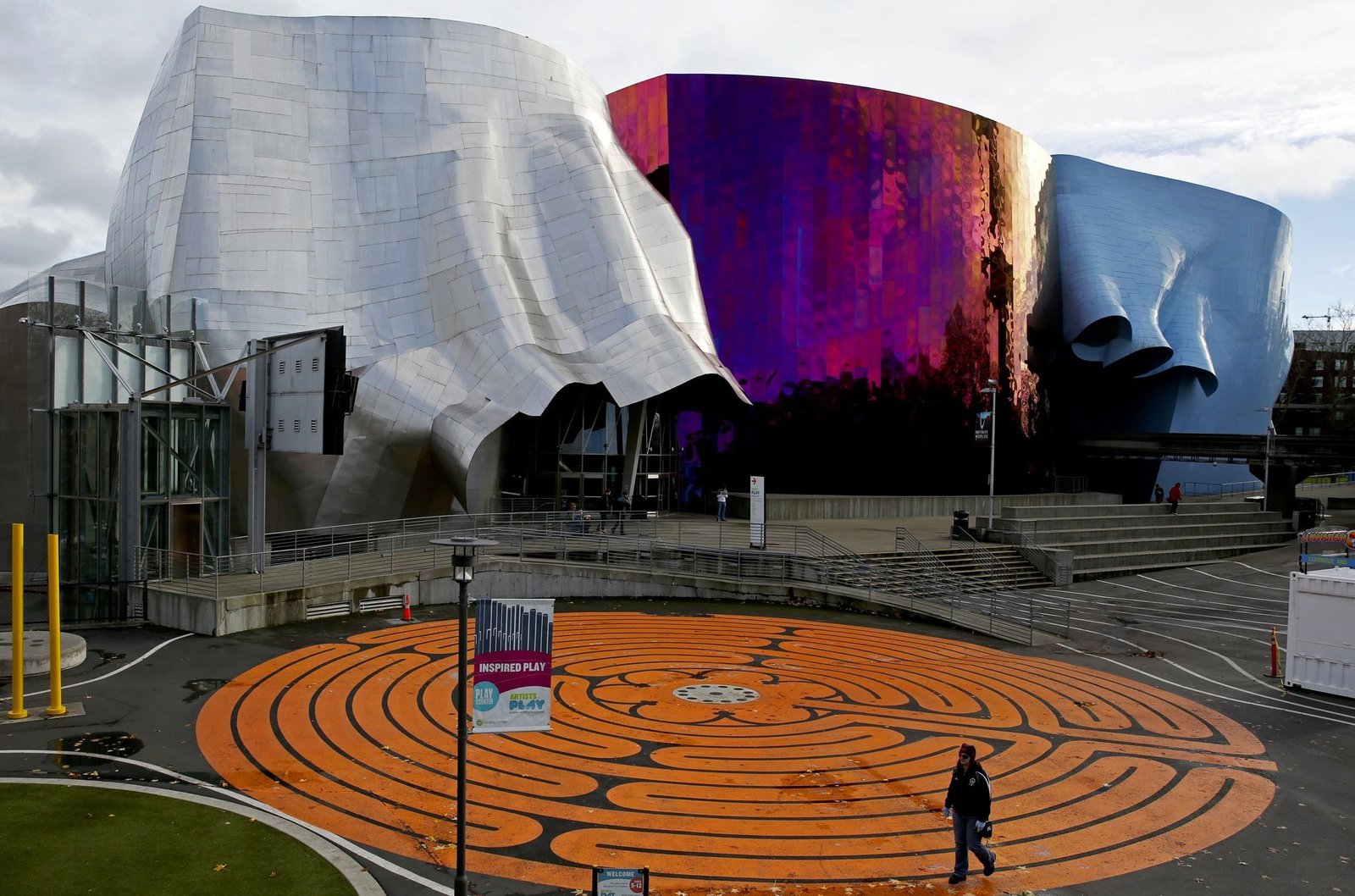
The Experience Music Project in Seattle offers another articulate illustration of how digital technology enabled Gehry to pursue extreme formal experimentation while maintaining technical control. The building’s surface appears as a collage of undulating metal skins in multiple colors, each shaped by complex curvature. These forms were generated through digital modeling that allowed Gehry to manipulate geometry with sculptural freedom while simultaneously preparing data for fabrication. Each metal panel was cut and assembled according to precise digital templates. Without computational mediation, the cost and risk of such an undertaking would have been prohibitive. The building thus stands as evidence that digital tools do not merely support iconic architecture after the fact but are deeply entangled with the very logic by which such architecture is conceived and realized.
At a deeper philosophical level, Gehry’s embrace of digital technology challenges the long standing humanist fear that machines might dominate creative processes. In his practice, computation does not replace artistic intuition but amplifies it. Sketches, physical models, and spontaneous formal gestures remain central to Gehry’s design process. Digital modeling enters not as an originator of form but as a translator and intensifier of it. The architect’s hand drawn lines and sculpted cardboard models are scanned and digitized, allowing their irregularities and idiosyncrasies to be preserved rather than rationalized away. In this way, digital technology becomes a servant of human intuition rather than its master. This philosophical stance resists the idea that computation inevitably leads to cold, algorithmic formalism. Instead, it demonstrates that digital systems can carry the emotional residue of artistic gesture into the most advanced layers of technical execution.
The implications of this approach for architectural education and professional identity are far reaching. Gehry’s integration of digital modeling as a design philosophy tool helped legitimize computational experimentation within mainstream architectural discourse. What was once considered a niche technical specialization became a central driver of formal innovation. Students and practitioners alike began to recognize that computational literacy was not merely a skill for documentation but a fundamental mode of conceptual thinking. This shift contributed to a broader transformation of architectural culture in which algorithms, parametric systems, and digital fabrication became integral to how architects imagine, test, and realize ideas. Gehry’s work thus occupies a pivotal position in the historical transition from analog to digital architectural paradigms.
Digital technology also plays a crucial role in enabling Gehry’s architecture to operate at the scale of the city and the global economy. Large scale civic and cultural buildings demand coordination among thousands of components, contractors, and regulatory frameworks. The complexity of Gehry’s forms would be impossible to manage without computational integration across design, engineering, and construction. Digital models become organizational infrastructures that govern not only geometry but schedules, costs, and logistics. In this sense, digital technology becomes a managerial as well as a philosophical tool. It allows architecture as sculpture to enter the realm of large scale urban production without collapsing under its own complexity. The freedom to imagine expansive, fluid forms is sustained by an equally expansive digital infrastructure of control.
The cultural meaning of this digital transformation is equally significant. Gehry’s digitally enabled buildings often become symbols of technological progress, innovation, and creative risk taking within their host cities. They signal a break from conventional construction imagery and announce participation in a global culture of experimentation. The visible complexity of these buildings communicates an invisible computational sophistication, reinforcing the association between contemporary architecture and advanced technological capability. This symbolic dimension extends Gehry’s philosophy beyond form into the realm of cultural identity, where digital architecture becomes a marker of a city’s aspirations.
At the same time, digital technology introduces new ethical and philosophical tensions. The ability to generate virtually any form raises questions about restraint, sustainability, and resource consumption. Gehry’s work has been both celebrated and criticized in this regard. Supporters argue that digital precision allows for optimization that can reduce waste and improve performance. Critics contend that the pursuit of iconic complexity may encourage excess. These debates highlight that digital technology is not a neutral tool but one whose philosophical implications depend on how it is deployed. Gehry’s practice occupies a contested space within this discourse, embodying both the liberating potential and the contentious consequences of computational freedom.
Another philosophical dimension of Gehry’s digital methodology lies in its treatment of error and imperfection. While digital systems are often associated with precision and control, Gehry’s work deliberately preserves irregularity, asymmetry, and unpredictability. Digital tools are used not to eliminate these qualities but to stabilize them within buildable constraints. This reconciliation of imperfection with precision reflects a deeper philosophical commitment to authenticity and process. The building is not meant to appear machine perfect. It is meant to carry traces of human intuition, experimentation, and risk even as it achieves industrial accuracy. Digital technology thus becomes a paradoxical tool that secures freedom rather than suppressing it.
As computational design tools continue to evolve, Gehry’s early adoption of digital modeling stands as a foundational precedent for the contemporary architectural landscape. Parametric design, robotic fabrication, and algorithmic optimization all extend the logic that Gehry helped legitimize: the idea that digital systems can serve as generative partners in architectural creation rather than as passive instruments of representation. Yet what distinguishes Gehry’s digital philosophy from many later computational practices is its persistent grounding in artistic intuition. The computer is not the author of form but the medium through which form is realized with unprecedented fidelity.
In the final analysis, digital technology as a design philosophy tool in Gehry’s architecture represents a profound reconfiguration of how buildings come into being. It dissolves the historical separation between imagination and construction, between artistic impulse and technical execution. By integrating advanced digital modeling into the very core of his practice, Gehry transformed computational systems into enablers of freedom rather than mechanisms of constraint. His buildings demonstrate that complexity is no longer the enemy of constructability, that sculptural ambition is no longer incompatible with industrial precision, and that intuitive art can coexist with algorithmic rigor. Through this synthesis, Gehry not only expanded the language of architecture but also redefined the philosophical role of digital technology within it. Digital tools in his work do not merely describe architecture. They participate in its becoming. They transform sketches into structures, dreams into data, and data into inhabitable reality. In doing so, they push the boundaries of what architecture can conceive, construct, and ultimately mean in an increasingly computational world.