Eladio Dieste stands as one of the most extraordinary yet understated innovators in the global history of architecture, a Latin American engineer whose work predated digital computation but whose ideas resonate profoundly with modern parametricism. His buildings, shaped primarily from thin-shell brick, demonstrate a deep understanding of material behavior, structural efficiency, and geometric logic. Long …
Eladio Dieste stands as one of the most extraordinary yet understated innovators in the global history of architecture, a Latin American engineer whose work predated digital computation but whose ideas resonate profoundly with modern parametricism. His buildings, shaped primarily from thin-shell brick, demonstrate a deep understanding of material behavior, structural efficiency, and geometric logic. Long before architects used algorithms, scripting, or digital simulations, Dieste was experimenting with curvature, morphogenesis, and the optimization of form. His architecture was parametric not through digital means but through a careful manipulation of variables: thickness, curvature radius, brick placement, load distribution, and structural continuity. These parameters formed a rule-based design system that allowed him to achieve spans and forms previously thought impossible with brick. In this sense, Dieste’s work lays a conceptual foundation for modern computational strategies. By examining his projects and their impact on contemporary digital designers, it becomes evident that Latin American parametricism has roots in experimental material logic rather than software. Dieste approached architecture as a living system of forces, constraints, and behaviors, and today’s computational architects—though equipped with advanced tools continue to learn from the simplicity and elegance of his approach. Understanding his influence helps reveal the deeper relationship between material intelligence, structural geometry, and the evolution of algorithmic design.
Dieste’s philosophy was formed around the principle that structural forms should not be imposed but discovered through an understanding of how materials naturally behave. In many ways, this is the essence of parametricism: geometry emerging from constraints and performance requirements rather than arbitrary composition. Dieste believed that brick, a humble material deeply rooted in Latin America’s architectural traditions, possessed untapped potential. By deploying it in thin layers and curving it into double-curved or singly curved surfaces, he could create structures that were lighter, stronger, and more expressive than conventional masonry systems. His manipulation of brick was entirely parametric in spirit. He treated curvature as a variable that responded to the forces running through the structure. He analyzed spans, calculated stresses, and adjusted geometry accordingly, much like an algorithm updates outputs in response to changing inputs. One of the greatest misconceptions about parametric architecture is that it began with computers. Dieste’s work proves that parametric thinking has existed for decades through engineering logic, structural experimentation, and a sensitivity to material performance.
One of Dieste’s most celebrated works, the Church of Cristo Obrero in Atlántida, Uruguay, demonstrates how curvature can be used to generate both structural efficiency and poetic spatial experience. The church is renowned for its undulating walls and roof, which follow a sinusoidal logic that distributes forces evenly across the structure. These waves were not decorative gestures; they were the geometry required for stability using thin-shell brick. Dieste varied the curvature based on structural necessity, exploring how the radius could shift to create continuous compression paths. This is parametricism at its core: letting geometric variation respond to performance conditions. The form-finding process Dieste used based on physical intuition, mathematical analysis, and iterative refinement resembles the computational methods now used in digital workflows such as Grasshopper or Finite Element Method modeling. Today’s architects simulate shell structures and optimize curvature through algorithms, but Dieste achieved these outcomes manually, guided by a near-instinctive understanding of how geometry influences mechanical behavior. The church stands as a quiet manifesto of pre-digital parametric thinking, a building where logic, material, and form converge seamlessly.
Another essential example of Dieste’s experimental material logic can be found in the Church of San Pedro in Durazno, where he used his signature Gaussian vaults to create a dramatic, light-filled interior. Gaussian vaults, which employ double curvature, are inherently more stable and efficient than traditional barrel vaults because they direct forces along complex paths that resist buckling. Dieste’s use of double curvature predates the computational craze surrounding freeform geometry. His vaults were shaped through intricate calculations that balanced thickness, curvature, and load. He treated the vault as a series of interdependent variables, adjusting one aspect and recalculating the others until the geometry reached equilibrium. Modern parametric tools automate this process, using inputs and constraints to generate optimized forms. Yet Dieste’s work reveals that the conceptual framework designing through relational thinking existed long before computation. The San Pedro church’s vaults also highlight Dieste’s acute awareness of the sensory and cultural dimensions of architecture. While the geometry was optimized structurally, it produced a spiritual atmosphere shaped by light, movement, and rhythm. This demonstrates that parametric systems, when rooted in material intelligence rather than aesthetic ambition, can produce architecture that is emotionally resonant as well as technically efficient.
Dieste’s use of materials also offers profound lessons for today’s computational designers. In an era when many parametric buildings rely on high-tech materials, CNC fabrication, and carbon-intensive processes, Dieste’s brick structures champion sustainability through local, low-cost, and low-carbon means. His thin-shell techniques reduced material usage dramatically, minimizing waste long before sustainability became an architectural priority. Each brick was placed with precision, forming part of a geometric system that required minimal reinforcement. This approach aligns with contemporary research into parametric sustainability, where minimizing material waste through optimized form becomes a central goal. What distinguishes Dieste’s work is that sustainability was not a trend but a necessity. Working in a Latin American context with limited resources, he treated efficiency as an ethic rather than a constraint. His ability to create monumental architectural experiences with minimal means provides a counterpoint to some parametric architecture that prioritizes visual complexity over ecological responsibility. Digital architects today increasingly turn to Dieste’s methods as inspiration for low-carbon parametric design, using computational tools not to create extravagant forms but to replicate the material efficiency Dieste achieved manually.
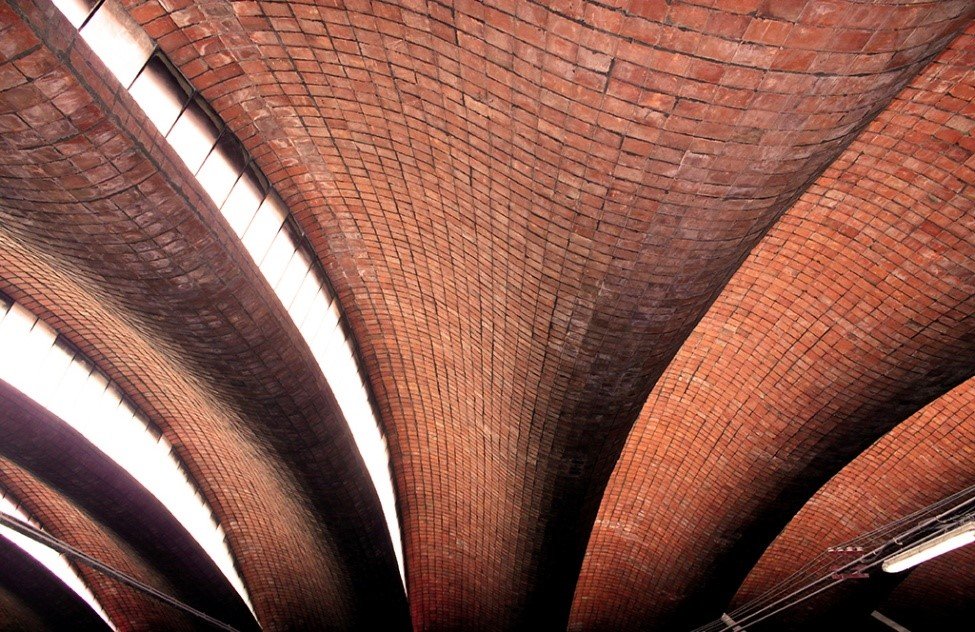
The influence of Dieste’s work on modern computation becomes even more evident when examining projects such as the Montevideo Shopping Center Parking Sheds. These massive vaulted roofs, built using thin-shell brick, created large column-free spaces through the use of varying curvature along their spans. The geometry responded to load paths and boundary conditions in a manner that directly parallels modern digital form-finding tools like Kangaroo Physics or RhinoVAULT. Dieste essentially performed analog simulations, identifying force trajectories through physical models and mathematical reasoning. His vaults relied on principles of funicular geometry another hallmark of computational parametric design. Funicular forms are achieved when structures are shaped according to the natural flow of forces, eliminating bending and maximizing efficiency. Today, architects use parametric modeling to generate funicular shells through algorithmic solvers. Dieste achieved the same by observing how materials behaved under gravity and adjusting his geometry accordingly. His parking sheds demonstrate that parametric architecture need not appear digital or futuristic; it can be deeply traditional in material but advanced in logic.
The bell tower of the Church of San Juan de Durazno provides another compelling illustration of Dieste’s pre-digital parametric sensibility. The tower twists gently as it rises, creating a dynamic form that reflects structural optimization and aesthetic intent. The twist was not arbitrary; it was developed based on wind loads, torsional resistance, and the desire to reduce mass while maintaining stability. Dieste treated the tower as a variable system where rotation, thickness, and curvature interacted to produce the final geometry. The logic of this twisting form prefigures the algorithmic techniques used today to produce towers that adapt to environmental conditions by rotating floors, adjusting mass distribution, or modifying facade patterns. Dieste’s bell tower shows that the principles behind such computational geometries were already being explored through material experimentation and structural intuition. This example is especially meaningful because it challenges the notion that parametricism is synonymous with digital form. Instead, it highlights that parametricism is a way of thinking an approach grounded in relationships, constraints, and adaptive geometry.
Eladio Dieste’s influence has expanded beyond structural engineering and now permeates contemporary architectural discourse, especially in the realm of digital fabrication and computational form-finding. Many architects and researchers studying masonry or thin-shell structures reference his work as a primary precedent. The resurgence of interest in tile vaulting, particularly through universities and research groups worldwide, owes much to Dieste’s legacy. Several parametric modeling tools have been developed explicitly to replicate and extend the geometric principles he pioneered. For instance, digital workflows that model compression-only structures draw from Dieste’s experiments with funicular geometry. These computational systems allow architects to generate forms that behave structurally like Dieste’s vaults, but with greater precision and flexibility. The digital revival of thin-shell masonry demonstrates that technology is not replacing Dieste’s ideas but amplifying them. In many ways, contemporary computational designers are rediscovering the power of material-efficient construction a power Dieste harnessed decades earlier with simple bricks and brilliant engineering.
Another key aspect of Dieste’s influence relates to the idea of expressive structure. In many parametric projects today, structure is not concealed but celebrated, often becoming the architectural identity of the building. This approach is directly aligned with Dieste’s philosophy. For him, structural logic was not merely a technical requirement but a form of architectural beauty. The rhythm of bricks, the curvature of the shell, the continuity of the vault all these elements created an embodied form of expression rooted in performance. Today’s computational architects pursue similar goals, using algorithms to optimize structure while simultaneously defining the architectural language. Projects such as freeform timber shells, digitally fabricated brick vaults, and optimized concrete shells reflect an aesthetic where geometry is governed by structural efficiency. This approach can be traced back to Dieste’s belief that architecture achieves its highest expression when form follows the forces within it. His influence thus extends into the artistic domain of parametricism, where beauty is discovered through logic and material behavior, not imposed from outside.
Dieste’s work also resonates with contemporary discussions about cultural contextualization within parametricism. Much criticism of parametric architecture argues that digital forms often lack cultural grounding, producing generic geometries that could exist anywhere. Dieste’s work counters this by showing how advanced geometric logic can emerge from local materials, traditions, and constraints. His buildings are unmistakably Latin American in spirit, yet universal in structural intelligence. This provides a valuable lesson for computational architects: that parametric design can be culturally rooted when it engages deeply with local conditions. Dieste worked with brick because it was abundant, affordable, and tied to regional craftsmanship. Yet he transformed this material into an advanced structural medium through innovation. Modern computational designers increasingly adopt this mindset, using algorithms to enhance vernacular materials like bamboo, timber, and earth. In this way, Dieste’s legacy contributes to a new wave of Latin American parametricism that blends digital tools with cultural identity and material authenticity.
Eladio Dieste’s life’s work stands as a testament to the profound relationship between material logic and geometric intelligence. Although he did not use digital tools, his thinking was algorithmic, his process iterative, and his designs parametric in the deepest sense of the term. He demonstrated that complex forms need not come from advanced technology but from a profound understanding of how materials behave and how geometry can be manipulated to make them perform more efficiently. His influence on modern computational architecture continues to grow as architects seek sustainable, elegant alternatives to energy-intensive construction. Dieste provides a model of parametric design that is grounded in ethics, resourcefulness, and cultural resonance. He teaches us that the most advanced architecture often emerges not through technological excess but through the inventive use of simple materials guided by intelligent rules. As the world confronts the urgent need for sustainable construction, Dieste’s experimental material logic offers a forward path one where computation serves not to complicate architecture but to clarify and amplify the intelligence already present within the material world. His legacy endures not only in the vaulted churches and elegant structures across Uruguay but also in the algorithms, digital models, and parametric workflows that continue to draw inspiration from his remarkable understanding of form, force, and craft. In this sense, Eladio Dieste is not a historical figure from the past but an active contributor to the evolving future of computational and parametric architecture.