In an age of speed and spectacle, when cities erupt in steel and glass and architecture often becomes a symbol of power or branding, Peter Zumthor stands apart calm, deliberate, and deeply human. His buildings do not shout. They breathe. They do not seek attention; they ask for quiet. They do not impose upon their …
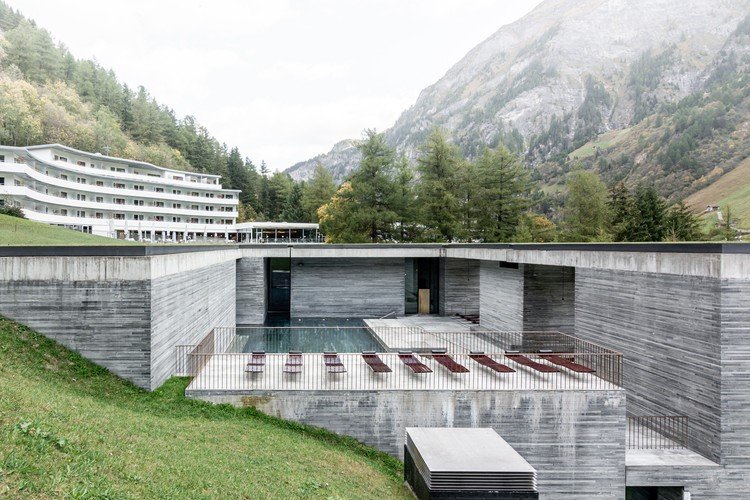
Table of Contents
- A Quiet Beginning
- The Philosophy of Atmosphere
- The Role of Silence
- Therme Vals: Architecture as Ritual and Sensation
- The Bruder Klaus Field Chapel: Silence Made Sacred
- The Kolumba Museum: Memory and Continuity
- The Protective Shell of the Swiss Pavilion at Expo 2000
- Material as Memory
- The Emotional Architecture
- The Discipline of Slowness
- Beyond Architecture: Ethics and Reverence
- Influence and Legacy
- The Timelessness of Silence
- Conclusion: Building with the Soul
In an age of speed and spectacle, when cities erupt in steel and glass and architecture often becomes a symbol of power or branding, Peter Zumthor stands apart calm, deliberate, and deeply human. His buildings do not shout. They breathe. They do not seek attention; they ask for quiet. They do not impose upon their surroundings; they listen to them.
Zumthor’s work is not about style or form, but about experience about how space feels, how materials smell, how light falls, and how sound moves. His architecture, stripped of ego and noise, invites contemplation. It whispers of memory, presence, and the intimate connection between body, material, and place.
He once said, “Atmosphere is the magic of a space, the thing that moves us.” To understand Zumthor is to understand this elusive idea atmosphere and his lifelong pursuit to make architecture not only seen but felt. His buildings, whether a remote chapel in a German field or a thermal bath in the Swiss Alps, are not monuments to ambition but to sensitivity. They transform simplicity into transcendence and silence into meaning.
A Quiet Beginning
Peter Zumthor was born in Basel, Switzerland, in 1943, the son of a cabinetmaker. From an early age, he absorbed a love for craft, precision, and the tactile honesty of materials. The scent of wood shavings, the sound of tools, and the patience of working with one’s hands shaped his sensibility far more than academic theory ever could.
He trained first as a cabinetmaker, then as an architect at the Kunstgewerbeschule in Basel and later at the Pratt Institute in New York. Yet even as he studied in the world’s urban heart, his instincts remained rooted in the quiet rural landscapes of Switzerland places where architecture served life, not spectacle.
When he established his own small studio in the alpine village of Haldenstein in 1979, Zumthor made a conscious decision to remain outside the mainstream currents of architectural fame. His practice has remained small, deliberately so, allowing him to immerse himself deeply in each project. For Zumthor, architecture is not a business but a craft, a long conversation between idea, material, and emotion.
The Philosophy of Atmosphere
Zumthor’s concept of atmosphere transcends visual aesthetics. It is multisensory and emotional. He writes in his seminal book Atmospheres that what matters in architecture is not what it looks like, but what it feels like to enter it the temperature of the air, the echo of footsteps, the texture of walls, the quality of light.
To create atmosphere is to orchestrate all these intangible elements into harmony. It is to build not only for the eyes but for the entire human being for the body, for memory, for the senses.
In his view, architecture must evoke a sense of presence. It must awaken our awareness of being alive in a place at a particular time. A building should not distract us with novelty but root us more deeply in the moment.
This approach requires slowness. Zumthor’s process is patient, contemplative. He sketches endlessly, experiments with materials, and visits sites repeatedly to absorb their spirit. His buildings often take years to design, not because they are complex in form, but because he seeks to uncover their essence.
The Role of Silence
If atmosphere is the emotional content of architecture, silence is its moral one. Silence, for Zumthor, is not emptiness; it is fullness without noise. His architecture embodies this kind of silence the kind that allows thought, emotion, and nature to resonate.
His buildings are devoid of unnecessary decoration or technological showmanship. Every element serves a purpose, every joint and shadow carefully considered. The silence comes from restraint, from knowing when to stop.
In a Zumthor building, one becomes acutely aware of one’s surroundings the coolness of stone, the warmth of sunlight, the distant hum of water. This heightened sensitivity to sensory detail becomes a kind of meditation. It is in silence that we feel the presence of architecture most profoundly.
Therme Vals: Architecture as Ritual and Sensation
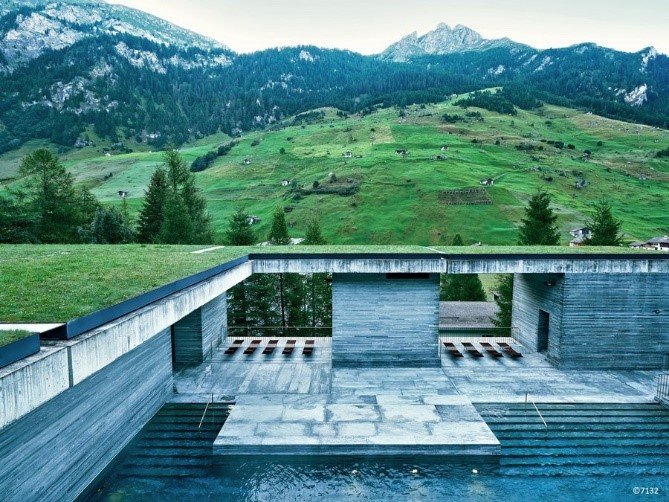
Perhaps the most famous embodiment of Zumthor’s philosophy is the Therme Vals (1996), a thermal bath complex built into the mountainside of the Swiss village of Vals. It is not simply a spa; it is an experience of elemental communion stone, water, light, and body intertwined.
Zumthor designed the building as though it had always been part of the mountain. Instead of constructing an object atop the landscape, he embedded it within the slope, using local quartzite stone quarried from the very site. The result is architecture that feels geological, timeless, as if carved by water and time itself.
The interior unfolds as a series of caverns and chambers bathed in filtered light. Water flows quietly through narrow channels, echoing against stone. The temperature shifts from pool to pool, from cold to warm to hot, guiding the visitor through a sensory journey that borders on the spiritual.
Every detail the sound of dripping water, the softness of the light, the subtle scent of stone contributes to the atmosphere. There is no visual excess, no overt statement. Instead, there is immersion. Visitors move slowly, almost reverently, as if participating in an ancient ritual.
Therme Vals reveals how Zumthor transforms architecture into experience. It is not a place to see, but to feel to feel the weight of the mountain, the flow of time, and one’s own body in elemental communion with nature.
The Bruder Klaus Field Chapel: Silence Made Sacred
If Therme Vals represents Zumthor’s dialogue with nature, the Bruder Klaus Field Chapel (2007) near Mechernich, Germany, represents his dialogue with the divine. Commissioned by a local farming couple to honor Saint Nicholas of Flüe, the patron saint of Switzerland, the chapel stands in an open field a simple, solitary form amid agricultural land.
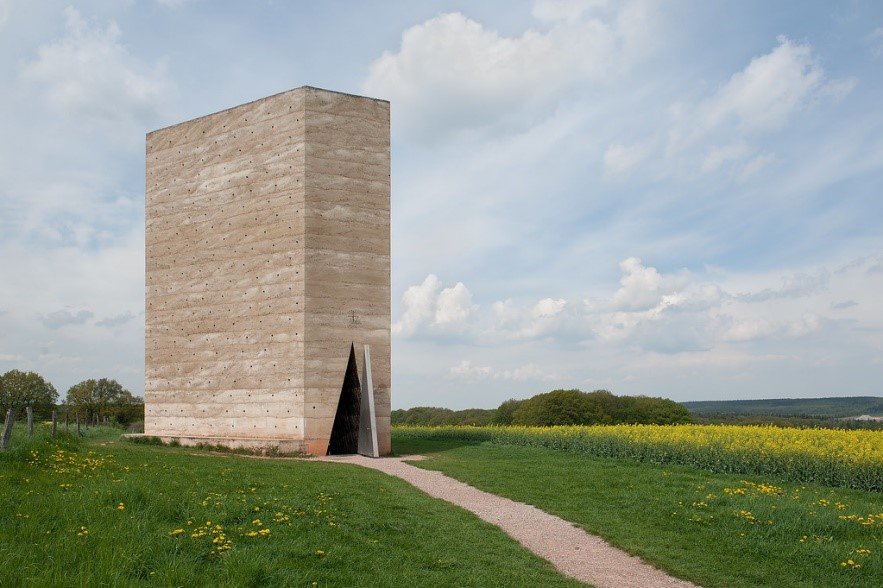
From the outside, the chapel is a rough concrete monolith, tapered slightly upward like a primitive tent or a shard of earth. It appears almost austere, silent, unyielding. Yet stepping inside reveals one of the most breathtaking spatial experiences in contemporary architecture.
Zumthor built the interior by assembling 112 tree trunks in the shape of a tepee, then pouring concrete around them. Once the concrete set, the wood was slowly burned away, leaving behind a dark, charred void with a ceiling pierced by a small circular opening. Light filters in like a divine spotlight, shifting with the day and weather.
The air smells faintly of soot and resin, a reminder of fire and transformation. The walls bear the imprint of the timber, their texture rough and tactile. The sound within is deep and resonant, amplifying silence into presence.
Inside the Bruder Klaus Chapel, time seems suspended. The building is both cave and cathedral, both humble and transcendent. It captures the essence of Zumthor’s belief that architecture can move the soul not through grandeur but through intimacy, honesty, and the interplay of material and light.
The Kolumba Museum: Memory and Continuity
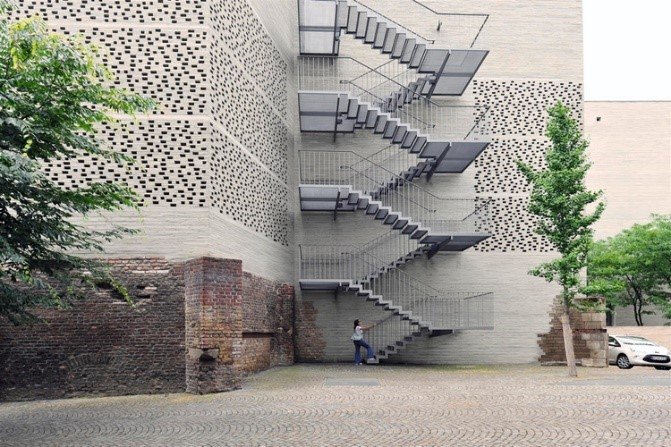
Zumthor’s Kolumba Museum in Cologne (2007) takes his ideas of atmosphere and silence into an urban context. The museum houses the art collection of the Archdiocese of Cologne on the ruins of a Gothic church destroyed during World War II.
Rather than erasing or restoring the past, Zumthor wove new and old together with exquisite sensitivity. He preserved the remnants of the church and built around them using pale grey brick, matching the tone and rhythm of the existing ruins.
Inside, the atmosphere is one of profound calm. Light seeps through slender windows, illuminating fragments of stone, relics, and artworks in a soft, diffused glow. The transitions between old and new are seamless yet legible one feels the continuity of history, the layering of time.
The museum’s spatial sequence encourages slow movement and reflection. Each room unfolds like a meditation, guiding visitors through an emotional rather than didactic journey. The architecture itself becomes an act of remembrance not a reconstruction of what was lost, but a respectful continuation of its spirit.
The Kolumba Museum demonstrates Zumthor’s rare ability to translate silence into urban space. Amid the noise of Cologne, it offers stillness. Amid the fragments of destruction, it offers reconciliation.
The Protective Shell of the Swiss Pavilion at Expo 2000
Another example of Zumthor’s poetic restraint was the Swiss Pavilion for Expo 2000 in Hanover, Germany. Here, he challenged the very notion of temporary architecture. The pavilion was built entirely from stacked, untreated timber beams held together by steel tension cables no nails, no glue.
After the exposition, the structure was designed to be dismantled, and the wood reused in construction elsewhere. This impermanence was not a limitation but a statement: architecture, like life, can be transient yet meaningful.
Visitors entered a labyrinth of light and shadow, with the scent of fresh wood filling the air. The structure emitted the warmth of a forest, reminding people that beauty and sustainability need not be separate pursuits.
This project expressed Zumthor’s deep respect for material honesty and the cyclical nature of creation. Even in a temporary exhibition, he infused atmosphere, silence, and soul.
Material as Memory
In Zumthor’s hands, materials are not neutral; they carry memory, weight, and emotion. Wood, stone, concrete, and metal each have their own voices, and he orchestrates them like instruments in a symphony.
He believes materials speak directly to the senses their temperature, texture, and scent communicate without language. For him, the beauty of a material lies not in perfection but in its authenticity, in the traces of its making.
In the Kunsthaus Bregenz (1997) in Austria, he used glass, steel, and concrete to create a building that seems to glow from within. The museum’s translucent glass facade filters daylight into the galleries, bathing artworks in soft, even illumination. The building changes constantly with the weather and time of day, becoming almost alive.
The Kunsthaus Bregenz reveals Zumthor’s mastery of immateriality how light itself can become a building material. The interplay of light and mass, transparency and opacity, produces an atmosphere of quiet intensity.
The Emotional Architecture
Zumthor’s architecture is often described as emotional rather than intellectual. He designs not for theory but for feeling. His buildings elicit wonder, peace, and sometimes melancholy. They remind us that architecture is not just about providing shelter but about enriching our inner lives.
His process begins with imagining the experience. He often closes his eyes and envisions what it would feel like to walk through the space what one would hear, see, and touch. Only then does he translate those sensations into form.
This approach stems from his conviction that architecture should resonate with the deepest parts of human experience with memory, nostalgia, and the body’s relationship to the world. In his work, even the simplest gesture can carry profound meaning: a shaft of light, the roughness of a wall, the echo of footsteps.
For Zumthor, these moments are not decorative; they are essential. They create a sense of belonging, of presence, of being at peace in the world.
The Discipline of Slowness
Zumthor’s buildings take time years of design, testing, and refinement. In a profession often driven by deadlines and efficiency, his commitment to slowness is almost radical.
This deliberate pace allows ideas to mature organically. Materials are tested for texture and resonance. Models are built by hand. Every line and junction is reconsidered until it feels right, not just looks right.
He once remarked that a building must have “the patience of a tree.” It must grow slowly, grounded in its site, shaped by seasons, and infused with care.
This philosophy of slowness extends to the experience of his architecture as well. His buildings ask visitors to slow down, to pay attention, to listen. They are antidotes to the overstimulation of modern life sanctuaries of stillness.
Beyond Architecture: Ethics and Reverence
Zumthor’s work is not only artistic but ethical. His restraint comes from a moral sense of responsibility to the land, to history, to craft, and to the people who will inhabit his spaces.
He rejects the notion of architecture as spectacle or commodity. For him, to build is to take part in something sacred: the shaping of human experience. This sacredness demands honesty and humility.
In this way, his philosophy aligns with that of the craftsman or the monk slow, disciplined, devoted. He once described architecture as “the art of creating a shell for human beings, a place that gives them dignity and peace.”
This reverence for human life is evident in every project he undertakes. Whether it is a chapel, a bath, or a museum, each building is designed to dignify the act of being to create a space where one can feel deeply alive, connected to the earth, to time, and to oneself.
Influence and Legacy
Despite his reluctance to engage in the global architectural circuit, Zumthor’s influence has been immense. Younger architects look to his work as a model of authenticity in an age of image-driven design. He demonstrates that architecture can be both contemporary and timeless, both minimal and profound.
He received the Pritzker Architecture Prize in 2009, the profession’s highest honor, recognizing not only his buildings but his integrity. Yet even after receiving global acclaim, he continued to work quietly from his studio in Haldenstein, choosing quality over quantity, essence over exposure.
His legacy lies not in the number of buildings he has completed but in the depth of their impact. They change the way we feel about space. They remind us that architecture, at its best, is an emotional and moral art.
The Timelessness of Silence
What distinguishes Zumthor most is his ability to create timelessness. His buildings seem both ancient and modern, tangible and ethereal. They resist categorization because they speak to something universal the human need for shelter, for peace, for connection to the world.
In the stillness of a Zumthor building, time slows. Light shifts, shadows deepen, and one becomes aware of being alive. The architecture does not distract or entertain; it grounds. It allows silence to do its work.
In this sense, his buildings are not just physical spaces but instruments of awareness. They invite us to listen to the sound of our breath, to the whisper of the wind, to the echo of footsteps and in that listening, to rediscover ourselves.
Conclusion: Building with the Soul
Peter Zumthor’s architecture is not about spectacle but about soul. He builds not with ego but with empathy. His philosophy of atmosphere and silence challenges the modern obsession with visibility, reminding us that true beauty lies in stillness, in touch, in memory, and in time.
To enter one of his buildings is to enter a state of presence. One feels the temperature of the stone, the softness of the light, the quiet hum of the world. It is an architecture that does not demand admiration but evokes gratitude gratitude for being alive in a space that understands you without words.
Zumthor has given the world a rare gift: the rediscovery of simplicity as a form of grace. His architecture does not merely house the body; it shelters the spirit. In his silence, we find meaning. In his restraint, we find generosity. And in his atmospheres, we find the reminder that architecture, at its truest, is not the art of building things it is the art of shaping how we feel in the world.