~Achyut Kanvinde Architecture Is Not a Museum of Material: Understanding Achyut Kanvinde through the ISKCON Temple, Delhi Architecture is, at its heart, a conversation between form and feeling, between the measurable and the immeasurable. Few Indian architects have understood this conversation as deeply as Achyut Purushottam Kanvinde, a pioneer of modern architecture in India. His …
~Achyut Kanvinde
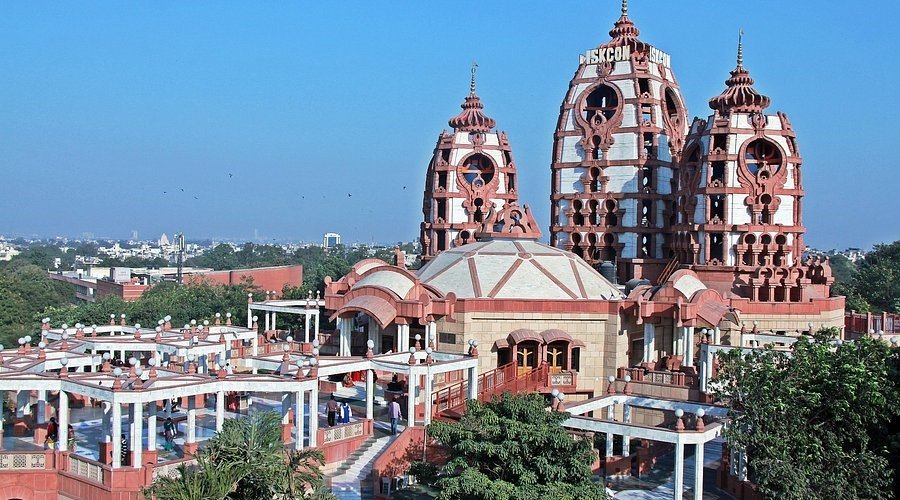
Table of Contents
- Architecture Is Not a Museum of Material: Understanding Achyut Kanvinde through the ISKCON Temple, Delhi
- 1. The Context of a Modern Indian Voice
- 2. The Meaning of the Quote
- 3. ISKCON Delhi: A Temple for the Modern Devotee
- 4. The Site and Spatial Logic
- 5. The Language of Form
- 6. Material as Medium, Not Message
- 7. The Human Experience
- 8. The Modern Indian Temple Typology
- 9. Light, Space, and Spirit
- 10. Function and Faith
- 11. Aesthetic Restraint as Spiritual Expression
- 12. Legacy and Lessons
- 13. A Personal Reflection
- 14. The Quote, Revisited
- 15. Conclusion: The Spirit of the Structure
Architecture Is Not a Museum of Material: Understanding Achyut Kanvinde through the ISKCON Temple, Delhi
Architecture is, at its heart, a conversation between form and feeling, between the measurable and the immeasurable. Few Indian architects have understood this conversation as deeply as Achyut Purushottam Kanvinde, a pioneer of modern architecture in India. His famous assertion “Architecture is not a museum of materials” is not merely a critique of excess or ornamental indulgence; it is a philosophy that calls for meaning over materiality, purpose over prettiness.
To understand this, one must not only read his words but walk through his work. Among his many remarkable projects, the ISKCON Temple in Delhi stands out as a physical manifestation of that philosophy a space that celebrates spirituality not through grandeur of materials but through the clarity of space, light, and human experience.
Let’s unfold this thought in layers, just as Kanvinde might unfold a plan carefully, deliberately, with reverence for both logic and life.
1. The Context of a Modern Indian Voice
When Kanvinde returned to India after studying under Walter Gropius at Harvard’s Graduate School of Design in the 1940s, he brought back not just modernist ideas but a new way of thinking about the role of architecture in a young, independent nation. India in the 1950s was a country eager to build both literally and symbolically. Architecture was no longer about palaces or colonial order; it was about identity, progress, and purpose.
Kanvinde, influenced by the Bauhaus principles of functionalism and human-centered design, believed that architecture must be rooted in context social, cultural, and climatic. He saw buildings not as static monuments but as living frameworks that respond to life. His philosophy was never about showing what materials could do, but rather about how spaces could serve.
In his view, the obsession with material be it marble, steel, or glass was missing the point. Architecture, he believed, should never become a “museum of materials,” a showcase of textures and finishes detached from the realities of human experience. Instead, it should be “a living organism,”shaped by function, light, and movement.
This idea became the invisible foundation beneath much of his work, from educational campuses and scientific research institutes to temples and housing. It found poetic expression in one of his most spiritually resonant projects: the ISKCON Temple at East of Kailash, Delhi.
2. The Meaning of the Quote
When Kanvinde said, “Architecture is not a museum of materials,” he was challenging two extremes that were emerging in the late 20th century. On one hand, postmodern architects were reviving ornamentation and eclectic aesthetics, often prioritizing surface over substance. On the other, global modernism was veering toward a sterile glass-and-steel vocabulary that ignored cultural context.
Kanvinde’s statement was a rebellion against both. He argued that materiality in architecture must serve a higher purpose not as a showcase of wealth or craft alone, but as a means to articulate function and spirit.
He often emphasized that a building must age gracefully, adapting to climate, use, and community. Materials were tools, not trophies. Concrete, brick, and stone could be humble or heroic, depending on how they were composed. What mattered was how they shaped light, how they guided movement, how they created a sense of belonging.
In that sense, Kanvinde was deeply Indian in his thinking. He saw architecture as a form of spiritual economy nothing wasted, nothing excessive, everything purposeful.
This is precisely why his ISKCON Temple in Delhi feels so distinct from other religious structures of its time. It does not overwhelm with opulence; it uplifts through order, proportion, and light.
3. ISKCON Delhi: A Temple for the Modern Devotee
Commissioned by the International Society for Krishna Consciousness (ISKCON) in the late 1980s and completed in 1998, the Delhi temple represented a new kind of religious architecture. It was not just a shrine it was envisioned as a cultural and educational complex, a place where devotion meets dialogue, and tradition engages with modernity.
Kanvinde approached this project not as an architect designing a temple in the conventional sense, but as a modern interpreter of sacred space. He understood that for a movement like ISKCON which sought to make Krishna consciousness accessible to the contemporary world the architecture too had to bridge eras.
Rather than mimicking ancient temple forms or indulging in decorative nostalgia, Kanvinde sought to evoke the essence of spirituality through space and light. The result was a temple that feels timeless without being traditional, spiritual without being sentimental.
4. The Site and Spatial Logic
Located in East of Kailash, the temple sits on a prominent urban site in South Delhi surrounded by residential and commercial development. The challenge was to create a sanctuary amid the city’s density, a space where visitors could transition from the noise of traffic to the serenity of devotion.
Kanvinde’s planning responds to this through a processional spatial sequence. The entrance leads through a gradually ascending pathway, drawing the devotee upward, physically and symbolically, toward the main shrine. This journey is not abrupt; it unfolds gently, allowing reflection to begin even before entering the sanctum.
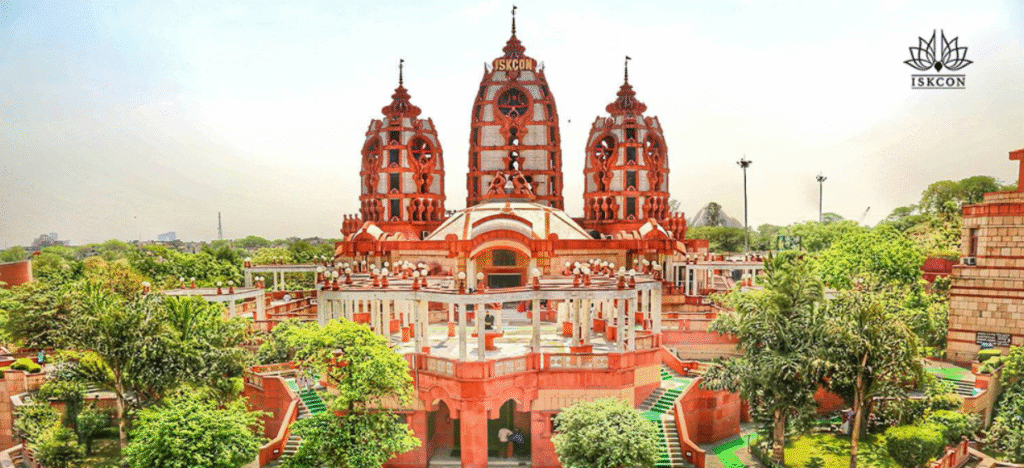
The layout follows a symmetrical composition, with the main temple at the center flanked by ancillary structures auditorium, museum, and administrative spaces. This symmetry reinforces order and stability, essential qualities in a place of worship.
Kanvinde’s genius lies in how he integrates functional zoning with spiritual progression. The temple complex operates as a living organism, accommodating worship, learning, and community activities without compromising the sanctity of the core.
5. The Language of Form
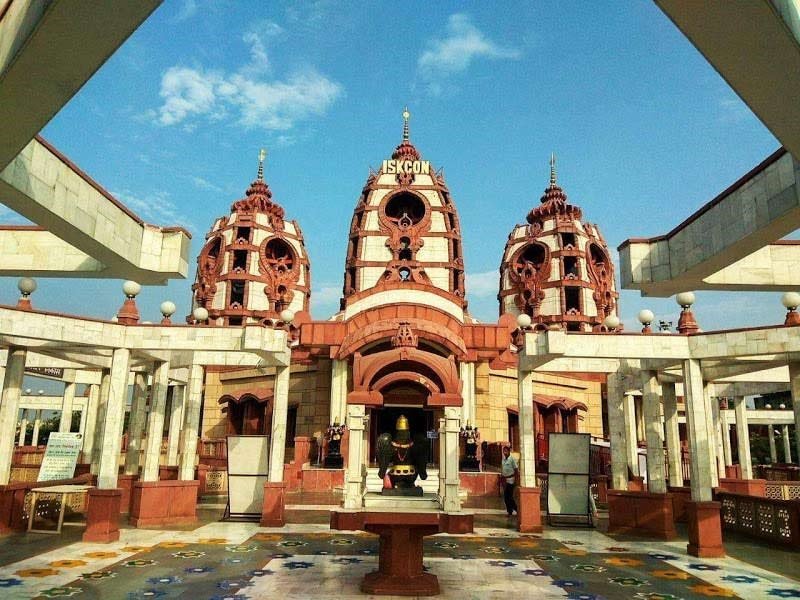
Kanvinde’s design vocabulary is modernist, but it speaks fluently in an Indian accent. The temple’s three soaring shikharas (spires) are abstracted interpretations of the traditional Hindu temple form. They are not literal reproductions of Nagara or Dravidian typologies; instead, they are sculptural expressions of aspiration reaching skyward, yet rooted in geometric order.
These spires rise from a base defined by strong horizontal planes terraces, parapets, and colonnadescreating a rhythmic dialogue between verticality and horizontality. The composition achieves both monumentality and restraint, qualities Kanvinde mastered through decades of designing institutional architecture.
The use of reinforced concrete and stone cladding is deliberate. Concrete offers structural freedom and durability; stone provides texture and timelessness. Yet, neither material dominates. They coexist in quiet harmony, each fulfilling its role without ostentation.
Light, as always in Kanvinde’s architecture, is the true ornament. Skylights and clerestory openings wash the interiors with diffused daylight, animating the surfaces and accentuating the spiritual ambiance. As the sun moves, so does the mood turn the temple into a living sundial of devotion.
6. Material as Medium, Not Message
This is where Kanvinde’s philosophy shines most clearly. In the ISKCON Temple, materials are not on display; they are in service of the experience.
He avoids polished opulence or decorative extravagance. Instead, surfaces are tactile, honest, and modest. Concrete walls express their grain; stone cladding reveals its texture. The material palette is restrained muted tones that allow the play of light and shadow to become the main visual drama.
In doing so, Kanvinde achieves something rare: a sacred architecture that feels modern without feeling cold, minimal without being austere. The materials dissolve into the experience they are not the story, but the paper on which the story is written.
The temple proves his statement: architecture is not a museum of materials because meaning cannot be manufactured; it must be felt.
7. The Human Experience
Kanvinde often said that architecture must be experienced at human scale no matter how monumental the form. The ISKCON Temple captures this principle beautifully.
The pathways are proportioned to encourage pause and reflection. The courtyards open up to the sky, reminding one of the cosmic dimension of faith. Even the stairs and railings feel designed to guide, not intimidate.
Inside, the sanctum sanctorum (garbhagriha) is neither dark nor enclosed; it glows with filtered daylight. The devotee is not crushed under grandeur but uplifted by light and proportion. The result is a democratization of sacred space everyone, from the curious visitor to the lifelong devotee, can find comfort here.
Kanvinde’s temple is thus a living dialogue between humanism and divinity, between structure and spirit.
8. The Modern Indian Temple Typology
In the broader context of Indian temple architecture, Kanvinde’s ISKCON Temple is a bold reinterpretation. Traditionally, Hindu temples are designed as cosmic diagrams complex compositions governed by Vastu Purusha Mandala, ornamentation, and symbolic iconography.
Kanvinde distills these elements into spatial principles rather than decorative gestures. The mandala becomes a geometric order guiding movement and hierarchy. The shikhara becomes a sculptural form expressing spiritual ascent. The ornament becomes light itself.
In doing so, he bridges tradition and modernity in a way that few have managed. His temple is neither nostalgic nor iconoclastic. It respects the essence of Hindu sacred architecture without replicating its historical forms.
This approach also aligns with ISKCON’s global vision a faith rooted in Indian philosophy but reaching a worldwide audience. Kanvinde’s modern vocabulary makes the temple both contextual and universal.
9. Light, Space, and Spirit
Light in Kanvinde’s architecture is never accidental. He used it as a structural material, shaping space through illumination rather than decoration.
In the ISKCON Temple, light orchestrates emotion. Morning light enters softly, creating an atmosphere of awakening; afternoon light intensifies, dramatizing the shikharas; evening light glows warmly through the stained glass, creating intimacy.
The play of light transforms the temple throughout the day, reinforcing the cyclical nature of devotion. The worshipper becomes aware not of the material surfaces but of the immaterial presence the divine.
This mastery of light is perhaps Kanvinde’s greatest tool against the idea of architecture as material display. Where others use marble to impress, he uses light to inspire.
10. Function and Faith
Kanvinde never saw faith and function as opposites. His buildings for education, research, and religion all share the same DNA: clarity, order, and purpose.
The ISKCON Temple complex includes not only the main shrine but also facilities for cultural events, dining, administration, and guest accommodation. Each function is housed with dignity but without excess. Circulation is logical; spaces flow naturally.
This reflects his belief that a temple is not merely a place of worship it is a community center, a space for dialogue between the sacred and the social. The architecture facilitates this without fanfare.
Even at its busiest moments festivals, processions, or lectures the temple maintains spatial coherence. That balance between order and emotion is pure Kanvinde.
11. Aesthetic Restraint as Spiritual Expression
Kanvinde’s restraint is not minimalism for its own sake it’s spiritual discipline. Like a monk’s vow of simplicity, his architecture expresses faith through purity of intent.
In a time when many religious structures were becoming theatrical showcases of marble, gold, and glass, Kanvinde’s ISKCON Temple stood apart as a quiet revolution. Its beauty lies in proportion, its richness in light.
The simplicity of materials allows visitors to focus on what truly matters the experience of being. This is architecture as meditation.
12. Legacy and Lessons
The ISKCON Temple, Delhi, continues to attract thousands of visitors daily. Many come for devotion, others for curiosity but all leave touched by the space’s serenity.
For architects, the temple offers a profound lesson: the future of design lies not in invention of form but in rediscovery of meaning.
Kanvinde’s philosophy remains deeply relevant today, when architecture often oscillates between technological spectacle and nostalgic imitation. His work reminds us that authenticity is not about style or material, but about integrity of thought.
When he said, “Architecture is not a museum of materials,” he was reminding his peers and perhaps us that architecture’s true material is human experience.
13. A Personal Reflection
Walking through the ISKCON Temple, one realizes how Kanvinde’s work transcends time. The building does not scream for attention; it listens. It listens to the light, the chants, the footsteps, the silences.
There’s a profound humility in its composition a humility that invites participation rather than awe. You don’t feel small before it; you feel centered within it. That’s the genius of Kanvinde: he designs not monuments to ego, but spaces for empathy.
His temple does not demand reverence it creates it naturally, through balance, scale, and spirit.
14. The Quote, Revisited
Now, with the ISKCON Temple as witness, Kanvinde’s quote reads less like a critique and more like a prayer:
“Architecture is not a museum of materials.”
It means architecture is not about collecting textures like trophies. It’s not about showcasing luxury or technology. It’s about crafting experiences that outlast their materials.
Concrete may crumble, stone may weather, but the light that falls through a thoughtfully placed opening the feeling it evokes remains eternal.
In that sense, Kanvinde’s architecture achieves what all great art aspires to: it disappears, leaving behind only the experience.
15. Conclusion: The Spirit of the Structure
Achyut Kanvinde’s ISKCON Temple in Delhi is more than a place of worship; it’s a meditation in concrete and light. It embodies his lifelong pursuit to create architecture that is rational yet poetic, modern yet spiritual, modest yet monumental.
By refusing to turn architecture into a “museum of materials,” Kanvinde reaffirmed its true purpose: to serve life, not to showcase it. His temple is a reminder that spirituality need not be marble-clad to be majestic; sometimes, it can be cast in concrete and still touch the divine.
In a world that often equates beauty with extravagance, Kanvinde’s temple stands as a quiet counterpoint a testament to truth, restraint, and timelessness.
For those who listen closely, the building whispers his philosophy through every shadow, every echo, every shaft of sunlight:
Architecture, when honest, does not need to flaunt its materials.
It needs only to reveal its soul.