~Louis Kahn Architecture is often thought of as a language a language of form, proportion, and light. But Louis I. Kahn, one of the twentieth century’s most poetic architects, went further. For him, materials themselves were capable of speech. “Material is what we make it speak,” he once said a phrase that is as mystical …

~Louis Kahn
Table of Contents
- 1. The Poet of Concrete
- 2. The Context of the Salk Institute
- 3. Making Material Speak
- 4. The Silence Between Walls
- 5. The Soul of Structure
- 6. The Meeting of Science and Spirit
- 7. Material and Light: A Sacred Dialogue
- 8. The Human Dimension
- 9. The Timelessness of Honesty
- 10. Lessons from the Salk Institute
- 11. The Spiritual Core of Kahn’s Architecture
- 12. Conclusion: When Buildings Breathe
Architecture is often thought of as a language a language of form, proportion, and light. But Louis I. Kahn, one of the twentieth century’s most poetic architects, went further. For him, materials themselves were capable of speech. “Material is what we make it speak,” he once said a phrase that is as mystical as it is technical, as philosophical as it is practical.
In that simple sentence lies Kahn’s entire architectural worldview: that materials have a voice, an inherent dignity, and an emotional potential that must be honored, not exploited. The architect’s task, then, is not to manipulate materials into submission, but to listen to discover what they wish to say and to amplify that truth through design.
And nowhere does that philosophy find more eloquent expression than in the Salk Institute for Biological Studies, his monumental masterpiece perched on the cliffs of La Jolla, California. In this project, concrete and travertine stone become more than construction components they become instruments in a symphony of silence, light, and thought.
To understand this quote, we must first understand the man who uttered it and the world he built around his words.
1. The Poet of Concrete
Louis Kahn was not a man of small thoughts. Born in Estonia in 1901 and raised in Philadelphia, he spent his career seeking the soul of architecture. His work was modernist in form but classical in spirit. While his contemporaries were racing toward steel-and-glass minimalism, Kahn was searching for timelessness a sense of permanence that could connect modern life to the ancient human impulse to build.
When Kahn spoke of materials “speaking,” he wasn’t being metaphorical for the sake of art. He meant it literally. He believed every material whether brick, concrete, or wood possessed an inherent will, a certain truth of being. “You say to brick, ‘What do you want, brick?’” Kahn famously said. “‘Brick says, I like an arch.’ And you say to brick, ‘Look, I want one too, but arches are expensive, and I can use a concrete lintel.’ And then brick says, ‘I know, but I like an arch.’”
This dialogue captures the essence of Kahn’s philosophy: that architecture is not an act of domination over matter but a conversation with it. The architect must become a kind of translator between human need and material nature giving form to both.
For Kahn, materials were not neutral. They had memory, gravity, and spirit. To make them “speak” meant to give them presence to reveal their strength, texture, and integrity in ways that touched both mind and emotion.
2. The Context of the Salk Institute
In the early 1960s, Kahn was commissioned by Dr. Jonas Salk the virologist who developed the polio vaccine to design a new research institute in California. Salk’s vision was not just for a laboratory complex but for a place of inspiration a setting that would nurture scientific creativity and contemplation.
Salk wanted a place where, as he put it, “a scientist could feel like a monk.”
That phrase must have delighted Kahn, for it echoed his own belief in the sacredness of space that even in buildings of science or industry, architecture could evoke reverence. The Salk Institute would therefore not only house laboratories; it would embody the very idea of inquiry a temple of thought.
The site chosen for the project was extraordinary: a high bluff overlooking the vast Pacific Ocean in La Jolla, California. Standing there, one could feel the boundlessness of the horizon the infinite space where science meets nature. Kahn’s challenge was to build a frame for infinity.
3. Making Material Speak
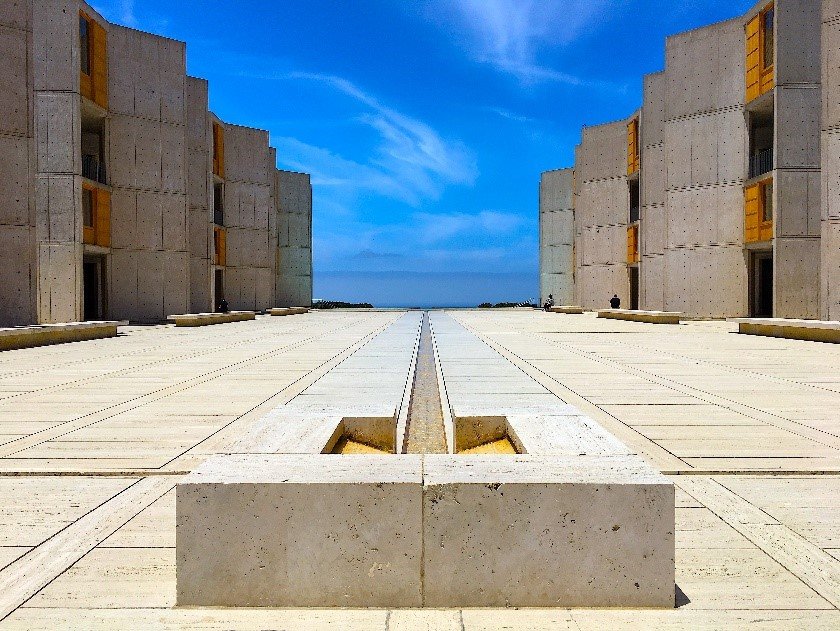
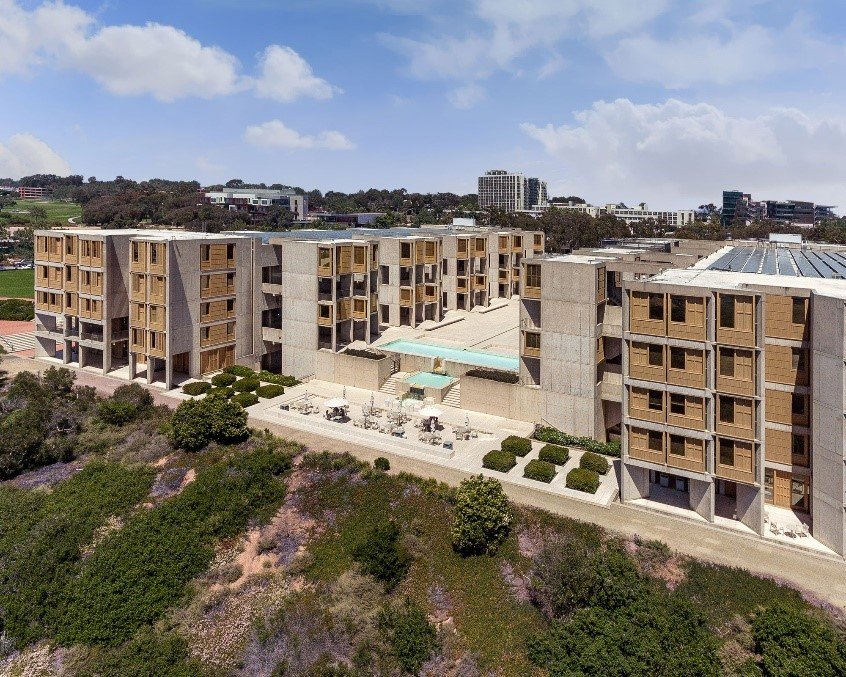
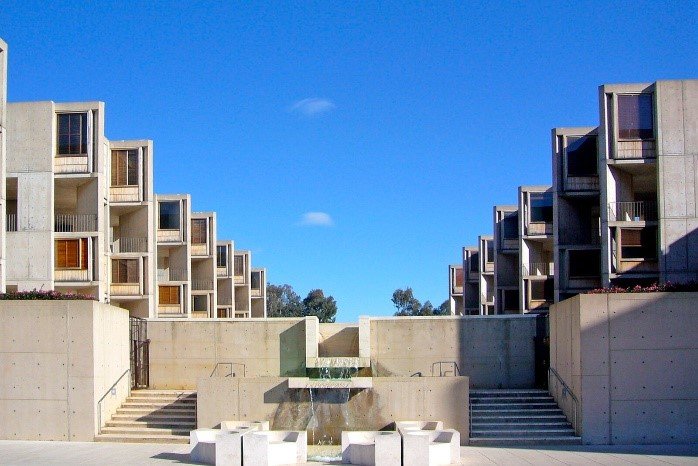
Kahn began by stripping away everything that was not essential. The resulting design is disarmingly simple yet profoundly moving. Two identical laboratory blocks stand on either side of a long central courtyard, open toward the ocean. Between them flows a thin channel of water a rill of pure geometry guiding the eye toward the horizon.
It is an act of breathtaking restraint. No ornamentation, no visual noise. Just form, proportion, and light.
Here, concrete becomes the primary voice. But it is not the cold, gray concrete of industrial modernism. Kahn’s concrete is warm, tactile, almost human. He treated it with reverence mixing it with volcanic ash to achieve a golden tone, leaving the wooden grain of the formwork visible on its surface. In doing so, he let the material tell its own story: the marks of its making, the truth of its casting, the honesty of its texture.
The result is concrete that speaks not of heaviness, but of quiet strength; not of raw utility, but of serene permanence.
Complementing the concrete is travertine stone, used for the courtyard floor. Its pale surface reflects the shifting sky, creating a dialogue between earth and air. Together, concrete and travertine form a perfect duet solid yet luminous, grounded yet transcendent.
This is what Kahn meant by making material speak. He did not decorate them; he gave them voice.
4. The Silence Between Walls
In Kahn’s architecture, silence is not emptiness it is the presence of the infinite. The spaces between his walls are charged with an almost spiritual energy, as if the air itself were part of the structure.
At the Salk Institute, the central courtyard known as the “Plaza” is the purest expression of this philosophy. It is utterly empty, save for the linear water channel that bisects it. Yet this emptiness is not absence; it is fullness. It allows light to move, wind to flow, and thought to expand.
Here, the materials withdraw just enough to let light take center stage. The travertine glows under the sun, the concrete walls capture shadow like an ancient ruin. The water line becomes a mirror, doubling the sky. In this play of elements stone, light, water, air one feels the architecture speaking in a language older than civilization itself.
And yet, every proportion, every joint, every texture is meticulously designed. The materials do not perform; they converse.
5. The Soul of Structure
Kahn believed that the structure of a building was its spiritual anatomy its inner truth made visible. He once said, “Structure is the giver of light.” That statement feels almost mystical, but it was deeply architectural.
At the Salk Institute, the structure is expressed with absolute clarity. The laboratories are open, column-free spaces supported by massive concrete frames. The service towers that flank them containing stairs, ducts, and utilities are treated not as afterthoughts but as sculptural elements, integral to the composition.
There is no attempt to hide or disguise. Pipes, joints, beams all are visible, honest, unapologetic. Kahn’s approach dignifies even the most utilitarian components. In his hands, mechanical systems become part of the poetry of the building.
This structural honesty is a form of moral integrity. It is the architect’s way of saying, “I will not make materials lie.” The building stands naked before the light proud of its making, certain of its purpose.
6. The Meeting of Science and Spirit
Dr. Salk’s hope that scientists would “feel like monks” was not misplaced. Walking through the Salk Institute, one senses a sacred stillness. The laboratories, bathed in natural light, feel less like workplaces and more like sanctuaries for inquiry.
Kahn’s careful orchestration of light and material turns the act of research into a ritual of discovery. The concrete surfaces absorb the quiet hum of thought; the travertine reflects the rhythm of time. Even the ocean becomes a collaborator its presence felt through the open courtyard, always there, always vast.
This is not architecture that preaches it contemplates. It doesn’t dictate what one should feel; it creates the conditions in which one can feel deeply.
Through this, Kahn achieves what very few architects ever do: he transcends function without denying it. The Salk Institute is both laboratory and monastery, both instrument and poem.
7. Material and Light: A Sacred Dialogue
To Kahn, light was not just illumination; it was the origin of form. He said, “The sun never knew how great it was until it struck the side of a building.” That poetic insight reveals how he saw materials as vessels for light.
At the Salk Institute, light is sculpted with as much care as concrete. The laboratories are designed with clerestory windows that admit soft, indirect light perfect for research and contemplation. The courtyard, meanwhile, is open to the sky, where light transforms the travertine into a living surface that changes by the hour.
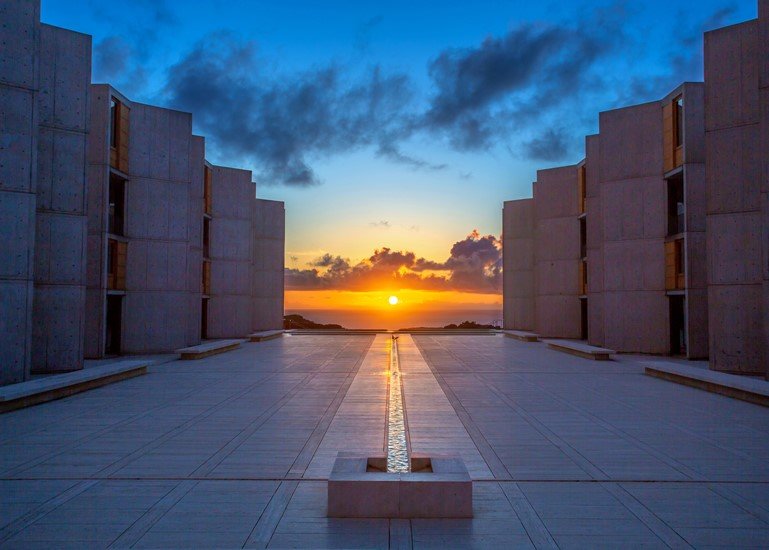
In the late afternoon, the sun sets directly along the water channel, turning it into a river of gold that seems to flow toward eternity. It is one of the most powerful architectural experiences in the world a moment when material and light become one, and the building speaks without words.
This is the ultimate expression of Kahn’s quote. Materials speak when they allow light, shadow, and space to express their full potential. Architecture speaks when its silence moves you.
8. The Human Dimension
For all its monumental power, the Salk Institute is deeply human. Kahn’s design gives every scientist access to light and view, recognizing that creativity thrives in connection with nature. The courtyards and terraces encourage informal gatherings, moments of reflection, and spontaneous conversation.
Even the tactile quality of the materials contributes to this humanity. The rough concrete feels grounded, the smooth travertine cool underfoot. These sensory experiences connect the users to the building in a way that polished luxury never could.
Kahn’s architecture does not impress through scale alone; it invites through intimacy. It creates spaces where people can think, feel, and belong.
That is the moral of his material philosophy: to make material speak is to make it speak to people, not just to architects.
9. The Timelessness of Honesty
More than sixty years after its completion, the Salk Institute still feels both ancient and modern as if it has always existed, waiting for human discovery. That sense of timelessness arises directly from its honesty of material.
Concrete and stone age gracefully because they were never forced to pretend. The marks of time weathering, patina, shadow become part of their story. Kahn understood that materials, like people, are most beautiful when they are true to themselves.
He often spoke of the difference between “form” and “design.” Design, he said, is the circumstantial the immediate solution to a problem. But form is the eternal the essence that transcends time and place. By letting materials speak, he believed architecture could touch form, not just design.
The Salk Institute achieves precisely that. It is not a style; it is a statement of being. It does not belong to an era; it belongs to the continuum of human creation.
10. Lessons from the Salk Institute
What makes the Salk Institute so endlessly relevant is that it teaches us a lesson that modern architecture too often forgets: restraint is power.
In an age of digital tools, parametric façades, and extravagant materials, Kahn’s quiet concrete masterpiece feels almost radical. It reminds us that architecture’s deepest beauty lies not in what is added, but in what is revealed.
His quot “Material is what we make it speak” is therefore a call to listen. To listen to the grain of wood, the weight of stone, the texture of earth, the way light caresses a wall. It’s an invitation to design with empathy not just for the user, but for the material world itself.
For architects, this means resisting the temptation to treat materials as branding tools or aesthetic trophies. Instead, it means asking: What does this material want to be? How does it behave under light, weather, and time? How does it participate in the life of a building?
Kahn’s architecture is a reminder that beauty does not come from control, but from collaboration with nature. The architect is not a sculptor imposing form; he is a listener discovering truth.
11. The Spiritual Core of Kahn’s Architecture
Though Kahn’s work was secular in function, it was profoundly spiritual in spirit. The Salk Institute, the Kimbell Art Museum, the National Assembly Building in Dhaka all share a quiet holiness born from truthful materials and luminous space.
He often spoke of the difference between “a building that serves” and “a building that inspires.” The former fulfills a need; the latter fulfills a calling. The Salk Institute does both.
Standing in its courtyard, one cannot help but feel that Kahn succeeded in building what Salk dreamed of a place where science meets soul. Every wall, every shadow, every glint of light participates in a dialogue older than architecture itself the dialogue between matter and meaning.
“Material is what we make it speak” is therefore not just a design principle it is a spiritual creed. It’s the belief that truth has texture, and that beauty begins when we allow the world to reveal itself honestly.
12. Conclusion: When Buildings Breathe
At the end of his life, Kahn was still sketching ruins fascinated by how ancient structures, stripped of function, still possessed profound presence. He once said, “A great building must begin with the unmeasurable, must go through measurable means when it is being designed, and in the end must be unmeasurable.”
The Salk Institute embodies that journey perfectly. It begins with an unmeasurable vision a place where scientists could think like monks. It goes through measurable precision concrete ratios, light studies, and structural logic. And it ends, finally, in the unmeasurable in awe.
In that space, as sunlight slides down the concrete walls and the Pacific stretches into forever, one realizes that materials truly can speak. They can whisper stories of time, gravity, and grace. They can remind us that architecture, at its best, is not a product but a prayer.
Louis Kahn gave materials a language, and through them, he gave architecture its soul.
So when he said, “Material is what we make it speak,” he wasn’t just talking about construction. He was talking about the possibility of poetry in concrete, of silence in stone, of life in light.
In the Salk Institute, that poetry still speaks softly, clearly, eternally.