As architects, we are often confronted with paradoxes. Few are as daunting as the challenge of building something enormous while making it feel intimate, of creating a symbol for a nation while ensuring it remains human in scale, of accommodating 68,000 people yet making each one feel at home. The Japan National Stadium, completed in …
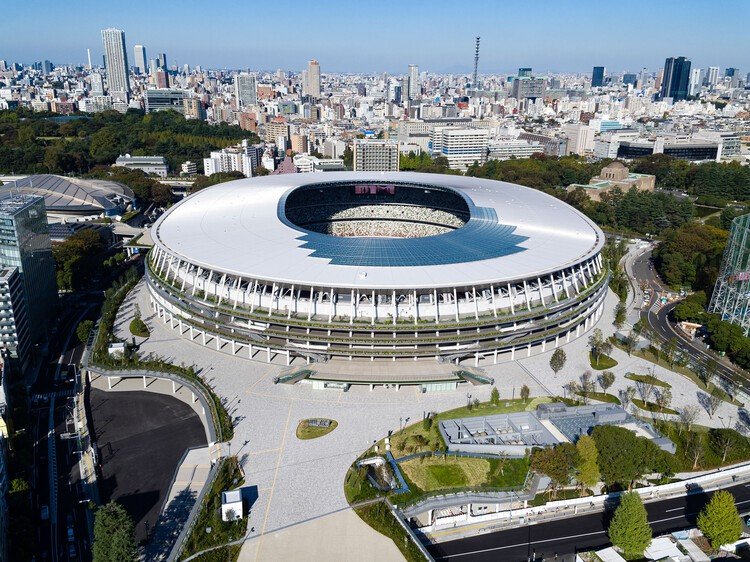
As architects, we are often confronted with paradoxes. Few are as daunting as the challenge of building something enormous while making it feel intimate, of creating a symbol for a nation while ensuring it remains human in scale, of accommodating 68,000 people yet making each one feel at home. The Japan National Stadium, completed in 2019 for the Tokyo Olympics and designed by Kengo Kuma, is an extraordinary resolution of such paradoxes.
When I first encountered the stadium, it did not feel like a monument in the way most Olympic structures do. It did not roar, it whispered. It did not rise to dominate the skyline, but instead sank softly into its surrounding greenery. At first glance, it seemed to be less a singular object and more an extension of the landscape itself. For me, as an architect, this was revelatory: here was a structure that rejected the ego of monumentality in favor of humility, belonging, and openness.
The Challenge of a Stadium
Stadiums are often problematic architectural types. They are vast in scale, consuming enormous amounts of resources, and too often become white elephants after the events they are built for. They impose themselves on cities, dominating their neighborhoods with concrete shells and asphalt deserts. Designing such a structure in the heart of Tokyo a city of intricate streets, intimate neighborhoods, and layered histories posed immense challenges.
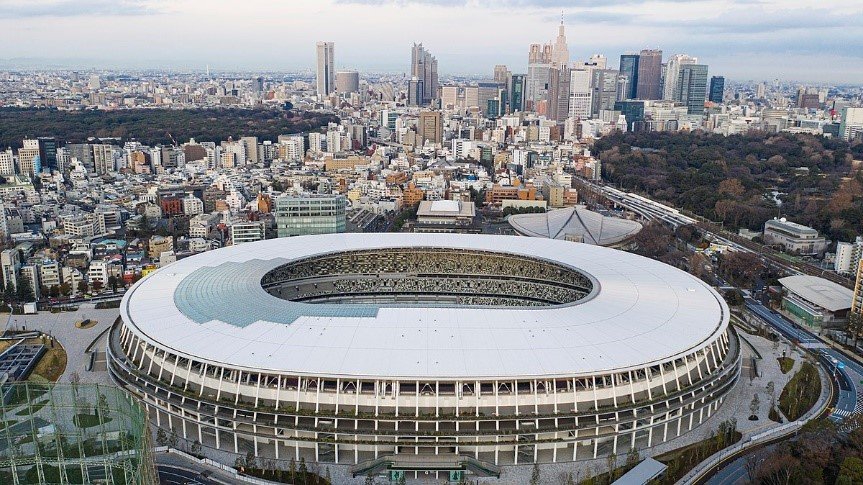
New national stadium Tokyo
Kengo Kuma approached this challenge not with a desire to impress through size or technological bravado, but with a quiet determination to weave the stadium into its context. He called the concept a “living tree,” and that metaphor captures both the form and the philosophy behind the project. Rather than treating the stadium as an isolated object, Kuma imagined it as a natural organism, rooted in place, growing upward with layers of timber and greenery.
Materiality: Wood as Memory and Symbol
The most striking aspect of the Japan National Stadium is its extensive use of timber. At first, the idea of cladding such a massive structure in wood might seem counterintuitive after all, wood is fragile compared to steel and concrete. Yet Kuma’s decision was both poetic and practical.
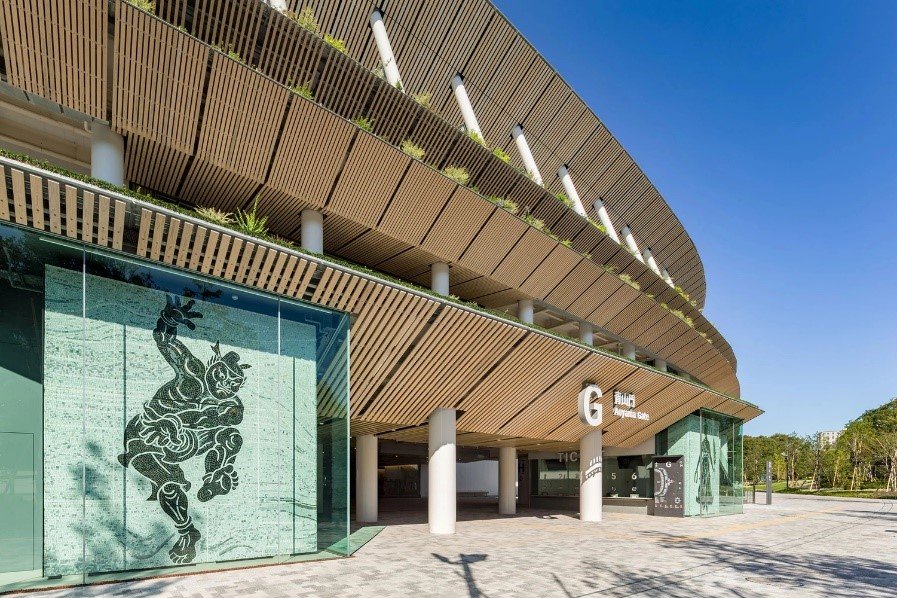
The timber was sourced from all 47 prefectures of Japan, symbolizing national unity. Each prefecture contributed wood, ensuring that the stadium was not just a Tokyo project but a collective gift from the entire country. This act of sourcing material became symbolic architecture in itself: the building embodied Japan as a whole.
Technically, the timber was not structural but used as cladding for the layered eaves. Its presence softens the building’s scale and texture. Instead of an intimidating concrete mass, the stadium presents warm horizontal bands of wood, echoing the eaves of traditional Japanese temples and shrines. For me, this was a masterstroke: by evoking cultural memory, Kuma ensured that the building feels both modern and timeless, both global and deeply local.
Scale and Humanization
One of the greatest achievements of the stadium is how it manages its colossal scale. Most stadiums loom oppressively, but Kuma fragmented the facade into horizontal layers of eaves, each lined with greenery. This breaks down the vertical scale, allowing the building to step gently into its surroundings. From street level, the structure feels surprisingly approachable.
As an architect, I am fascinated by how Kuma manipulates perception. He knows that people rarely perceive a building as a whole; they experience it in fragments, at eye level, as they move. By layering timber and plants at multiple levels, Kuma creates a constantly shifting experience. One moment, you see a vast roof floating like a canopy. The next, you notice a delicate detail in the joinery of the wood. This oscillation between macro and micro scales is what makes the stadium feel both monumental and intimate.
Integration with Nature
Perhaps the most radical aspect of the stadium is its embrace of nature. The layered eaves are not only clad in timber but also planted with vegetation. Native species from different regions of Japan were chosen to reflect seasonal change and local ecology. Walking around the stadium, one experiences it less as a building and more as a vertical garden, breathing with the city.
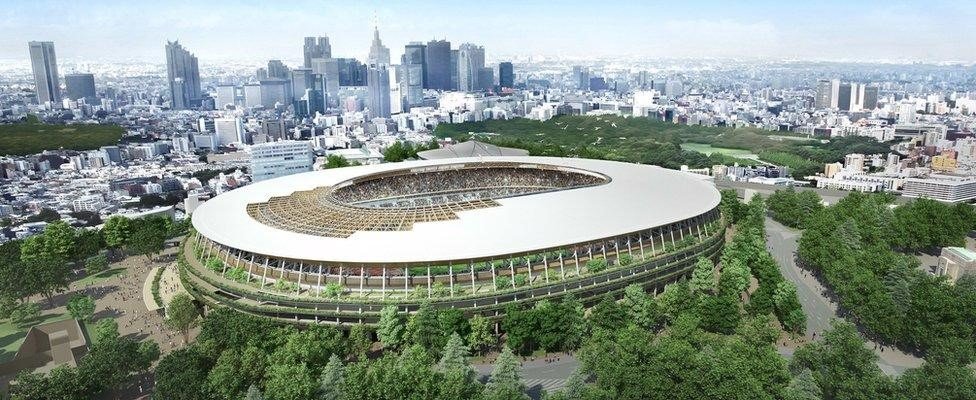
Kuma has often spoken about “dissolving architecture” into the environment. The Japan National Stadium is a powerful realization of that idea. The building does not assert itself against the trees of Meiji Jingu Shrine or the greenery of its park surroundings it joins them. From a distance, the roofline almost disappears into the horizon of trees. For a stadium of this scale to achieve such invisibility is remarkable.
The Roof as Sky
The roof, designed in collaboration with structural engineer Takeshi Obayashi, is another marvel. Made of lightweight steel trusses and clad in wood, it spans the massive bowl while appearing deceptively delicate. Large openings at the edges allow natural ventilation, reducing the reliance on air-conditioning. This is not merely an engineering feat but an environmental gesture.
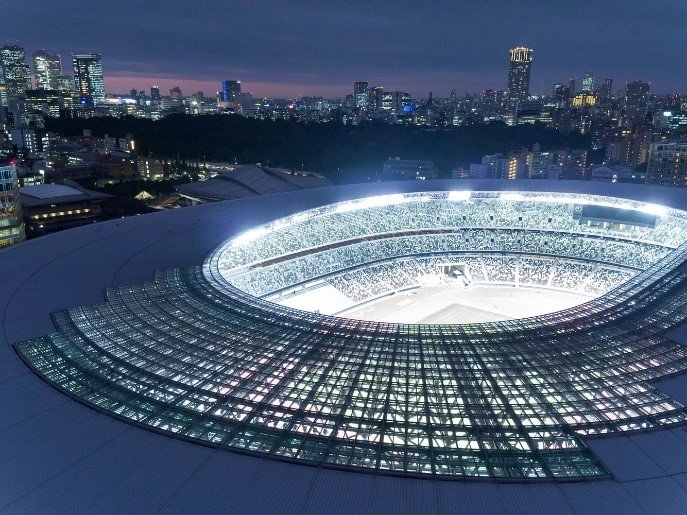
Standing beneath the roof, one feels sheltered but not enclosed. It frames the sky rather than blocks it. During events, the sound of the crowd rises into this canopy, amplifying the sense of being part of something larger yet still connected to nature. From an architect’s perspective, this is a profound achievement: the roof transforms an arena into a sky-filled space, blurring the line between inside and outside.
Sustainability and Climate Response
In an era of climate crisis, the environmental performance of such a massive building is critical. Kuma’s design employs multiple strategies: natural ventilation, shading from the deep eaves, and the cooling effect of greenery. The use of wood also reduces the carbon footprint compared to all-concrete or all-steel construction.
But beyond technical performance, the stadium’s very philosophy of openness is ecological. By inviting wind to flow through and plants to grow on its facade, the building participates in the cycles of nature. It does not stand apart from its environment but becomes an extension of it.
Cultural Symbolism
Architecture for the Olympics is always symbolic. It must stand as a representation of the host nation to the world. In this regard, Kuma’s stadium is a quiet yet profound statement about Japan.
Rather than pursuing futuristic spectacle, the design looks to tradition. The layered eaves recall temple roofs, while the timber references centuries of Japanese craftsmanship. The greenery reflects Shinto reverence for nature. At the same time, the structure is undeniably contemporary, with advanced engineering and global-scale ambition. In this balance of old and new, local and global, the stadium encapsulates Japan’s cultural identity: rooted in heritage, yet open to innovation.
Experience as Architecture
Ultimately, architecture is not about images but about experience. Walking toward the Japan National Stadium, one does not feel the anxiety that often accompanies massive structures. Instead, there is curiosity, warmth, even calm. The wooden eaves cast gentle shadows; the greenery sways in the wind. The approach feels like moving through a landscape rather than approaching a fortress.
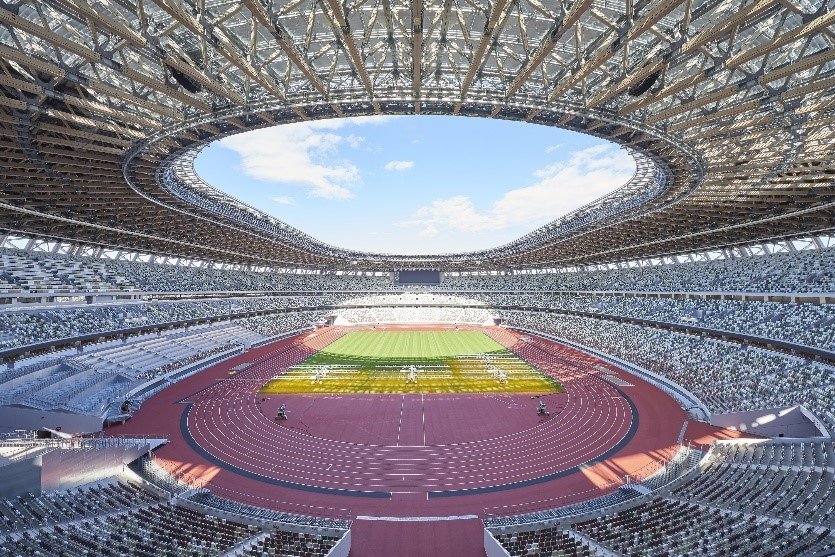
Inside, the bowl embraces rather than overwhelms. The sightlines are clear, the acoustics amplified naturally by the roof. Yet what lingers most is not a sense of engineering but of atmosphere the openness to sky, air, and people. Kuma has created not just a place for sports, but a civic space, a gathering ground where architecture becomes the background to collective experience.
Lessons for Architects
From an architect’s perspective, the Japan National Stadium teaches several lessons.
First, scale can be humanized. Even the largest structures can feel intimate if their mass is fragmented, layered, and textured.
Second, symbolism can be authentic. By drawing from tradition timber, eaves, greenery Kuma created a national icon without resorting to cliché or spectacle.
Third, sustainability is not only about technology but about philosophy. A building that opens to wind, light, and nature inherently consumes less and gives more.
Finally, architecture is most powerful when it disappears. Kuma often speaks of “anti-object” the idea that buildings should not be dominant objects but part of a larger environment. The Japan National Stadium embodies this perfectly. It is less a monument to the ego of architecture and more a humble stage for human life.
Conclusion
The Japan National Stadium stands as a profound achievement in contemporary architecture. It demonstrates that even the most daunting of building types a vast Olympic arena can be designed with humility, openness, and sensitivity. By using timber from across Japan, by layering eaves that evoke tradition, by integrating greenery that breathes with the city, Kengo Kuma has redefined what a stadium can be.
For architects, the lesson is clear: greatness does not come from size alone. It comes from belonging, from listening, from dissolving boundaries. The Japan National Stadium does not dominate Tokyo it harmonizes with it. It does not shut itself off from wind or people it welcomes both.
In a time when architecture is too often about spectacle, this stadium reminds us of another possibility: architecture as harmony, as continuity, as life itself. To stand in its presence is to feel the truth of Kuma’s words architecture should be open to the wind, and open to the people.