With this single line, Japanese architect Kengo Kuma captures the essence of his lifelong pursuit: an architecture that dissolves boundaries, embraces nature, and welcomes community. In a world where buildings are often celebrated for scale, spectacle, or technological bravado, Kuma’s work stands apart for its humility. His projects do not seek to dominate the landscape …
With this single line, Japanese architect Kengo Kuma captures the essence of his lifelong pursuit: an architecture that dissolves boundaries, embraces nature, and welcomes community. In a world where buildings are often celebrated for scale, spectacle, or technological bravado, Kuma’s work stands apart for its humility. His projects do not seek to dominate the landscape but to belong within it; they do not exclude but invite.
Openness, in Kuma’s philosophy, is not a stylistic gesture but an ethical one. To be open to the wind is to acknowledge the role of climate as a collaborator in design. To be open to the people is to ensure that architecture serves life in all its unpredictability, rather than dictating it. Together, these ideas form the core of Kuma’s design language a language that is at once ancient and contemporary, rooted in tradition yet resolutely forward-looking.
The Philosophy of Openness
For Kuma, wind represents more than airflow or ventilation. It is a metaphor for freedom, impermanence, and the invisible forces that shape human experience. Buildings that resist the wind through sealed facades, excessive air-conditioning, or rigid geometries often lose their connection to nature. By contrast, buildings that invite wind into their courtyards, verandas, and porous facades become living organisms, animated by the changing environment.
Equally, people are not mere occupants of architecture but its co-creators. A building open to people is one that allows adaptation, appropriation, and improvisation. It does not impose a single, fixed mode of use; instead, it provides stages for countless acts of everyday life. In this way, Kuma redefines architecture not as a static object but as a dynamic condition, always shaped by its users.
Asakusa Culture and Tourism Center (Tokyo, 2012)
Situated in one of Tokyo’s most crowded districts, the Asakusa Culture and Tourism Center could easily have been an imposing urban structure. Instead, Kuma stacked seven “house-like” volumes on top of one another, each slightly shifted to break the monotony of a tower. The result is a building that feels human in scale, even as it rises above the street.
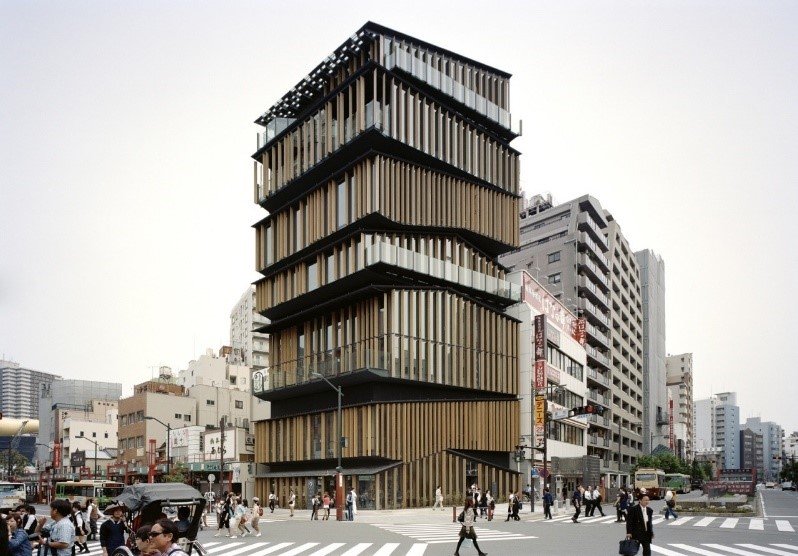
The Asakusa Culture and Tourism Center
Large openings, deep eaves, and terraces allow wind and light to flow naturally through the building. Just as importantly, the building is not an exclusive monument it is open to both visitors and locals. Its public spaces, viewing decks, and ground-floor lobby serve as points of gathering and orientation. By reframing the typology of a tourism center, Kuma makes it less about information and more about experience an architecture where wind and people are equally welcome.
Sunny Hills Store (Tokyo, 2013)
In the Sunny Hills Store, Kuma demonstrates how even a small commercial building can embody the principle of openness. The store, which sells pineapple cakes, is wrapped in a delicate wooden lattice inspired by traditional Japanese joinery. The structure filters sunlight and channels breezes, creating a space that feels both sheltered and permeable.
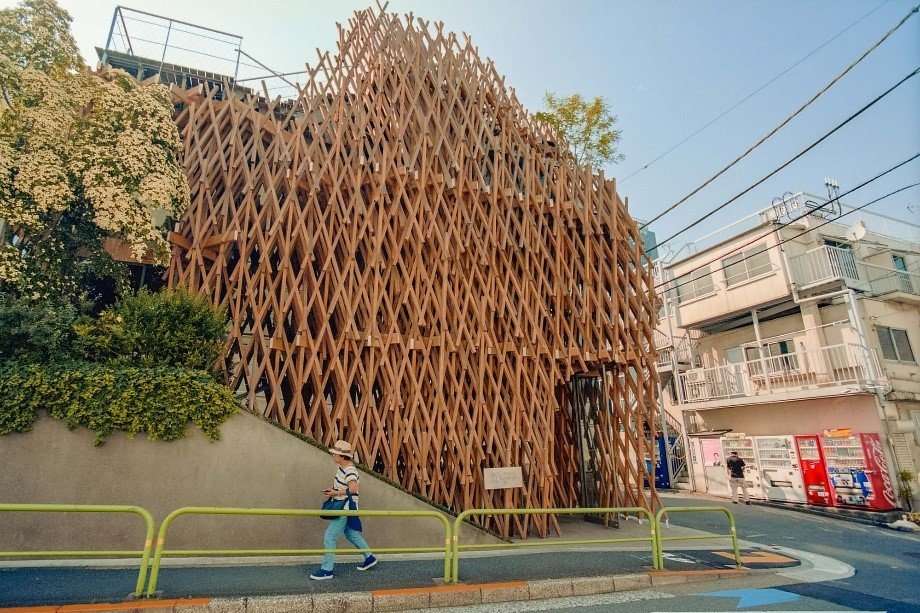
SunnyHills | Aoyama
The openness is not only physical but also social. The lattice invites curiosity from passersby, blurring the boundary between interior and exterior. Customers do not simply enter a shop; they step into an environment where the act of hospitality is expressed architecturally. By weaving craft, climate, and community into a single design, Kuma transforms a retail space into a generous gesture.
V&A Dundee (Scotland, 2018)
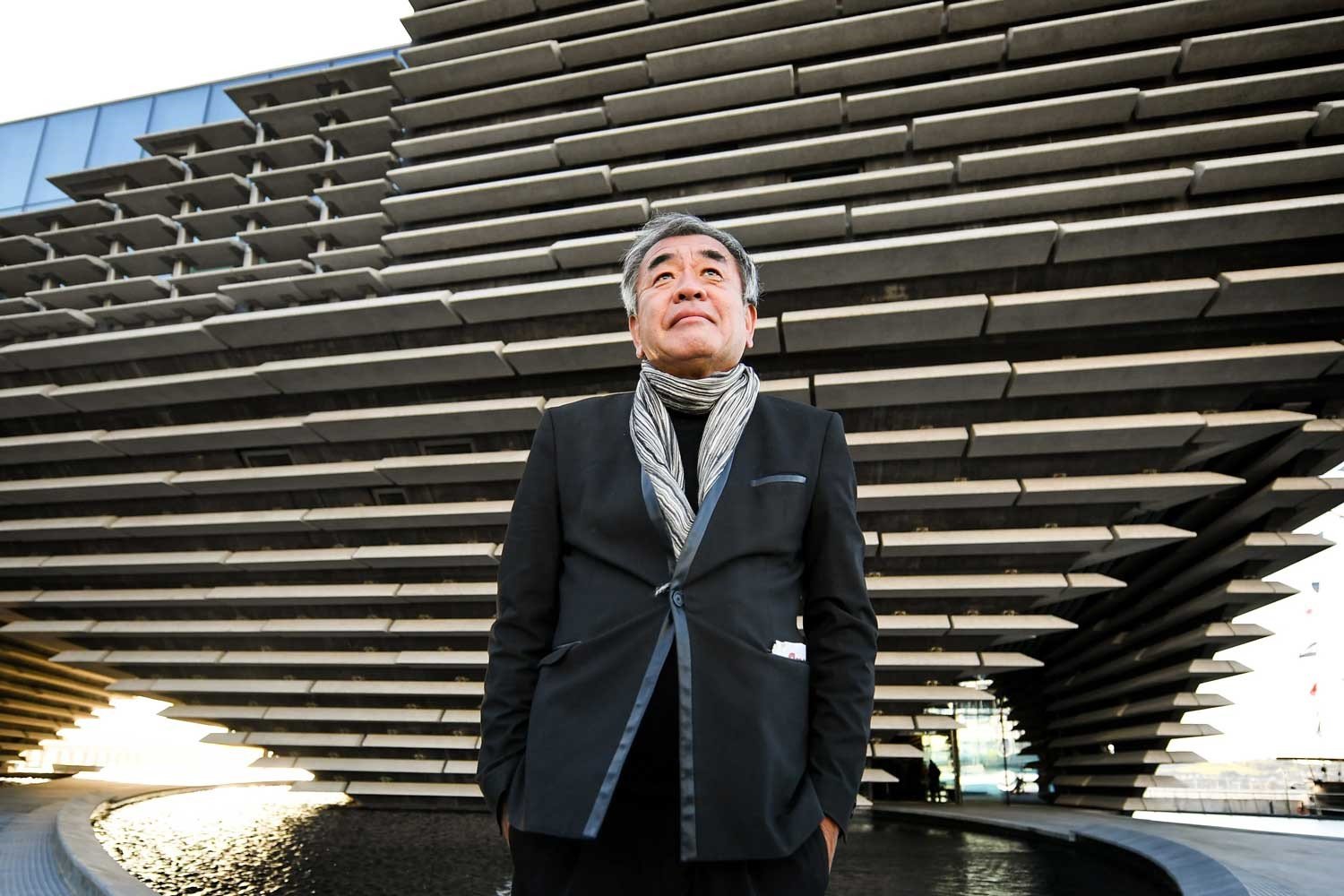
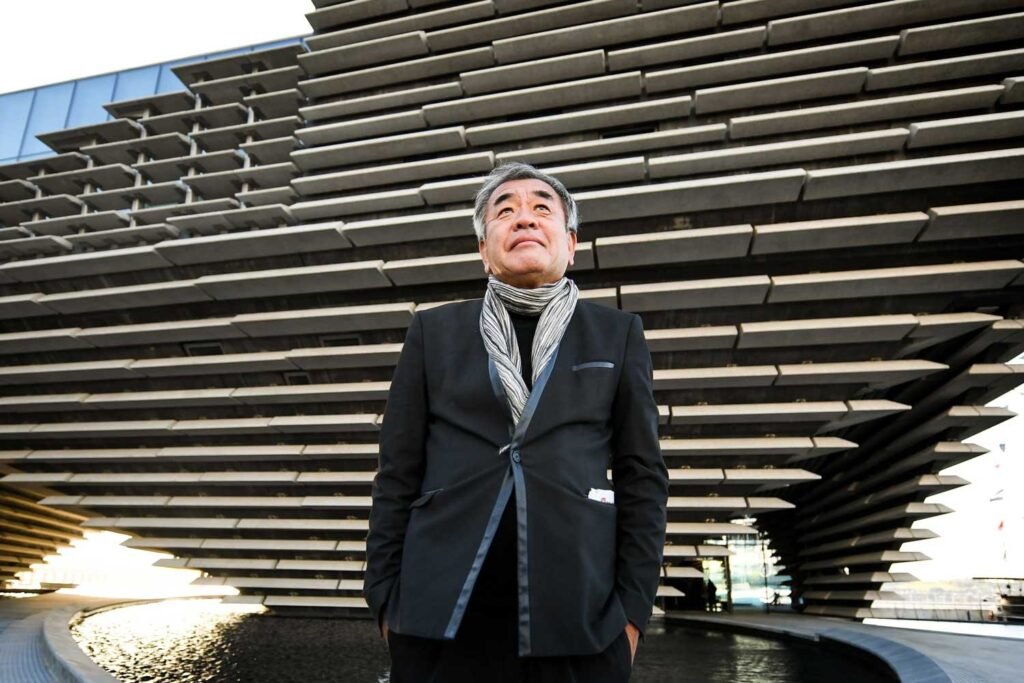
When designing the V&A Dundee, Kuma turned to the rugged cliffs of the Scottish coastline for inspiration. The museum’s horizontal concrete panels extend outward like strata eroded by wind and water, creating deep crevices that capture shifting light and shadow. The form appears less like a building imposed on the landscape and more like a geological condition shaped over centuries.
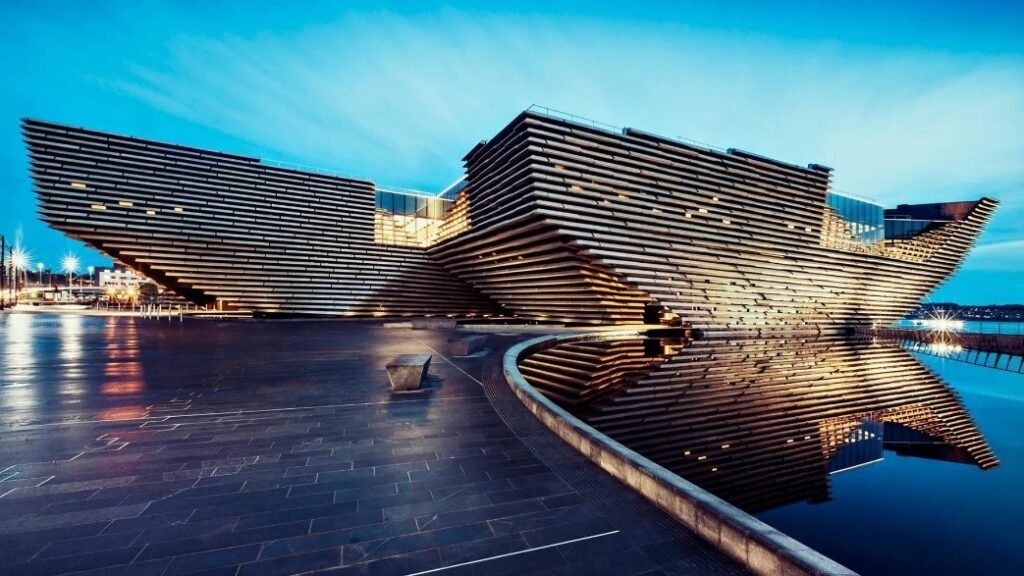
Unlike many museums that present themselves as closed cultural fortresses, the V&A Dundee is porous at ground level. The public can walk beneath its elevated form, engaging with the building without the need for a ticket. In this way, the museum becomes part of the city’s civic fabric open not only to its collections but to the people of Dundee themselves.
Japan National Stadium (Tokyo, 2019)
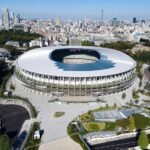
Perhaps the most ambitious expression of Kuma’s philosophy is the Japan National Stadium, built for the Tokyo 2020 Olympics. Tasked with designing a massive structure in the heart of the city, Kuma resisted the temptation to create a monumental icon. Instead, he conceived the stadium as a “living tree,” wrapping it in layers of timber eaves and planting greenery across its tiers.
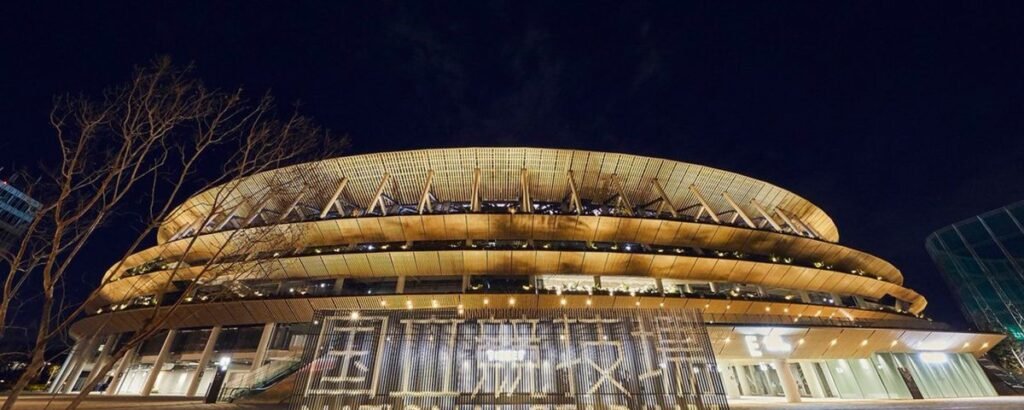
Japan National Stadium
By using wood sourced from all of Japan’s 47 prefectures, the project symbolically opened itself to the entire nation. The layered eaves soften the scale of the stadium, allowing breezes to move through while reducing the visual heaviness of its form. Though vast in size, the building feels grounded, rooted in both tradition and environment. Rather than dominating Tokyo, it bows gently to it.
Lessons in Openness
Across these projects, certain principles emerge. Openness to the wind requires designing with climate in mind: orienting buildings to capture breezes, using porous materials, and carving voids that act as courtyards or atriums. Openness to the people means rethinking thresholds not as barriers, but as invitations. Lobbies become plazas, steps become seating, terraces become gathering spaces.
This dual openness creates architecture that is not only sustainable but also humane. In an era of climate change, reliance on passive strategies such as ventilation, shading, and permeability is essential. Equally, in a time of social fragmentation, creating spaces where people can meet, linger, and interact is a civic responsibility. Kuma’s work shows that these goals are not separate but intertwined: by designing for wind, one designs for people; by designing for people, one designs in harmony with nature.
The Challenges of Openness
Of course, openness is not without its challenges. In dense urban environments, questions of privacy, security, and efficiency often push architecture toward enclosure. Developers may prioritize rentable area over shared space; clients may demand sealed facades to maximize climate control. Yet Kuma’s work demonstrates that openness need not be absolute it can exist in degrees. A screen that filters air and light, a terrace that extends the boundary between inside and outside, a ground-level passage that connects city and building these are subtle but powerful ways to remain open within constraint.
Toward the Future
Kengo Kuma’s words resonate far beyond Japan. They suggest a future of architecture that is not about spectacle but about sensitivity. To be open to the wind is to embrace sustainability at its most fundamental level working with, not against, the environment. To be open to the people is to recognize that architecture is not an autonomous art form but a social stage.
As cities grapple with environmental and social challenges, Kuma’s philosophy offers a path forward. Buildings that breathe naturally reduce energy demands. Spaces that welcome people foster community and resilience. In this sense, openness is not only an aesthetic choice but an ethical imperative.
Conclusion
Kengo Kuma’s architecture embodies a quiet revolution. By dissolving boundaries, he creates spaces that are both deeply traditional and radically contemporary. Whether in the bustling streets of Asakusa, the quiet hospitality of a Tokyo shop, the windswept coast of Scotland, or the global stage of the Olympics, his projects remain consistent in their message: architecture should belong to the wind, and it should belong to the people.
In a world where buildings often seek permanence and control, Kuma’s work reminds us that true strength lies in openness. To design in this way is to accept the unpredictable, to welcome the ephemeral, and to trust in the life that architecture makes possible. His vision challenges not only architects but everyone who encounters his work to rethink what it means for a building to be alive.
To be open to the wind, to be open to the people this is not just Kuma’s vision. It may well be the future of architecture itself.