There are architects who design buildings, and then there are those who question what a building even is. Sou Fujimoto belongs firmly in the second camp. Born in Hokkaido, Japan in 1971, Fujimoto emerged as one of the most radical voices of his generation by asking a deceptively simple question: what does it mean to …
There are architects who design buildings, and then there are those who question what a building even is. Sou Fujimoto belongs firmly in the second camp. Born in Hokkaido, Japan in 1971, Fujimoto emerged as one of the most radical voices of his generation by asking a deceptively simple question: what does it mean to dwell? His answer is encapsulated in a phrase that sounds almost paradoxica “primitive future.” Through this lens, Fujimoto reimagines architecture not as the production of fixed forms or functional enclosures, but as a living, breathing field of possibilities a fluid negotiation between nature and structure, between the instinctual and the technological, between past and future.
In Fujimoto’s world, the primitive is not something archaic or regressive. It is the essential, the origin, the raw encounter between the human body and space. It recalls the first shelters of humankind the cave, the nest, the forest places where boundaries were vague, where people adapted to the contours of the environment rather than imposing geometry upon it. The “future,” on the other hand, represents our evolving relationship with technology, cities, materials, and each other. For Fujimoto, the two are not opposites but interdependent: the more we advance, the more we must return to that primal intimacy with space. His architecture proposes that the future of living is found in a renewed connection to our most ancient instincts to explore, to play, to seek shelter, to dwell freely in ambiguity.
This philosophy is not a purely abstract theory. It manifests tangibly in Fujimoto’s built works, where lightness, transparency, and spatial ambiguity redefine how people move, see, and interact. Through projects such as the Serpentine Pavilion in London and House N in Oita, Fujimoto crafts architectures of freedom open frameworks that invite discovery rather than dictate behavior. His designs are not merely physical shelters; they are spatial invitations to imagine new ways of living.
Fujimoto’s journey toward this “primitive future” began in the forests of Hokkaido, where he grew up surrounded by nature’s quiet intelligence. In interviews, he often recalls wandering through trees as a child, discovering the richness of spatial experience how a branch could become a roof, how sunlight filtered through leaves could define a room without walls. These memories profoundly shaped his architectural sensibility. When he later studied at the University of Tokyo, he became fascinated with how modern architecture had become obsessed with precision, function, and enclosure with drawing clear boundaries between inside and outside, between architecture and landscape. Fujimoto’s instinct was to question those boundaries. What if architecture could be porous, indeterminate, even wild? What if, instead of controlling nature, it could coexist with it even mimic its complexity?
His seminal book, Primitive Future, lays out these ideas in poetic terms. He speaks of the cave and the nest as two opposing yet complementary models of architecture. The nest represents the modern tradition carefully designed, purpose-built, enclosed. It is the architecture of control, efficiency, and order. The cave, by contrast, is the architecture of discovery. It is not designed for a particular function; instead, it offers a landscape of potential. In a cave, one finds niches, corners, gradients of light and shadow. People choose how to inhabit it according to their needs. Fujimoto sees this as a powerful metaphor for how architecture could evolve from rigid functionalism toward open-endedness, where inhabitants co-author their environments. The “primitive future,” therefore, is not a nostalgic return to caves but a reawakening of that spirit of adaptability, this time expressed through contemporary materials and forms.
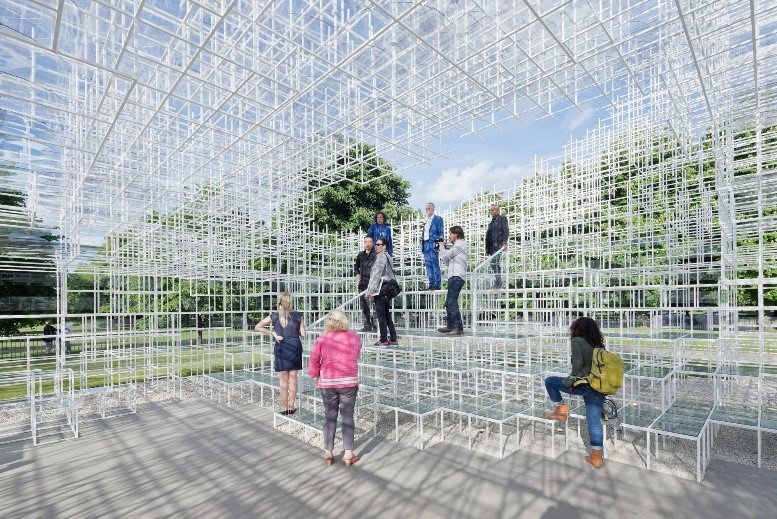
To see these ideas come alive, one need look no further than the 2013 Serpentine Gallery Pavilion in London perhaps Fujimoto’s most internationally celebrated project. Each year, the Serpentine Gallery invites an architect of global stature to design a temporary summer pavilion in Kensington Gardens, and Fujimoto’s proposal was unlike anything London had seen before. Rather than building a conventional enclosure, he created what he described as a “cloud” a delicate three-dimensional lattice made of thin white steel poles arranged in a cubic grid. The structure shimmered in the sunlight, hovering between visibility and invisibility. From a distance, it looked almost like a digital mist, a ghostly framework that both emerged from and dissolved into the surrounding landscape.
The genius of this pavilion lay in its ambiguity. It was simultaneously architecture and atmosphere, structure and sculpture, shelter and landscape. Visitors could climb onto its stepped grid, sit on its surfaces, or simply wander beneath it, discovering shifting perspectives at every turn. There were no prescribed paths, no doors, no walls only a continuous field of possibilities. The pavilion’s form encouraged a sense of exploration reminiscent of Fujimoto’s childhood walks through forests. Just as branches, leaves, and shadows define ever-changing territories, the lattice created gradients of enclosure and exposure. Light filtered through the steel matrix, creating dappled patterns that changed with the time of day and the weather.
What was radical about this pavilion was not its appearance but its attitude toward habitation. Fujimoto had designed an architectural condition rather than a building. It was an invitation for people to define their own relationship to space to climb, to rest, to play, to meet strangers. It transformed the very idea of architecture from a static object into a social and environmental experience. In doing so, it embodied his “primitive future” perfectly: a futuristic construction born from a primitive instinct to explore and inhabit.
The Serpentine Pavilion also embodied Fujimoto’s recurring interest in lightness and transparency both visual and conceptual. For him, lightness is not merely about reducing material mass but about increasing perceptual freedom. A light structure allows the mind to breathe, to imagine. Transparency, too, is not just a visual property but a social one a way of creating connections, overlaps, and encounters. In the pavilion, transparency erased the hierarchy between inside and outside, public and private, natural and artificial. One could see through layers of structure to the trees beyond, and the movement of people became part of the architecture’s living composition.
If the Serpentine Pavilion represented Fujimoto’s philosophy in a temporary, experiential form, his residential projects demonstrate how these ideas translate into daily life. Among them, House N in Oita stands out as a masterpiece of spatial thinking. At first glance, House N appears as a simple white box nested within another white box, and yet another three shells, each slightly offset from the other, creating a gradient from exterior to interior. But this simplicity hides a profound spatial complexity.
House N is not a house in the conventional sense; it is a series of thresholds. The outermost shell defines the boundary of the site yet remains permeable with large openings and courtyards. The middle shell encloses semi-private spaces such as living and dining areas, while the innermost shell contains the most intimate rooms. Between these layers are zones that are neither fully inside nor outside verandas, walkways, gardens. These in-between spaces are where the life of the house truly unfolds. They are not corridors or leftover spaces but places of encounter, rest, and reflection.
This layered composition captures Fujimoto’s fascination with ambiguity. The house refuses to draw a sharp line between nature and architecture. Instead, it stages a gradual transition, much like the way a forest shifts from clearing to canopy. Light filters through multiple layers of walls and openings, creating a subtle choreography of illumination and shadow. The residents experience changing degrees of openness throughout the day and across the seasons. What results is not a static interior but a dynamic environment that evolves with life itself.
In House N, Fujimoto challenges the traditional notion of rooms and functions. There are no strict divisions between kitchen, living room, or hallway. Spaces flow into one another, encouraging spontaneous behavior. A child might use a ledge as a playground, while an adult might find a corner perfect for quiet reading. The architecture accommodates multiple interpretations it is alive, adaptable, unfinished in the best possible way. In this sense, House N embodies the spirit of the cave: a landscape of potential rather than a plan of functions.
Perhaps what makes House N so resonant is how it reimagines the relationship between privacy and community. By opening the domestic realm to the outdoors, Fujimoto does not expose it; he enriches it. The gradation of shells allows for nuanced relationships moments of connection with neighbors and nature without loss of intimacy. In a society where modern life often isolates people behind walls and screens, Fujimoto’s architecture reminds us that true comfort may lie not in separation but in subtle openness, in the freedom to choose our own degree of exposure.
Another project that deepens this conversation is House NA in Tokyo. Here, Fujimoto takes the idea of transparency and freedom to an almost extreme degree. The house consists of a stack of transparent floor plates supported by thin columns and encased in glass. There are no internal walls, no clear rooms only a vertical landscape of platforms at varying heights, connected by ladders and stairs. The inhabitants, a young couple, live in a state of spatial fluidity, constantly redefining where and how they dwell. One might sleep on a mezzanine one night, work by the window the next, or invite friends for tea on an upper platform with a view of the street.
To an outsider, House NA might seem radical, even impractical. But Fujimoto sees it as a prototype for new urban living. In dense cities like Tokyo, where space is scarce and privacy paradoxical, traditional divisions between rooms may no longer make sense. House NA’s transparency creates a new kind of intimacy not the intimacy of enclosure, but of awareness. The residents are always in visual contact with each other and with the city, yet they can find solitude in the vertical layering of space. It is a home that functions more like a tree, with branches and perches rather than rooms and corridors.
This comparison is not accidental. Fujimoto often uses the metaphor of the forest or the treehouse to describe his ideal architecture spaces where structure and freedom coexist. In nature, order and randomness intertwine beautifully; there is pattern but also infinite variation. His architecture seeks the same balance. The house as tree, the city as forest these are recurring motifs in his thought. They express a vision of architecture as part of a larger ecological continuum rather than an isolated object.
Across all these works, a few themes recur consistently: lightness, transparency, ambiguity, and play. Lightness, for Fujimoto, is an ethical as well as aesthetic value an antidote to the heaviness of modern life and architecture. His buildings seem to float, not because they deny gravity, but because they align with the natural flow of light and air. Transparency is his way of reconnecting people to their surroundings. It allows the city or landscape to infiltrate architecture, blurring distinctions and creating mutual awareness. Ambiguity is the space of freedom the refusal to define, to constrain, to predetermine how people must live. And play perhaps the most human of all instincts is the ultimate goal. For Fujimoto, architecture should encourage curiosity, interaction, and joy.
These ideas resonate deeply in an age when architecture often swings between spectacle and efficiency. Fujimoto’s work reminds us that the real innovation lies not in new materials or technologies, but in new relationships between humans and space, between architecture and nature. His “primitive future” is less a style than an attitude: one of openness, humility, and rediscovery.
In recent years, Fujimoto’s philosophy has found expression in larger-scale projects as well, such as the L’Arbre Blanc residential tower in Montpellier, France. This striking building, co-designed with other architects, takes the metaphor of the tree literally its balconies extend like branches, creating a porous interface between individual apartments and the city. Once again, Fujimoto explores how architecture can mediate between private and public, between structure and landscape. Even in high-density urban contexts, he insists on porosity, lightness, and interaction.
At the core of all his work is a belief that architecture should not dictate behavior but inspire it. Instead of designing “perfect” spaces, Fujimoto designs frameworks for life structures that adapt, evolve, and invite participation. In this sense, he shifts architecture from the language of control to the language of possibility. The role of the architect, he suggests, is not to prescribe but to propose, not to define boundaries but to open them.
What makes Fujimoto’s philosophy particularly powerful is its humanism. Despite his futuristic aesthetics, he is not seduced by technology for its own sake. His buildings may appear ethereal, but their essence is deeply human. He designs for the body, for movement, for perception. He understands that space is not only physical but emotional that how we experience light, shadow, openness, and proximity shapes our sense of belonging.
In a world where architecture often becomes a vehicle for spectacle or commercial ambition, Fujimoto’s work stands as a quiet yet radical reminder: the most advanced architecture might be the one that feels most natural. His “primitive future” is not about returning to the past but about rediscovering what makes us human our curiosity, our adaptability, our desire for connection. It is about creating spaces that do not imprison us in function but liberate us to inhabit them as we wish.
Perhaps that is the true legacy of Sou Fujimoto: he teaches us to see architecture not as an object but as an environment, not as a solution but as a question. His buildings ask us to reconsider the boundaries we take for granted between inside and outside, between home and city, between structure and landscape, between ourselves and others. In doing so, they open a space for imagination, empathy, and play.
To walk through a Fujimoto building is to enter a world where the familiar becomes strange and the strange becomes inviting. It is to experience architecture not as a finished product but as a living dialogue between past and future, between human and nature, between what is and what could be. In that delicate space of “in-between,” where steel becomes mist and walls become air, we glimpse the essence of Fujimoto’s vision: a future that is as open, light, and free as the first shelter humankind ever built a cave, a tree, a cloud.
That is Sou Fujimoto’s “primitive future”: a return to beginnings in order to imagine what comes next. His work invites us not merely to inhabit buildings but to rediscover the act of inhabiting itself as a form of exploration, as a dance with light and air, as a timeless play between nature and architecture. And perhaps, as Fujimoto would suggest with his quiet smile, that is the most human thing of all.