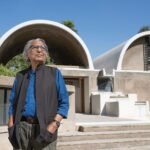
~Tadao Ando In an age when architecture often shouts for attention, Tadao Ando whispers. His buildings are not spectacles of glass and steel, but meditations carved in concrete and light. They do not overwhelm you; they invite you to pause, breathe, and feel. When Ando says, “I create enclosed spaces mainly to produce the emptiness …

~Tadao Ando
In an age when architecture often shouts for attention, Tadao Ando whispers. His buildings are not spectacles of glass and steel, but meditations carved in concrete and light. They do not overwhelm you; they invite you to pause, breathe, and feel.
When Ando says, “I create enclosed spaces mainly to produce the emptiness inside,” he reveals the soul of his work. It is not the walls, the materials, or even the form that define his architecture it is the emptiness that lives within them. To him, space is not something to be filled, but something to be revealed.
This idea finds its most profound and distilled expression in his Church of the Light (1989) a small concrete chapel in Ibaraki, Japan, that has become one of the most spiritually charged buildings of the modern world. But before we step into that sacred silence, we must first understand what Ando means by emptiness.
1. The Meaning of Emptiness
In Western thought, emptiness often suggests absence a lack of something, a void that must be filled. But in the Japanese aesthetic tradition, emptiness or Ma is the opposite. It is not nothingness; it is potential. It is the pause between two breaths, the silence that gives meaning to sound, the space that makes form alive.
Ando draws deeply from this philosophy. To him, architecture is not about adding more, but about removing carving, refining, and distilling until only the essential remains. The enclosed space becomes a vessel for light, shadow, and reflection. The walls do not confine; they contain silence.
When Ando speaks of producing emptiness, he is not talking about physical voids. He means a psychological and spiritual spac a place where the mind can quiet itself, where the soul can awaken to light, time, and self-awareness.
His architecture does not try to entertain; it asks you to be still.
2. The Architect and His Journey
Ando’s path to architecture was unconventional. He was a self-taught architect, a former boxer who traveled the world studying buildings by observing, sketching, and feeling them. His lack of formal education freed him from academic rigidity he learned architecture by walking through it.
This physical, almost bodily understanding of space shaped his design philosophy. He believed that architecture should be experienced, not merely viewed. The way you move through it, the way light touches your skin, the way sound echoes these sensations are as important as form itself.
In his early works, Ando experimented with the relationship between inside and outside, solid and void, darkness and illumination. Gradually, his buildings became meditations on light and emptiness the invisible forces that give meaning to material form.
By the time he designed the Church of the Light, he had already mastered the art of using minimal means to evoke maximum emotion.
3. Understanding the Quote
“I create enclosed spaces mainly to produce the emptiness inside.”
This sentence is almost paradoxical. Enclosure and emptiness seem opposed one defines presence, the other absence. Yet, for Ando, they are inseparable. Without walls, there can be no space; without emptiness, walls have no meaning.
Ando uses enclosure not to trap space, but to frame it to give emptiness a shape. His architecture acts like the pause in a piece of music a controlled silence that makes the melody resonate.
The “emptiness inside” is not a void to be feared; it is a spiritual fullness that emerges when distraction disappears. By creating minimal, enclosed spaces, Ando helps people encounter the essential light, air, sound, and themselves.
This is where architecture becomes philosophy and in the case of the Church of the Light, where it becomes prayer.
4. The Site and the Vision
In 1988, the small Christian community of Ibaraki, near Osaka, approached Tadao Ando to design a new church. They had a modest budget, a small plot of land, and a big challenge: how to create a place of worship that would reflect the sacredness of faith in an increasingly secular, urban environment.
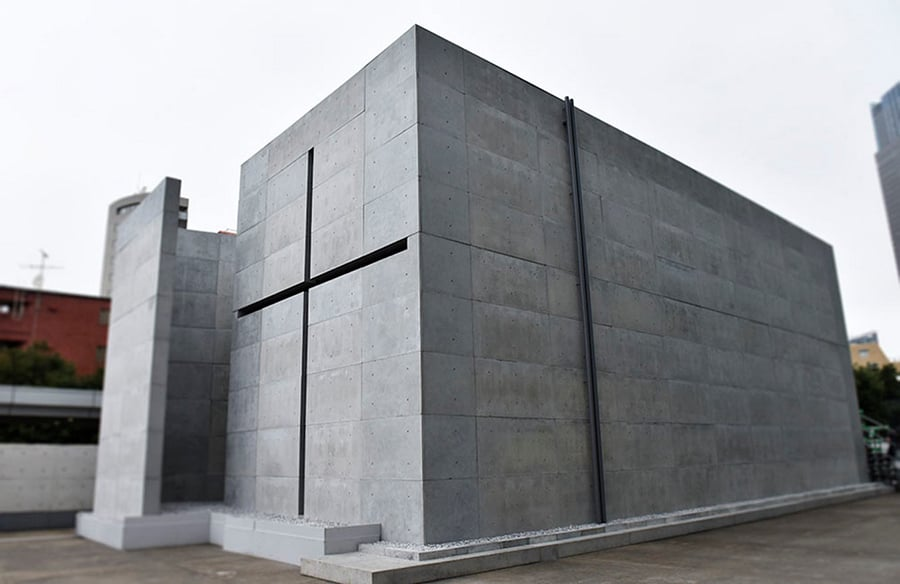
Ando accepted the challenge, but instead of designing a grand, ornate church, he envisioned something radical a simple box of raw concrete intersected by light itself.
The church, completed in 1989, measures barely 6 by 18 meters smaller than many living rooms. Yet within that narrow, enclosed space, Ando created an experience so powerful that it feels infinite.
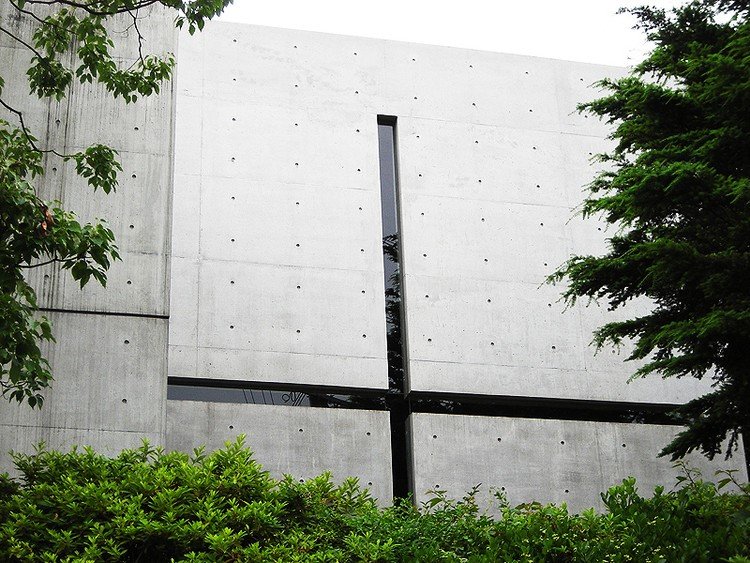
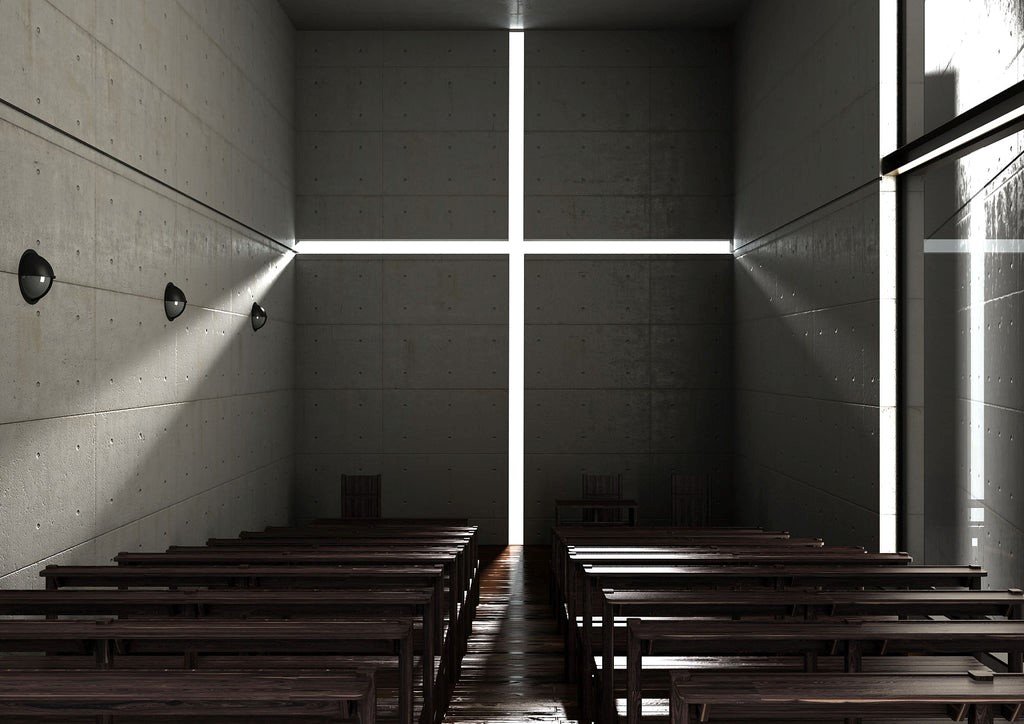
The design is astonishingly simple: a rectangular volume sliced by a diagonal wall that separates the entrance corridor from the main sanctuary. At the far end, two narrow slits intersect to form a cross of light, cutting through the concrete wall and illuminating the darkness within.
This single gesture a cross made not of matter, but of absence transforms emptiness into revelation.
5. Light as Structure
In most buildings, light is an afterthought something to be controlled or distributed. In the Church of the Light, light is the main material. The building’s walls, roof, and floor exist only to shape and direct it.
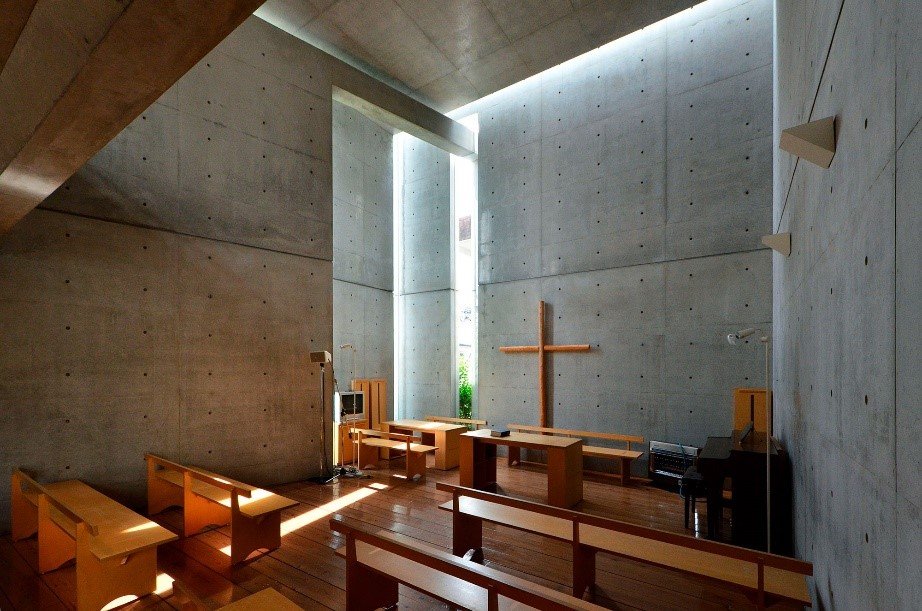
During the day, light filters through the cruciform opening, projecting a glowing cross onto the floor and walls. As the sun moves, the light shifts, dissolving and reforming, transforming the static concrete box into a living organism.
This light is not decorative; it is spiritual. It embodies the duality at the heart of Ando’s philosophy the dialogue between solid and void, matter and spirit.
By enclosing the space in darkness, Ando allows light to speak. The absence of ornament, color, or texture intensifies the experience. You become acutely aware of your senses the faint echo of footsteps, the softness of light, the weight of silence.
The emptiness inside becomes a mirror, reflecting your own presence back to you.
6. Concrete and Faith
Ando’s material of choice bare reinforced concrete is often seen as cold and industrial. Yet in his hands, it becomes warm, human, and almost sacred. He treats concrete as if it were paper or clay, shaping it with precision, polishing its surface until it feels like skin.
In the Church of the Light, concrete takes on the role of a monk’s robe plain, modest, and disciplined. It hides nothing. Every joint, every mark, every shadow is visible. Ando’s perfectionism in casting those smooth planes mirrors his belief that spirituality lies in discipline and restraint.
The concrete enclosure isolates you from the world outside, but it also heightens your connection to what’s within. Its silence amplifies the faintest sound; its weight makes the light more ethereal. The material and the immaterial coexist like body and soul.
7. The Journey of Approach
Ando choreographs the experience of entering his buildings as carefully as a film director composes a scene. At the Church of the Light, the approach is crucial.
You don’t simply walk through a door. Instead, you move along a diagonal path defined by an angled concrete wall that partially obscures the entrance. The route slows you down, forcing you to turn, to adjust, to become conscious of movement.
This simple detour is deeply symbolic. It represents the journey from the profane to the sacred, from distraction to focus. You leave behind the noise of the outside world, and with each step, the air grows quieter, the light dimmer, until you cross into darkness.
And then, there it is the cross of light, piercing the shadow like revelation. It is not merely seen; it is felt.
This procession transforms architecture into ritual. The building itself becomes a spiritual teacher, guiding you inward.
8. Emptiness as Presence
Once inside, there is almost nothing to look at no icons, no stained glass, no ornate altar. Just the bare floor, the rough pews, and the luminous cross. Yet the space feels full full of meaning, of stillness, of awareness.
This is the paradox of Ando’s architecture: emptiness becomes presence. The absence of distraction heightens perception. You notice how light falls, how shadows breathe, how silence deepens.
In this emptiness, every subtle detail matters. The air itself feels sculpted. Time slows down. You begin to feel part of something larger a universal rhythm that transcends religion, culture, or language.
Ando once said that his goal is to “restore the spiritual dimension of architecture.” In the Church of the Light, he succeeds not by adding symbols, but by creating emptiness a vessel for the sacred to enter.
9. The Cross of Light
The cruciform opening at the east wall is the chapel’s defining feature simple, direct, and profound. It is both void and vision.
Unlike traditional churches where the cross is a solid, carved symbol, Ando’s cross is made of absence a subtraction rather than an addition. It’s not imposed on the space; it is the space.
As sunlight enters through the cross, it transforms into a living presence, reminding visitors that divinity cannot be held by matter. The cross of light becomes a metaphor for faith itself invisible, intangible, yet utterly real.
When you sit quietly inside, you realize that the cross doesn’t just illuminate the space; it illuminates you. It becomes a mirror of consciousness a gentle, wordless sermon on the nature of light and soul.
10. The Dialogue Between Opposites
Throughout the Church of the Light, Ando explores dualities light and darkness, solid and void, silence and sound. But these opposites are not in conflict; they complete each other.
Without darkness, light has no power. Without enclosure, emptiness cannot exist. Without silence, sound loses meaning.
This balance reflects not only Ando’s architectural philosophy but also the broader Zen Buddhist worldview, where harmony arises from the tension between opposites.
The church thus becomes more than a religious building it becomes a cosmic diagram, expressing the unity of contradictions that defines life itself.
11. The Human Experience
Despite its austerity, the Church of the Light is profoundly human. Its scale is intimate; its proportions resonate with the body. The light shifts with the time of day, making each visit unique.
You don’t simply see the building you inhabit its silence. The architecture invites contemplation without instruction, allowing each visitor to find their own meaning. Some feel awe; others feel peace; some even feel discomfort in the confrontation with emptiness.
And that’s precisely the point. Ando doesn’t design to please; he designs to awaken. His buildings are not passive shelters but active participants in human transformation.
12. The Role of Nature
Though made entirely of concrete, the Church of the Light is deeply connected to nature. The cross allows sunlight and even wind to enter the space; the sound of rain or birds filters through faintly from outside.
Ando often says that architecture should be a “dialogue with nature.” In this building, that dialogue happens through light. The concrete walls act as the ground, while light becomes the sky.
This synthesis between the man-made and the natural transforms the church into a bridge between earth and heaven, matter and spirit.
Nature, for Ando, is not something outside the building; it’s the very essence that breathes within it.
13. Minimalism with Meaning
Minimalism is often misunderstood as emptiness without depth a style of subtraction for aesthetic effect. But for Ando, minimalism is ethical, not stylistic. It’s about stripping away excess until only truth remains.
The Church of the Light is minimal not because of budget or trend, but because anything more would distract from the essence. Every line, every shadow, every surface exists for a reason.
This purity is what gives the building its timelessness. Decades after its construction, it still feels contemporary not because of technology, but because it deals with eternal questions: How does light shape space? How does silence shape thought? How does emptiness awaken spirit?
14. The Emotional Resonance
Architecture at its highest level does not merely provide function; it evokes emotion. The Church of the Light accomplishes this without any overt gestures.
People who visit often describe feeling a deep calm, even if they are not religious. The light seems to wash away noise, the silence feels compassionate rather than cold. In that moment, you understand what Ando means by producing emptiness he is producing presence through absence.
This emotional resonance is rare in contemporary architecture, where form often overshadows feeling. Ando reminds us that the greatest spaces are not those filled with objects, but those that allow reflection.
15. Lessons for Contemporary Architecture
In today’s world of overstimulation where buildings compete for attention through height, color, and novelty Ando’s work stands as a quiet rebellion. It asks us to slow down and rediscover the power of simplicity.
“I create enclosed spaces mainly to produce the emptiness inside” becomes not just a personal philosophy but a lesson for the entire discipline. Architecture’s purpose is not to fill the world with more, but to help people feel more deeply with less.
The Church of the Light proves that architecture can achieve transcendence not through scale or ornament, but through light, proportion, and stillness. It shows that spirituality is not the monopoly of religion it can arise from the sheer discipline of design.
16. A Personal Encounter
Standing inside the Church of the Light, you feel suspended between material and immaterial worlds. The raw concrete walls are so solid that they ground you; the light cross is so intangible that it uplifts you. Between them, you find yourself small, silent, and awake.
The emptiness is not intimidating; it’s liberating. It clears away the clutter of thought. You realize that architecture, at its most profound, does not teach you about buildings; it teaches you about yourself.
Ando has said that he wants his architecture to make people “confront the existence of the self.” In this tiny church, that confrontation happens quietly, through light falling on your face.
It’s humbling and unforgettable.
17. Beyond Religion
Although designed for a Christian congregation, the Church of the Light transcends religious boundaries. Buddhists, atheists, artists, and architects alike find meaning in its emptiness.
This universality comes from Ando’s belief that spirituality is not about doctrine but about experience. The act of being still, of witnessing light move through darkness, connects all humans.
Thus, the building becomes a universal temple not of any one faith, but of awareness itself.
18. Form, Light, and Silence
Ultimately, the Church of the Light represents the perfect synthesis of Ando’s three obsessions: form, light, and silence.
Form provides the framework pure geometry, strong and quiet.
Light animates it shifting, breathing, alive.
Silence completes it giving the visitor space to listen inward.
Together, they create an architecture that feels eternal, beyond style or time.
When Ando speaks of creating emptiness, he means creating a condition where these forces can converge where architecture becomes a vessel for the invisible.
19. The Legacy of Emptiness
The Church of the Light has inspired generations of architects not because of its scale or complexity, but because of its clarity of vision. It demonstrates that architecture’s ultimate goal is not expression, but essence.
Ando’s quote continues to resonate in an age of digital overload. It reminds us that space real, physical, breathing space is sacred. That silence and emptiness are not voids to be avoided, but foundations for meaning.
As cities become louder and denser, Ando’s architecture stands as a kind of antidote a retreat into stillness.
His “emptiness” is not a lack, but a gift.
20. Conclusion: The Power of the Invisible
Tadao Ando’s words “I create enclosed spaces mainly to produce the emptiness inside” capture the heart of his genius. He builds not to display, but to reveal. He encloses not to confine, but to liberate.
The Church of the Light embodies this philosophy in its purest form. It is a building of concrete and nothingness, of shadow and illumination. Within its modest frame, it holds infinity.
Ando shows us that architecture’s true power lies not in the physical form, but in the experience it awakens in the way it makes us aware of light, time, and existence itself.
The emptiness he creates is not absence it is presence magnified. It is where silence becomes eloquent, and where architecture transcends construction to become meditation.
Standing in that church, bathed in light that is both cross and sky, you understand: this is not a building you visit. It is a space that visits you quietly, profoundly, forever.