India’s sacred spaces stand as living testaments to a civilization that thrived on dialogue not just of words, but of design, craft, and spiritual imagination. Indo-Islamic architecture is one of history’s grandest artistic conversations, where domes spoke to shikharas, and calligraphy met carved lotus motifs. Through monuments like the Qutub Minar complex, Fatehpur Sikri, and …
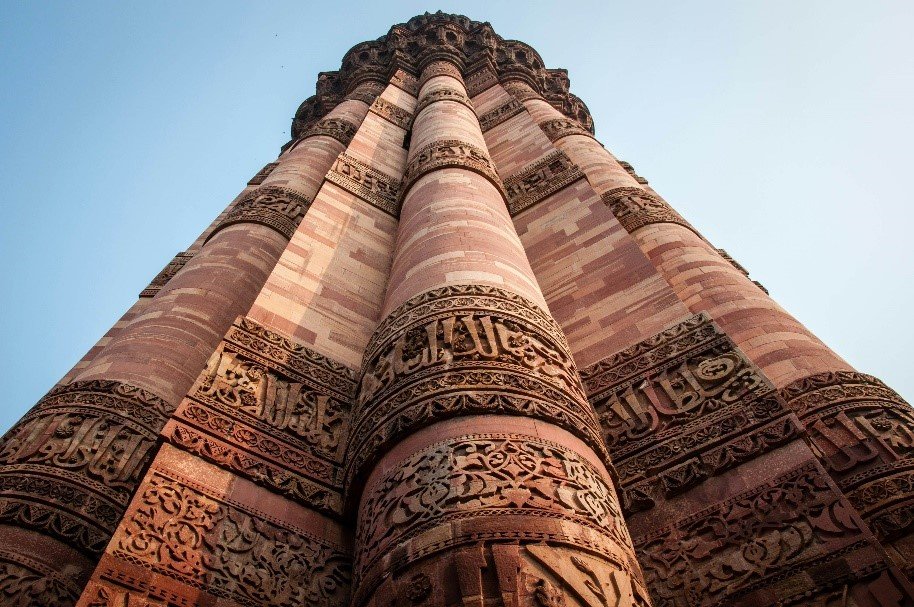
Table of Contents
India’s sacred spaces stand as living testaments to a civilization that thrived on dialogue not just of words, but of design, craft, and spiritual imagination. Indo-Islamic architecture is one of history’s grandest artistic conversations, where domes spoke to shikharas, and calligraphy met carved lotus motifs. Through monuments like the Qutub Minar complex, Fatehpur Sikri, and the Gol Gumbaz, this architectural syncretism produced a visual language that was both divine and distinctly Indian.
The Meeting of Worlds: Foundations of Indo-Islamic Aesthetics
When Islamic dynasties began to establish themselves in the Indian subcontinent from the 12th century onward, they encountered a land already rich in architectural traditions temples, stupas, rock-cut caves, and intricate wooden and stone craftsmanship. The early Muslim rulers, arriving mainly from Central Asia, Persia, and Afghanistan, brought their own styles: the horseshoe arch, lofty domes, geometric ornamentation, and a love for symmetry and monumental scale.
But India had its own genius a vocabulary of ornate carvings, corbelled domes, and symbolic spatial organization tied deeply to religious philosophy. Rather than erasing one another, these two aesthetic traditions began a remarkable fusion, creating something neither fully Persian nor purely Indian but profoundly Indo-Islamic.
This architectural evolution was not linear. It adapted to geography, material, political will, and regional artisanship. The resulting sacred spaces weren’t just built structures; they were cultural dialogues in stone and mortar silent but eloquent declarations of unity in diversity.
Early Experiments: The Qutub Minar Complex, Delhi
If Indo-Islamic architecture were a symphony, the Qutub Minar complex would be its overture a bold beginning that announced a new era. Built in the late 12th and early 13th centuries under Qutb-ud-din Aibak and Iltutmish, the complex includes the Qutub Minar itself, the Quwwat-ul-Islam Mosque, and several tombs each echoing the blend of newly introduced Islamic elements with local Indian craftsmanship.
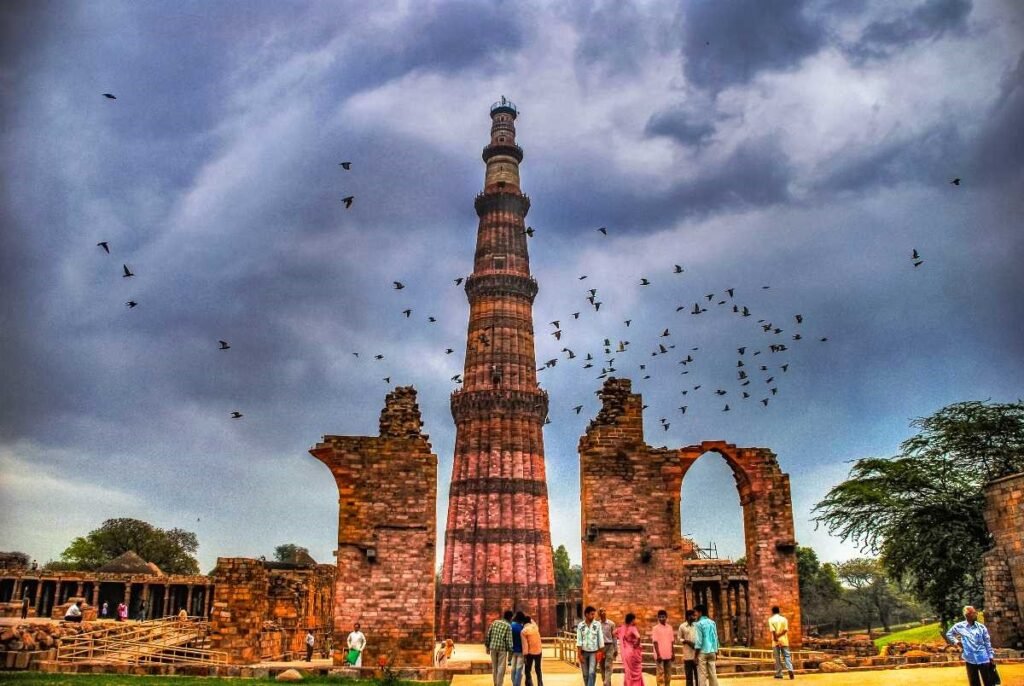
The Qutub Minar Complex, Delhi
The Mosque of “Might of Islam”
The Quwwat-ul-Islam Mosque, ironically named “Might of Islam,” is a perfect emblem of syncretic beginnings. It was constructed using spolia carved pillars and fragments from 27 Hindu and Jain temples that had once stood on the site. But these weren’t merely reused; they were reinterpreted.
The mosque’s colonnades still bear floral carvings, kalash motifs, and even hints of temple iconography all recontextualized within a mosque layout. The result is not just a case of reuse, but of cultural continuity through transformation.
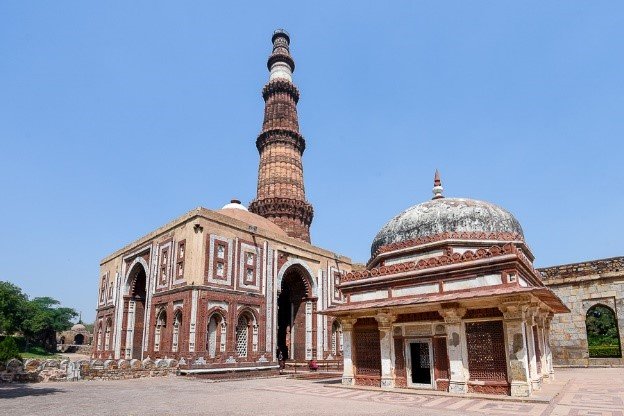
The Quwwat-ul-Islam Mosque
The Qutub Minar: Tower of Victory
The Qutub Minar itself, rising like a colossal exclamation mark over Delhi’s skyline, draws from Central Asian minaret traditions but speaks in an Indian accent. Its fluted red sandstone shafts, alternating between circular and angular flutings, are covered in bands of intricate calligraphy an innovation that replaced figural ornamentation with textual beauty.
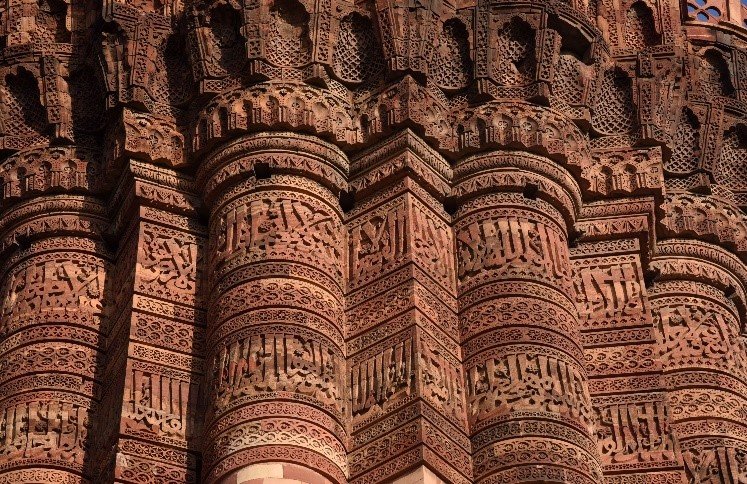
Yet, the stone carving techniques were unmistakably Indian. The craftsmen who built temples now chiseled Quranic verses, adapting their skills to a new faith’s aesthetic demands. Thus, the Qutub Minar isn’t just a tower; it’s a dialogue in sandstone between Delhi’s artisans and their new patrons.
Mature Harmony: The Splendor of Fatehpur Sikri
By the time Emperor Akbar built Fatehpur Sikri in the late 16th century, the Indo-Islamic synthesis had matured into a confident, expressive style. Akbar, with his famously inclusive vision, encouraged experimentation and the result was an imperial capital that felt more like a philosophical statement than a city.
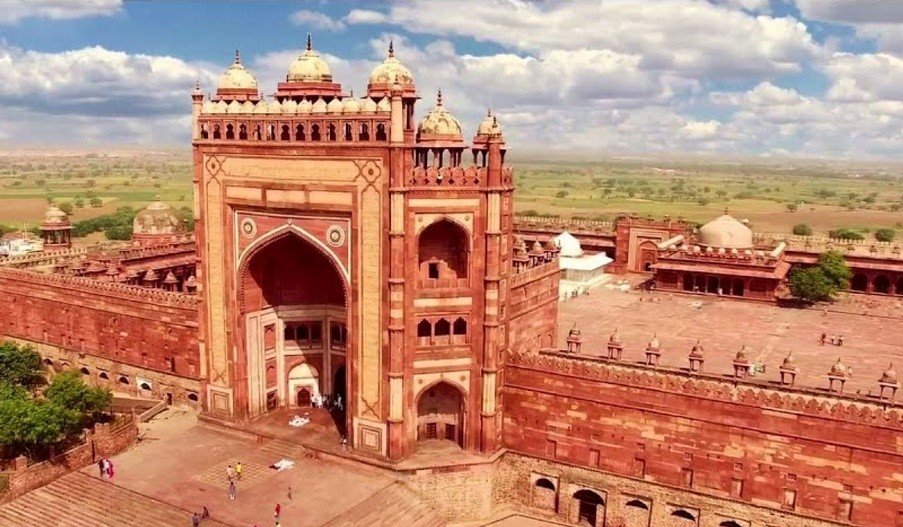
Fatehpur Sikri
Akbar’s Architectural Vision
Fatehpur Sikri was constructed primarily in red sandstone, the same material used for Mughal forts and palaces, but here it achieved an almost lyrical quality. The city integrated Persian planning with its charbagh gardens and symmetrical layouts into a context that also drew deeply from Hindu and Jain architectural vocabulary.
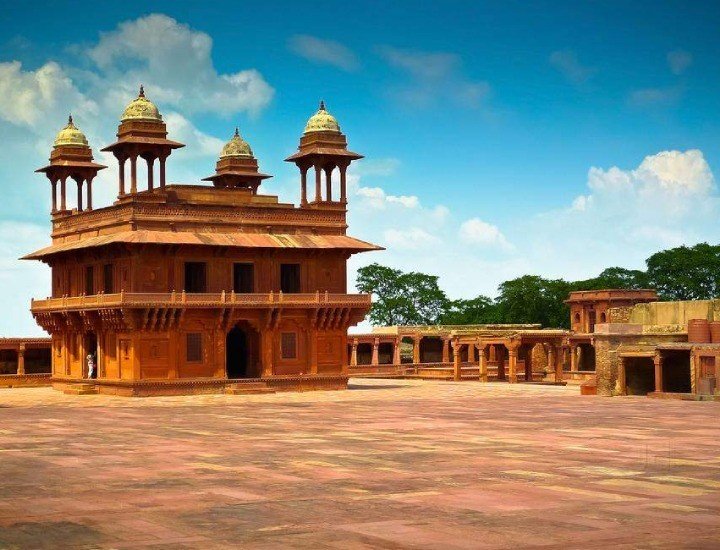
In buildings like the Diwan-i-Khas (Hall of Private Audience), we see brackets, chhatris (domed kiosks), and intricately carved columns reminiscent of Rajasthani palaces. The central pillar, branching out into a lotus-shaped capital, seems to merge both spiritual symbolism and structural innovation. The radiating bridges from this central column represent Akbar’s famous “sulh-e-kul” universal tolerance in architectural form.
Jodha Bai’s Palace and Birbal’s House
Within the palace complex, Jodha Bai’s Palace reveals this fusion at a more domestic scale. While Islamic in layout with courtyards and privacy-oriented zoning the detailing is thoroughly Indian: pierced stone screens (jali work), painted ceilings, and carved cornices.
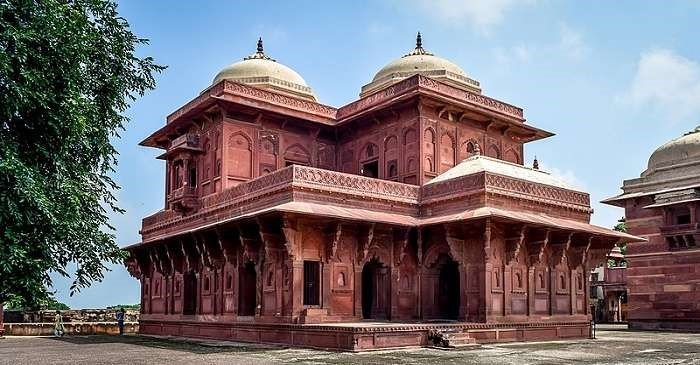
Birbal’s House, too, mixes geometrical Islamic ornament with Hindu narrative motifs, creating a cheerful hybrid space where neither tradition dominates but both shine.
The Buland Darwaza: Gateway to Heaven
The grand Buland Darwaza, built to commemorate Akbar’s victory in Gujarat, is perhaps one of the most stunning manifestations of this fusion. Towering 54 meters high, it combines Persian monumentalism with Indian decorative intricacy.
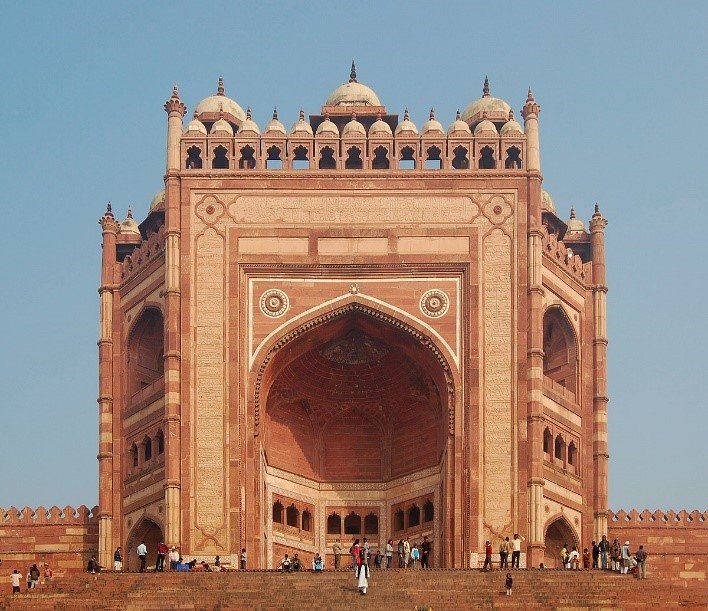
Its pointed arches and calligraphic panels express Islamic grandeur, while the ornamentation and use of local red sandstone root it firmly in Indian soil.
Fatehpur Sikri’s genius lies not only in its visual splendor but in how comfortably it straddles cultures a Mughal emperor’s spiritual and political vision turned into an architectural utopia.
The Deccan’s Distinct Flavor: Gol Gumbaz and Beyond
Moving southward, the Deccan Sultanates developed their own brand of Indo-Islamic architecture one that blended Persian influences with Dravidian artistry and local construction materials.
Gol Gumbaz, Bijapur: The Whispering Dome
Built in the 17th century under Muhammad Adil Shah of Bijapur, Gol Gumbaz is the grand finale of the Deccan style. Its most famous feature the massive dome is one of the largest in the world, unsupported by pillars, and perfectly symmetrical. The whispering gallery beneath it adds an almost mystical dimension, where even the faintest sound echoes seven times.
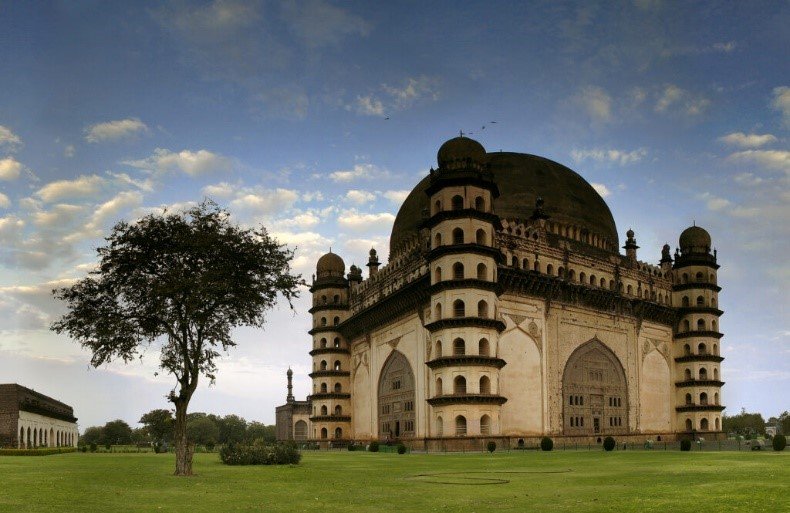
While its basic form the cube topped with a hemispherical dome is Islamic, the ornamentation and construction methods reflect strong Indian sensibilities. The lotus finials, the projecting cornices, and the detailing of the arches reveal a local hand.
Here, geometric perfection meets human warmth a recurring theme in India’s sacred architecture.
Ibrahim Rauza: A Jewel of Bijapur
Often called the “Taj Mahal of the Deccan,” Ibrahim Rauza is a twin structure consisting of a mosque and the tomb of Ibrahim Adil Shah II. The pairing of these two buildings, surrounded by a garden, follows Persian precedents, yet the ornamental richness with its blend of calligraphy, latticework, and miniature temple-like projections feels quintessentially Indian.
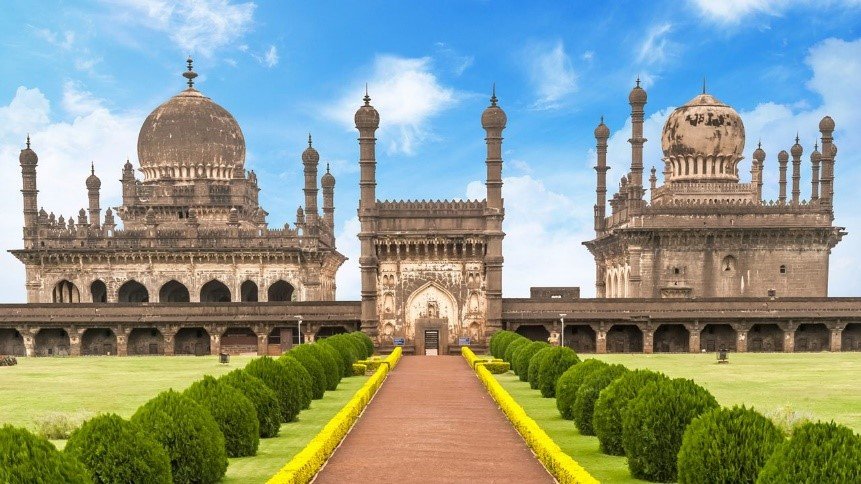
It was said that the architects here designed “a song in stone,” and one can almost hear its melody in the rhythmic repetition of arches and domes.
Regional Adaptations: Gujarat, Bengal, and Malwa
While Delhi and Agra grabbed the limelight, the true diversity of Indo-Islamic syncretism shines in the regional Sultanates. Each region interpreted the blend differently adapting to its own materials, artisans, and cultural histories.
Gujarat: Elegance in Restraint
The architecture of Gujarat, particularly in Ahmedabad and Champaner, demonstrates an exquisite balance between Islamic geometry and Hindu ornamentation. The Jama Masjid of Ahmedabad (1424 CE) features domes supported by intricately carved pillars and windows with stone jalis that rival the delicacy of lace.
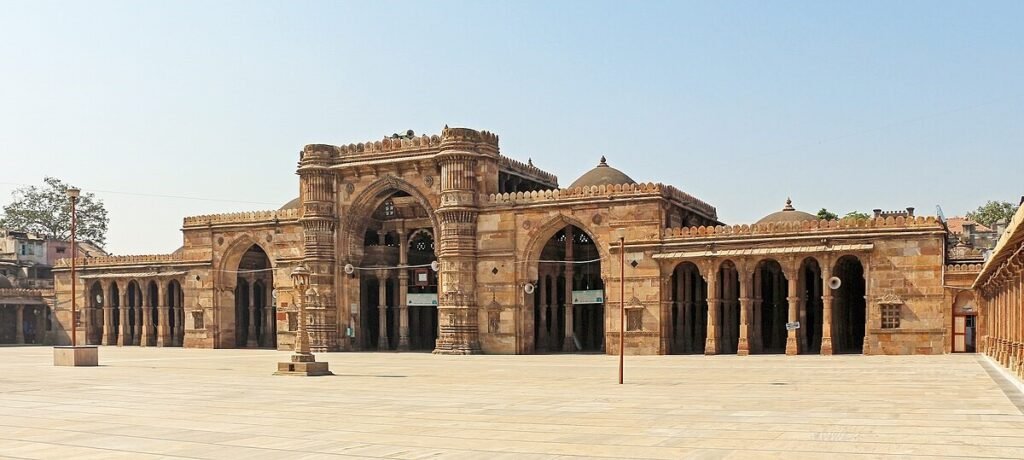
The stepped minbars and lotus carvings make it hard to tell where temple design ends and mosque design begins.
The Gujarati craftspeople, long accustomed to carving temples, brought a sensuous lightness to Islamic spaces. The results were airy, lace-like structures mosques that seemed to breathe sunlight.
Bengal: Brick and Terracotta Artistry
In Bengal, where stone was scarce, architects turned to brick and terracotta. The Adina Mosque (1375 CE) in Pandua showcases both scale and ingenuity its massive hypostyle hall echoes the grandeur of Central Asian mosques, but the detailing in terracotta panels reflects indigenous artistry.
The Eklakhi Mausoleum and the Chhota Sona Mosque continue this dialogue between form and material. Rounded arches and curved cornices echo local bamboo architecture, proving that syncretism wasn’t limited to ornament it extended to structure itself.
Malwa: Poetry in Stone
In Mandu, the capital of the Malwa Sultanate, the Jahaz Mahal and Hoshang Shah’s Tomb capture another shade of Indo-Islamic imagination. The tomb, in white marble, is said to have inspired the Taj Mahal. Yet, beneath its Islamic simplicity lie Hindu architectural subtleties chhatris, cornices, and decorative bands.
Mandu’s architecture feels playful, almost theatrical a city of pleasure palaces, pavilions, and terraces that combine Persian romanticism with Indian sensuality. It’s as if the landscape itself participated in the architecture.
Sacred Geometry Meets Sensuous Ornament: The Aesthetic Language
The beauty of Indo-Islamic sacred spaces lies in how they resolve apparent opposites: geometry and emotion, austerity and ornament, faith and pluralism. This synthesis is visible across several shared motifs:
- The Arch and the Bracket: The Islamic pointed arch met the Hindu corbelled bracket, resulting in inventive hybrid forms that balanced strength and grace.
- The Dome and the Shikhara: The dome, symbol of heaven in Islamic architecture, often borrowed visual cues from the curvilinear shikhara creating silhouettes unique to India.
- Calligraphy and Carving: Quranic inscriptions often intertwined with floral vines, lotus petals, or bell motifs merging spiritual and natural imagery.
- The Jali Screen: While rooted in Persian architecture, Indian jali evolved into an expressive art form combining geometry with narrative, turning light and shadow into an ever-changing sacred pattern.
- Material Adaptation: From Delhi’s red sandstone to Bengal’s terracotta and the Deccan’s black basalt, local materials shaped the aesthetic language, making each region’s expression distinctive.
Spiritual Syncretism: Beyond Form and Ornament
Indo-Islamic architecture wasn’t merely a visual fusion; it reflected deeper philosophical syncretism. Islamic emphasis on unity (tawhid) resonated with Indian ideas of cosmic oneness. Both traditions used architecture as a means to express divine harmony.
Sufi shrines like Nizamuddin Auliya’s Dargah in Delhi became physical embodiments of this fusion spaces where people of all faiths sought solace. Their design, modest yet intricate, symbolized inclusiveness. Similarly, the use of gardens (charbagh layouts) reflected a shared metaphor paradise as order amidst nature.
In many ways, these sacred spaces anticipated the cultural pluralism that became a defining feature of India. They were not about erasing difference but celebrating it turning diversity into an art form.
The Taj Mahal: The Pinnacle of Fusion
No discussion of Indo-Islamic architecture can be complete without mentioning the Taj Mahal the ultimate expression of aesthetic synthesis. Commissioned by Shah Jahan in the 17th century, it’s often seen as the zenith of Mughal art, yet its perfection lies in its hybridity.
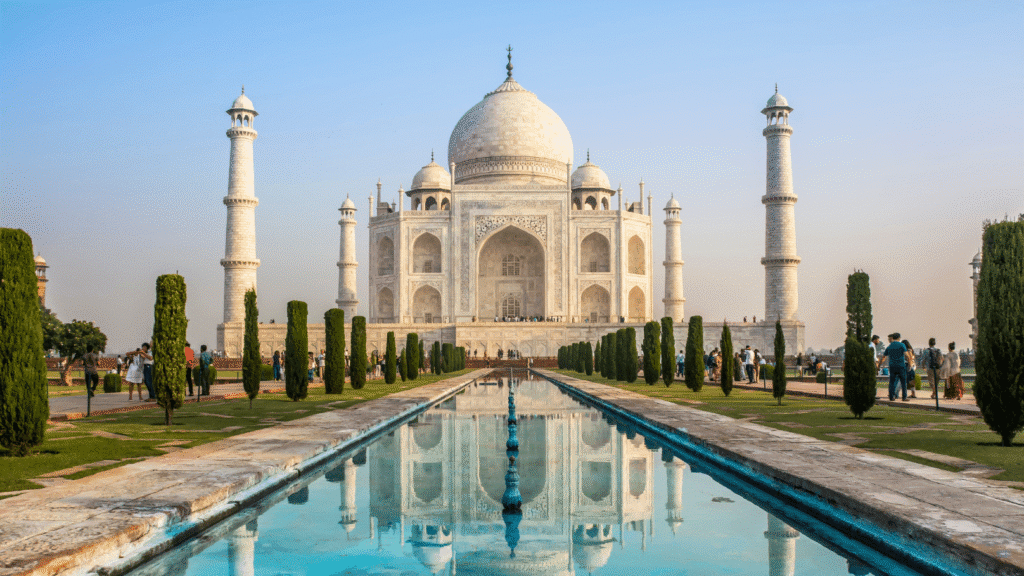
While the basic plan and symmetry are Islamic, the floral inlays, pietra dura work, and chhatris that crown the corners all echo Indian motifs. The garden layout is Persian in origin, but the riverfront placement an Indian adaptation creates a unique spatial experience.
The Taj’s marble seems to absorb every tradition before it from the lotus finial on the dome to the jaalis that diffuse divine light. It is, in every sense, a temple of synthesis.
Enduring Legacy: The Spirit of Coexistence in Stone
Indo-Islamic architecture’s greatest triumph wasn’t just structural or decorative it was philosophical. It showed that architecture could be a language of empathy. Each monument, whether a mosque, tomb, or palace, became a silent negotiation between worlds political, religious, and artistic.
Even centuries later, these monuments continue to inspire modern architects, reminding us that true creativity often arises not from purity, but from dialogue. The fusion of styles became a metaphor for India itself plural, layered, and endlessly inventive.
Today, as one stands under the dome of Gol Gumbaz, in the shadow of the Qutub Minar, or at the threshold of Fatehpur Sikri, the message carved in stone remains timeless: diversity is not disorder it’s design.
Conclusion: Harmony as Heritage
Indo-Islamic architecture is more than a historical style; it’s an attitude a creative embrace of the “other.” From the earliest Delhi Sultanate mosques to the Mughal marvels and the Deccan dynasties’ experiments, this architectural tradition stands as a profound reminder that beauty flourishes where boundaries blur.
In these sacred spaces, syncretism wasn’t an accident it was the design principle. The builders didn’t just construct walls; they built bridges between faiths, aesthetics, and worlds.
And in doing so, they left us a legacy of stone that still whispers across centuries:
When art listens, civilizations sing.