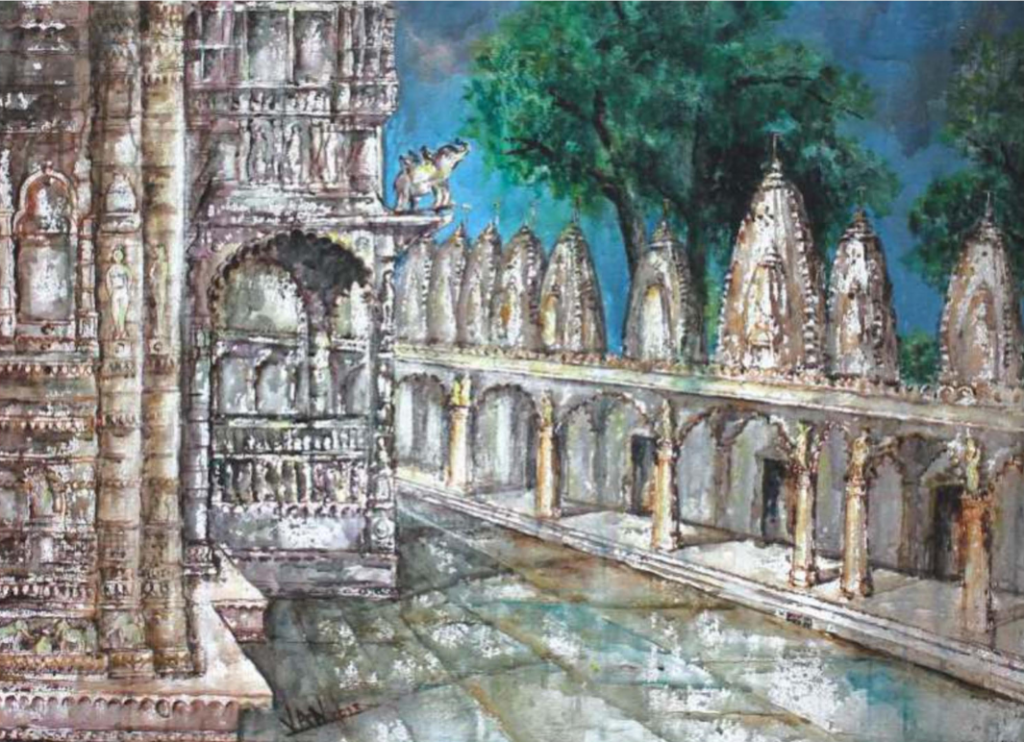
From the dimly lit silence of the Ajanta caves to the open courtyards of Nalanda, Buddhist architecture in India chronicles a profound journey from rock-cut devotion to architectonic enlightenment. Each stage of its evolution reflects not only artistic mastery but also the changing ways people conceived of faith, space, and community. This is the story …
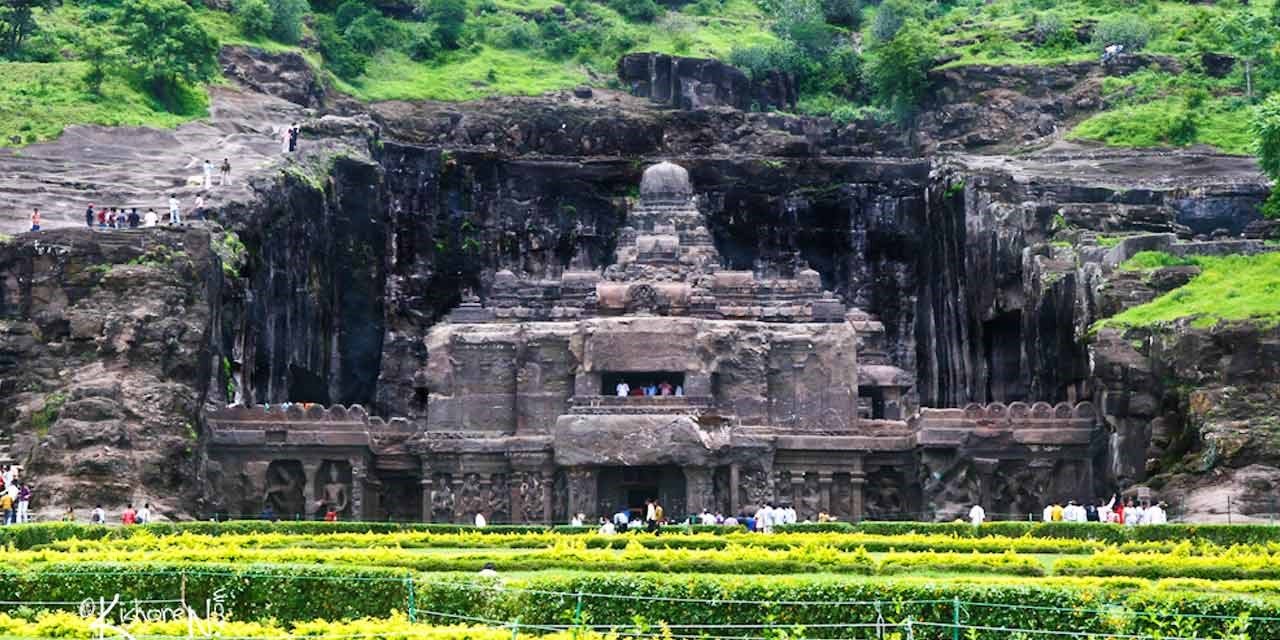
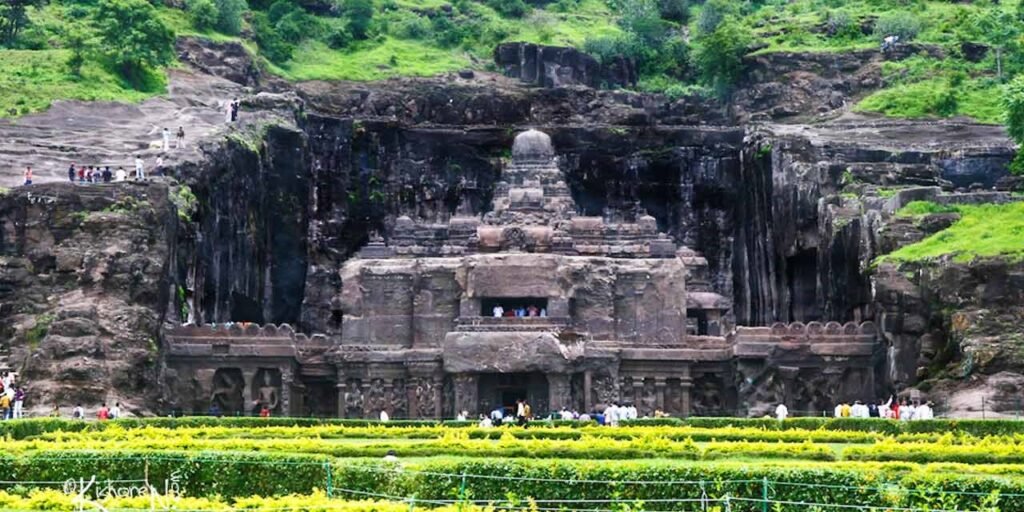
Table of Contents
- The Origins: Faith Finds Form in Stone
- The Rock-Cut Revolution: Ajanta, Ellora, and the Birth of Sacred Space
- Ajanta Caves: Murals of Faith
- The Chaitya-Griha: Cave No. 9 and 10
- The Viharas: Cave No. 1 and 2
- Ellora Caves: A Dialogue of Faiths
- Karla and Bhaja: The Wooden Soul of Stone
- From Caves to Structures: Buddhism Steps into the Light
- Sanchi: The Stupa That Started It All
- The Stupa’s Symbolic Blueprint
- Nalanda: The Monastic Metropolis
- Urbanism Meets Monasticism
- Material and Innovation
- Bodh Gaya: The Axis of Enlightenment
- The Mahabodhi Temple: From Stupa to Shikhara
- Vikramashila and Odantapuri: The Monastic Network
- Vikramashila (8th century CE)
- Somapura Mahavihara
- From Aniconism to Iconography: The Buddha in Architecture
- Technology, Material, and Symbolism
- Beyond India: The Architectural Diaspora
- The Decline and Afterlife
- From Stone Chisels to Spiritual Skylines
- Conclusion: Architecture as Enlightenment
From the dimly lit silence of the Ajanta caves to the open courtyards of Nalanda, Buddhist architecture in India chronicles a profound journey from rock-cut devotion to architectonic enlightenment. Each stage of its evolution reflects not only artistic mastery but also the changing ways people conceived of faith, space, and community. This is the story of how stone became sermon, how chisel became philosophy, and how Buddhism carved its soul across centuries of architecture from mountain sanctuaries to monastic universities.
The Origins: Faith Finds Form in Stone
When Buddhism emerged in the 6th century BCE, it began as a spiritual movement more than an architectural one. The Buddha’s teachings emphasized impermanence, introspection, and simplicity. Yet as the faith spread, its followers sought physical spaces that could express the intangible serenity, compassion, and enlightenment.
The earliest Buddhist structures were stupas domed mounds enshrining relics of the Buddha. Simple in form but profound in symbolism, the stupa represented both the Buddha’s physical presence and the cosmos itself. Over time, these shrines evolved into complex architectural statements, complemented by monasteries (viharas), prayer halls (chaitya-grihas), and later, full-fledged learning centers.
But before India built monasteries that soared toward the sky, it dug inward into rock, into mountains, and into faith itself.
The Rock-Cut Revolution: Ajanta, Ellora, and the Birth of Sacred Space
Between the 3rd century BCE and the 7th century CE, the western Deccan plateau became the cradle of Buddhist architectural innovation. The stone was abundant, the craftsmen gifted, and the royal patrons especially the Satavahanas and later the Vakatakas generous. Out of this alchemy came the rock-cut cave temples, the earliest and perhaps most audacious expressions of Buddhist architecture.
Ajanta Caves: Murals of Faith
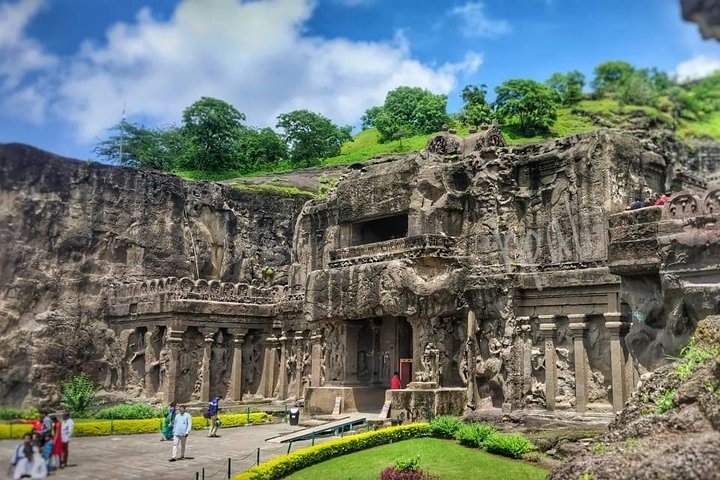
Nestled along a horseshoe-shaped gorge of the Waghora River, the Ajanta Caves (2nd century BCE–6th century CE) are not just architecture they’re emotion carved in basalt. The site consists of 30 caves a combination of chaitya halls (prayer halls) and viharas (monastic cells) each telling a chapter in the story of Buddhism’s evolution.
The Chaitya-Griha: Cave No. 9 and 10
The earliest chaityas at Ajanta, such as Caves 9 and 10, are direct descendants of wooden prototypes. Their facades feature horseshoe-shaped windows and ribbed barrel vaults imitating timber beams a touching reminder that even in stone, early Buddhist architecture retained memory of its humble wooden origins.
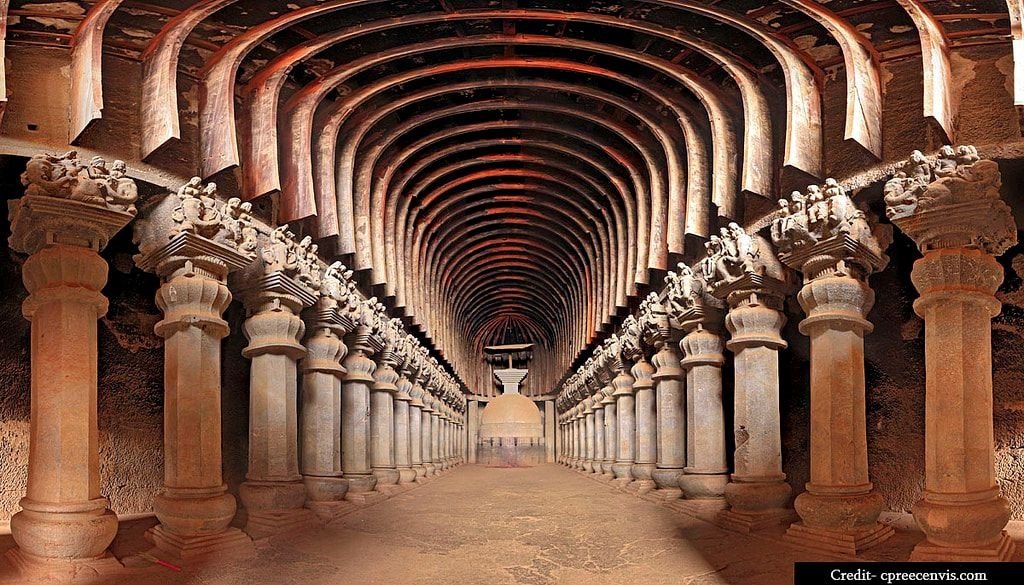
Inside, a stupa stands at the end of the nave, the object of veneration. Rows of columns flank the central aisle, guiding the devotee’s circumambulation (pradakshina). The space is rhythmic, acoustic, and deeply meditative designed not for congregation but for communion.
The Viharas: Cave No. 1 and 2
By the 5th century CE, viharas evolved from simple monk cells into elaborate multi-roomed complexes. Cave 1 at Ajanta is a masterpiece: a pillared hall, richly painted ceilings, and a sanctum housing a sculpted Buddha seated in dharmachakra mudra (gesture of teaching).
The murals here the Jataka tales painted with near-cinematic finesse merge architecture, sculpture, and painting into a single act of devotion. Ajanta represents Buddhism’s shift from aniconic simplicity to iconic grandeur, from symbolic stupas to humanized images of the Buddha.
Ellora Caves: A Dialogue of Faiths
If Ajanta was introspective, Ellora was extroverted. Excavated between the 5th and 10th centuries CE, Ellora houses Buddhist, Hindu, and Jain caves side by side a breathtaking visual of India’s religious coexistence.
The Buddhist caves (1–12) mark a crucial architectural transition. Unlike Ajanta’s isolated meditation cells, these caves particularly Cave 10, the Visvakarma Cave feature sculpted Buddhas and Bodhisattvas, hinting at the growing influence of Mahayana Buddhism.
Cave 12, the Tin Thal, is a three-storeyed monastery effectively a vertical vihara. Each level has cells, pillared halls, and shrines, demonstrating how Buddhist spaces began to mimic urban, organized communities rather than secluded retreats. It’s architecture anticipating the idea of a “monastic city.”
Karla and Bhaja: The Wooden Soul of Stone
Even earlier than Ajanta, the Karla and Bhaja caves (near Lonavala) illustrate the genesis of Buddhist rock-cut design. The Great Chaitya at Karla (1st century CE) stands as one of the finest examples of early structural claritya high vaulted hall with a large stupa at one end and a facade pierced by a great horseshoe window that floods the interior with natural light.
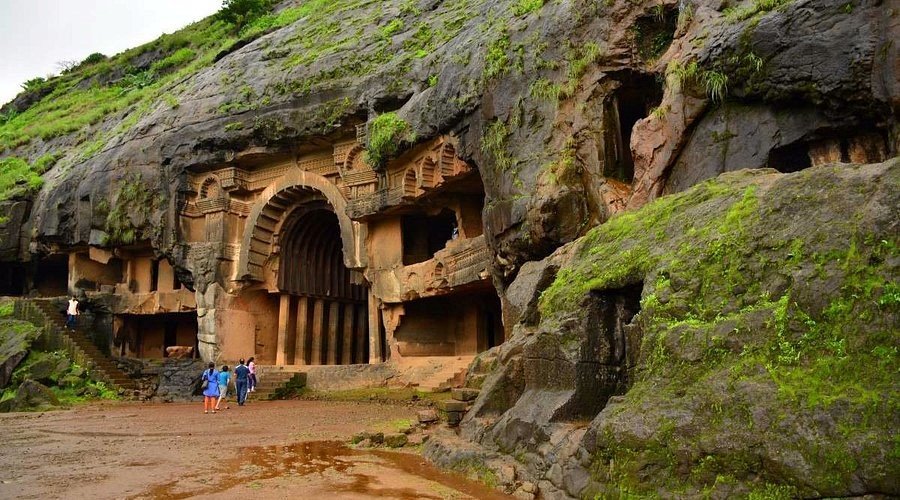
The wooden ribs lining the roof aren’t mere decoration they are remnants of real timber beams, preserved in stone. It’s a poetic moment in architectural evolution when the memory of wood lingered in the mind of stone.
From Caves to Structures: Buddhism Steps into the Light
By the 5th–6th centuries CE, as Buddhism spread eastward across India and beyond, the limitations of rock-cut architecture became apparent. Carving into cliffs was monumental but immobile; a faith that was now cosmopolitan needed spaces that could grow, teach, and connect.
Enter structural monasterie freestanding constructions made of brick and stone, designed to house not just monks but scholarship, pilgrims, and entire communities.
Sanchi: The Stupa That Started It All
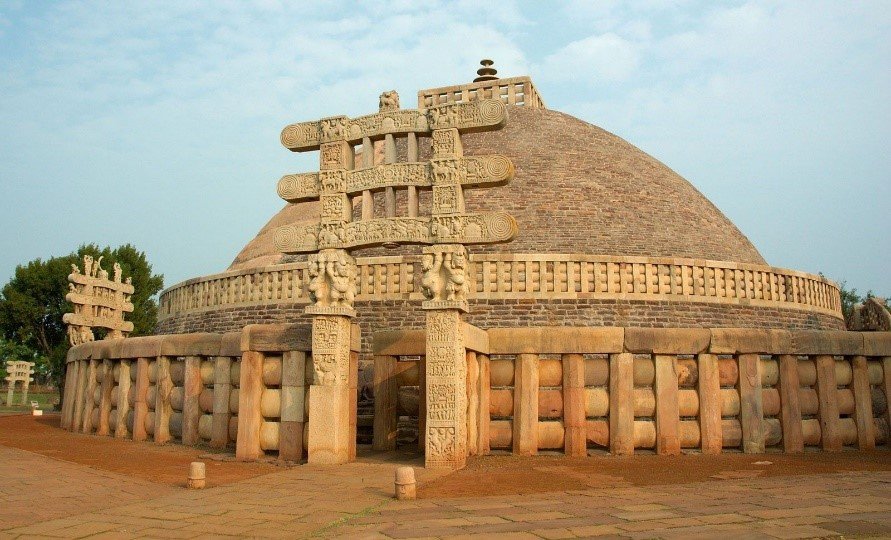
Before the great monasteries rose, Sanchi (in Madhya Pradesh) had already defined the grammar of Buddhist sacred architecture. Commissioned initially by Emperor Ashoka in the 3rd century BCE, Sanchi’s Great Stupa became the architectural template for centuries.
The Stupa’s Symbolic Blueprint
At first glance, the stupa appears simple a hemispherical dome on a terrace, crowned by a harmika (railing) and a parasol. But every element encodes cosmic meaning:
- The dome (anda) represents the world mountain, the womb of the universe.
- The harmika marks the celestial realm.
- The chattravali (umbrella) symbolizes spiritual sovereignty.
- The toranas (gateways) depict the Buddha’s life, reimagined through symbols a tree, a wheel, a thronesince early Buddhists avoided human depictions.
The four toranas, placed along the cardinal axes, orchestrate the devotee’s movement turning the act of walking into meditation. It’s urban design as spiritual choreography.
Sanchi’s stupa thus bridges the conceptual gap between burial mound and architectural cosmos, transforming a simple reliquary into a symbol of the Buddha’s eternal presence.
Nalanda: The Monastic Metropolis
If Ajanta was the cave of contemplation and Sanchi the stupa of symbolism, Nalanda (5th–12th century CE) was the city of enlightenment. Located near modern-day Patna, Nalanda grew from a small vihara into one of the world’s earliest residential universities hosting over 10,000 students and 2,000 teachers from across Asia.
Urbanism Meets Monasticism
Unlike the secluded caves, Nalanda’s architecture was open, rational, and civic. The layout followed a linear axis, with rows of monasteries (viharas) alternating with temples (chaityas). Each vihara was a quadrangular brick structure cells arranged around a central courtyard, often with two or more storeys.
The temples, such as Temple No. 3, evolved from simple stupas into towering brick shrines with niches filled with sculpted Buddhas prototypes for later pagodas in Southeast Asia.
This interplay of monastic order and monumental worship space created a new kind of architecture one that was institutional yet sacred, educational yet devotional.
Material and Innovation
Nalanda’s architects transitioned fully from rock to brick, mastering both engineering and ornament. Glazed tiles, terracotta panels, and molded friezes decorated the facades a vivid contrast to the austere stone of earlier caves.
Functionally, the use of brick allowed flexibility: expansion, reconstruction, and adaptation qualities a living university demanded. Nalanda thus marked Buddhist architecture’s evolution from permanence carved into stone to adaptability built into space.
Bodh Gaya: The Axis of Enlightenment
While Nalanda was the city of knowledge, Bodh Gaya was the city of awakening. It was here that Siddhartha Gautama attained enlightenment beneath the Bodhi tree, and here arose one of the most iconic structures in Buddhist architecture the Mahabodhi Temple.
The Mahabodhi Temple: From Stupa to Shikhara
Originally built by Ashoka in the 3rd century BCE as a simple stupa, the Mahabodhi Temple evolved over centuries into a soaring brick tower its final Gupta-era form (5th–6th century CE) still standing today.
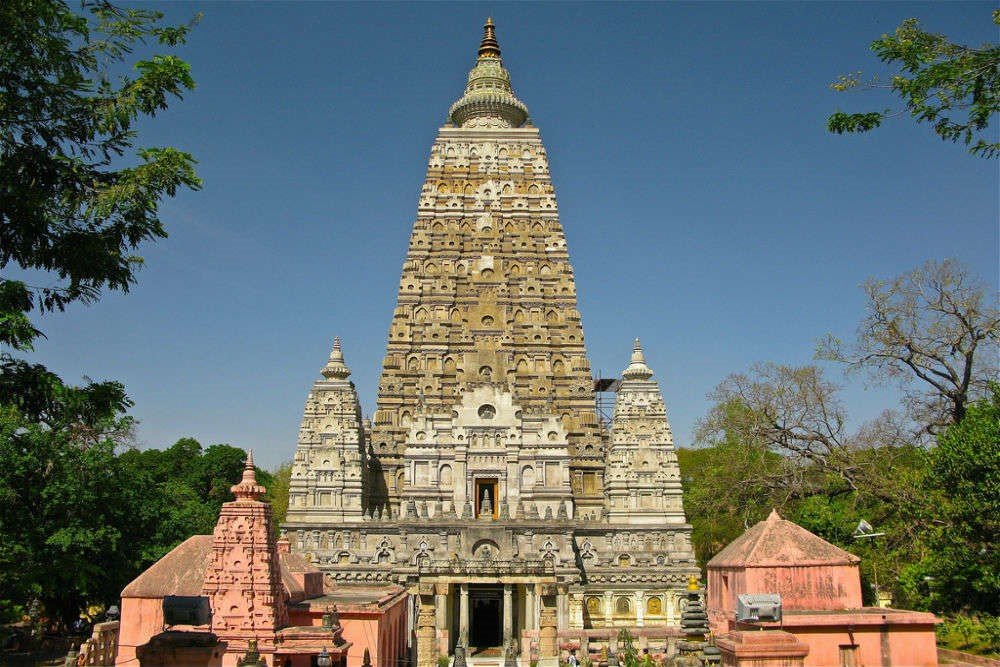
The design marks a pivotal transition: from the solid dome of the stupa to the vertical geometry of the temple, anticipating the shikhara forms later seen in Hindu architecture. The tall pyramidal spire, crowned by a small stupa, draws the eye upward symbolizing the ascent from earthly ignorance to spiritual illumination.
The temple’s plan integrates sacred landscape with built form the Bodhi Tree, the Vajrasana (Diamond Throne), and surrounding shrines create a network of sacred points, turning the site into a three-dimensional mandala of enlightenment.
Bodh Gaya thus transformed Buddhist architecture into a dialogue between earth and sky the moment stone first aspired to transcend itself.
Vikramashila and Odantapuri: The Monastic Network
After Nalanda’s success, other grand universities followed Vikramashila, Odantapuri, and Somapura Mahavihara (in modern Bangladesh). Each expanded the architectural vocabulary of Buddhist learning.
Vikramashila (8th century CE)
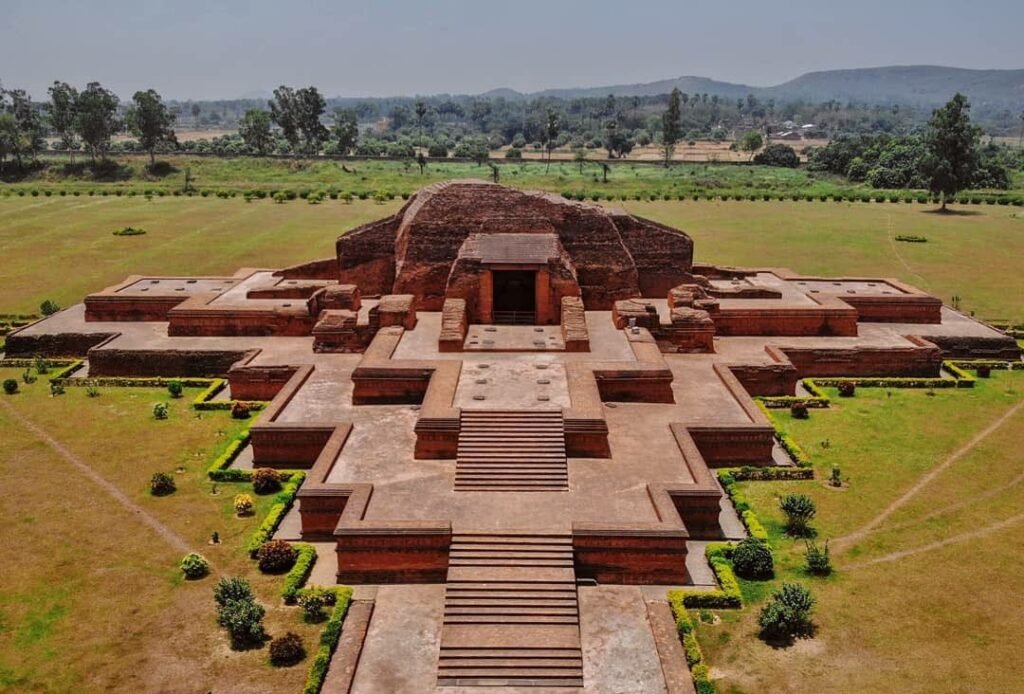
Founded by Pala king Dharmapala, Vikramashila featured a massive cruciform stupa at its center surrounded by 108 smaller shrines. The layout symbolized the universe radiating from the Buddha’s presence. The monasteries around it, built in brick and stone, were multi-storeyed and systematically planned indicating how monastic life had become an organized, almost urban institution.
Somapura Mahavihara
Somapura, one of the largest Buddhist viharas in South Asia, takes the Nalanda plan and magnifies it. Its cruciform central temple, rising from a square courtyard surrounded by monks’ cells, bridges Indian stupa tradition with the tiered pagodas of Southeast Asia. Indeed, its influence reached all the way to Myanmar, Java, and Tibet.
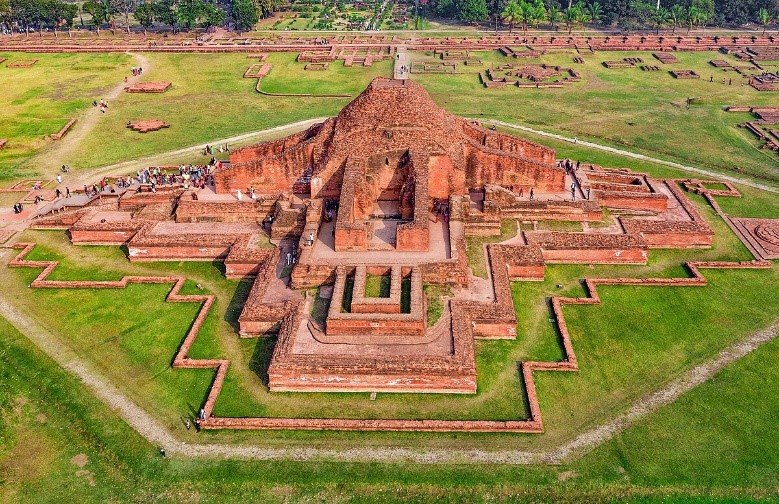
These later monasteries reflect the globalization of Buddhist architecture where Indian spiritual concepts met local materials and forms, producing hybrids that still define Asian sacred architecture today.
From Aniconism to Iconography: The Buddha in Architecture
Early Buddhist art avoided depicting the Buddha in human form using symbols like the lotus, wheel, or empty throne. But by the time of Ajanta and Nalanda, the Buddha had become both deity and teacher and his image, ubiquitous.
This shift from aniconic to iconic profoundly reshaped architecture:
- Shrines now housed statues instead of relics.
- Facades became narrative screens, filled with reliefs and murals.
- The focus of worship moved from circumambulation to contemplation.
In short, architecture moved from movement around to meditation within.
The devotee’s journey turned inward mirrored in the progression from the external stupa to the interior sanctum.
Technology, Material, and Symbolism
Buddhist architecture’s evolution also mirrored material mastery:
- Stone (Ajanta, Karla): Symbol of permanence and introspection.
- Brick (Nalanda, Bodh Gaya): Symbol of adaptability and expansion.
- Stucco and Terracotta (Pala Period): Mediums of artistic flourish, democratizing ornamentation.
Structurally, architects moved from subtractive to additive processes:
- Rock-cut (subtractive): The temple revealed by removing matter a metaphor for enlightenment through negation.
- Structural (additive): The temple-built layer by layer enlightenment through accumulation of wisdom.
Thus, the very act of construction became an allegory for Buddhist philosophy.
Beyond India: The Architectural Diaspora
As Buddhism journeyed beyond India to Sri Lanka, Myanmar, China, and Japan its architectural DNA traveled with it. The Indian stupa transformed into the dagoba of Sri Lanka, the chedi of Thailand, and the pagoda of East Asia.
Yet, the spirit of Indian prototypes remained. Nalanda’s brick viharas became the blueprint for monastic complexes across the Buddhist world, while Bodh Gaya’s pyramidal tower inspired Southeast Asian temple mountains like Borobudur and Bagan.
The evolution of Buddhist architecture thus traces not just a regional style, but the migration of ideas a cultural Silk Road of stone and space.
The Decline and Afterlife
By the 12th century CE, political upheavals and the decline of Buddhist patronage in India led to the fall of great monastic institutions like Nalanda and Vikramashila. Yet, their architectural language survived absorbed by Hindu temple traditions and revived later in Buddhist Asia.
In a poetic twist, Bodh Gaya, once the seat of enlightenment, fell into ruin only to be rediscovered and restored by modern archaeologists and devotees. The global Buddhist renaissance of the 19th–20th centuries would reclaim these ancient forms, proving that sacred architecture, like faith itself, never truly disappears it simply transforms.
From Stone Chisels to Spiritual Skylines
Tracing Buddhist architecture from rock-cut caves to monumental monasteries reveals more than stylistic evolution it unveils a spiritual migration.
- In Ajanta, faith withdrew into darkness to find light within.
- In Nalanda, it expanded into the daylight of knowledge.
- In Bodh Gaya, it reached for the heavens.
Each phase wasn’t a rejection of the last, but an unfolding from inward meditation to outward expression, from caves echoing chants to cities humming with scholars.
Buddhism’s architecture began by carving devotion into mountains and ended by constructing it into the world.
Conclusion: Architecture as Enlightenment
The story of Buddhist architecture is the story of human aspiration the will to shape space in the image of peace. From the silent austerity of stone caves to the ordered courtyards of Nalanda, it reflects a civilization’s evolving relationship with knowledge, nature, and the sacred.
These monuments weren’t built merely to honor the Buddha; they were designed to replicate enlightenment itself to make stillness spatial, compassion structural, and wisdom visible.
And so, when we stand beneath Ajanta’s frescoed vaults or in Bodh Gaya’s shadowed sanctum, we aren’t just witnessing ancient art.
We are walking through a philosophy of space one that began with stone chisels and still aspires toward spiritual skylines.