When we think of educational excellence, our minds usually go straight to great teachers, modern curriculum, innovative pedagogy, and technology-driven classrooms. But there is an equally powerful, often underestimated factor that shapes how students learn, interact, collaborate, and grow: the psychology of space. The way a campus is planned its pathways, courtyards, classroom clusters, green …

Table of Contents
- 1. Understanding the Psychology of Space in Educational Design
- 2. How Campus Layout Influences Student Behaviour
- 3. Learning Environments Start Outside the Classroom
- 4. Spatial Hierarchy: Giving Students a Sense of Place
- 5. How Campus Layout Affects Cognitive Performance
- 6. Case Study Architect: Louis Kahn Master of Educational & Institutional Spaces
- 7. What Modern Campuses Can Learn from Kahn
- 8. Designing Emotionally Intelligent Campuses Today
- 9. Why Campus Layout Matters More Than Ever
- 10. Conclusion: The Campus as a Living Teacher
When we think of educational excellence, our minds usually go straight to great teachers, modern curriculum, innovative pedagogy, and technology-driven classrooms. But there is an equally powerful, often underestimated factor that shapes how students learn, interact, collaborate, and grow: the psychology of space.
The way a campus is planned its pathways, courtyards, classroom clusters, green pockets, social nodes, and even the direction of windows has a profound impact on student behaviour. Campus design is not merely an aesthetic exercise; it is a subtle psychological framework that influences every part of the learning process.
A campus is essentially a small world in itself. It shapes identities, supports communities, and unconsciously directs student movements and interactions. The most successful educational institutions whether schools or universities are those that understand how the built environment communicates with the human mind.
In this article, we’ll explore how space psychology influences learning, and why thoughtful campus design is essential for future-ready education. The blog also highlights the work of a notable architect who excels in designing impactful campuses.
1. Understanding the Psychology of Space in Educational Design
Psychology of space refers to the emotional, cognitive, and behavioural impact a built environment has on its occupants. This includes:
- How safe students feel
- How motivated they are
- How easily they can collaborate
- How they interact socially
- How much time they spend outdoors
- How connected they feel to the institution
Spaces communicate. They tell students whether they belong, whether collaboration is encouraged, whether creativity is valued, or whether discipline and structure are priorities.
For example, long, narrow corridors with closed doors give a very different emotional signal compared to open learning commons with visual transparency.
Campus layout becomes a silent teacher shaping habits, prompting behaviours, and influencing mindsets.
2. How Campus Layout Influences Student Behaviour
2.1 Movement Patterns & Orientation
Human behaviour is strongly influenced by how easy or difficult a space is to navigate.
A campus that is intuitive and interconnected encourages:
- exploration
- confidence in movement
- spontaneous social encounters
- clarity in reaching important learning zones
Poorly planned campuses, however, cause confusion, frustration, and disengagement particularly for new students.
2.2 Social Interaction & Community Building
Learning is social. Most meaningful learning moments occur outside formal classrooms: in hallways, lawns, canteens, and informal seating clusters.
Small courtyards, shaded seating areas, amphitheatres, social nodes near faculties, and pedestrian-friendly walkways all help create:
- peer learning
- collaborative culture
- sense of belonging
- emotional comfort
Good campus designers use proxemics the study of how distance affects interaction to create environments that encourage communication without forcing it.
2.3 Privacy, Solitude & Personal Space
Students need play, but they also need privacy.
Campus design must balance:
- active zones like sports courts
- quiet zones like libraries, green retreats
- transition zones hallways, terraces, shaded walkways
Spaces for reflection and solitude enrich mental well-being, help reduce stress, and support deeper learning.
2.4 Safety, Security & Emotional Comfort
Campus layout affects a student’s sense of safety.
Features like:
- visible sightlines
- adequate lighting
- passive surveillance
- separation of vehicular and pedestrian movement
make students feel protected and free to explore.
Emotionally safe spaces provide the foundation for curiosity, risk-taking, and self-expression.
2.5 The Impact of Nature & Open Spaces
Biophilic design the integration of nature into architecture increases happiness, attention span, and cognitive performance.
Educational campuses often incorporate:
- gardens
- outdoor classrooms
- green rooftops
- courtyards
- water bodies
These elements lower anxiety and promote restorative learning experiences.
3. Learning Environments Start Outside the Classroom
We often judge educational architecture by classroom design. But the real magic lies in the interstitial spaces the “in-between” areas that shape the emotional rhythm of the school day.
Examples include:
- shaded corridors
- breakout zones
- central plazas
- café-style lounges
- steps doubling as seating
- campus greens
These are not afterthoughts they are the heart of student life.
A well-planned campus understands that learning is continuous and multi-sensory, and designs every corner to serve as a potential learning environment.
4. Spatial Hierarchy: Giving Students a Sense of Place
Every well-designed campus uses a carefully crafted hierarchy of spaces:
- Major hubs central courtyards, atriums
- Medium spaces departmental plazas
- Minor spaces outdoor nooks, stair landings, small gardens
This layered planning ensures students can intuitively determine:
- where they are
- where they need to go
- how spaces relate to each other
Good hierarchy reduces stress and empowers independence essential for young learners developing spatial intelligence.
5. How Campus Layout Affects Cognitive Performance
Several studies have shown that spatial design impacts:
- focus
- memory retention
- mood
- problem-solving ability
- creativity
Here’s how:
5.1 Daylight Exposure
Natural light increases serotonin levels, improves concentration, and reduces eye strain.
5.2 Acoustical Planning
Quiet zones improve language processing, particularly for younger learners.
5.3 Colour Psychology
Colours affect mood and behaviour:
- Blue: focus & calm
- Green: balance & creativity
- Yellow: energy & social interaction
- Neutral tones: concentration
5.4 Visual Connectivity
Glass walls, open corridors, and indoor-outdoor links reduce stress and provide a sense of freedom.
6. Case Study Architect: Louis Kahn Master of Educational & Institutional Spaces
Louis Kahn, one of the most influential architects of the 20th century, is a powerful example of how architecture can shape human behaviour and emotional experience. His work is deeply rooted in light, order, spatial clarity, and the spiritual quality of spaces all of which resonate strongly with campus design psychology.
Kahn believed that educational spaces should inspire curiosity and invite contemplation. His architecture is proof that thoughtfully designed campuses can serve as living, breathing organisms that encourage learning in every corner.
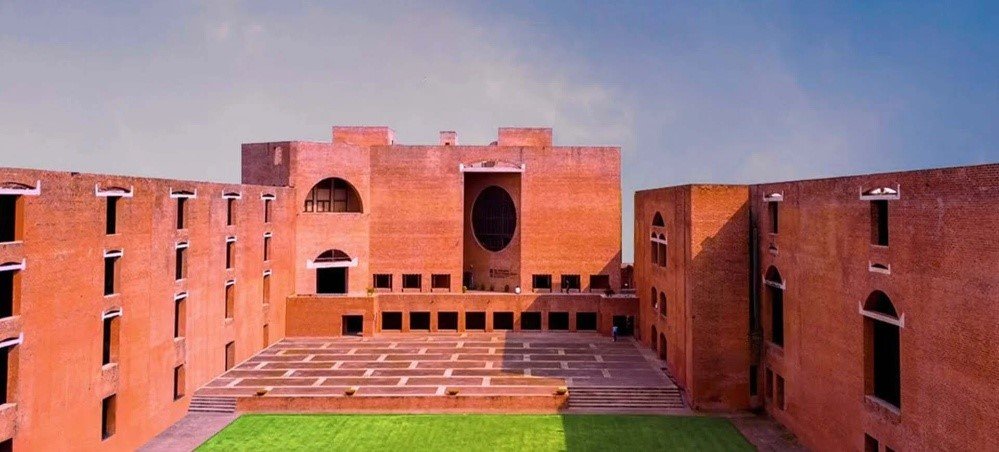
6.1 Example Project 1: Indian Institute of Management Ahmedabad (IIMA)
(Designed by Louis Kahn, completed 1974)
IIMA is one of the clearest demonstrations of Kahn’s mastery in shaping educational behaviour through architecture.
Key Psychological & Spatial Features
• The Brick Façade & Geometric Openings
These massive brick surfaces with circular and triangular voids create:
- timeless stability
- visual identity
- emotional grounding
The monumental character makes students feel part of something larger, promoting responsibility and purpose.
• Courtyard-Centric Planning
The entire campus is arranged around interconnected courtyards.
This design:
- encourages informal learning
- supports cross-department interaction
- enhances natural ventilation
- creates community hubs
• Play of Light & Shadow
Kahn used light as a design element to guide movement and create calm interiors.
Students naturally gravitate to well-lit spaces, improving positivity and alertness.
• The Famous Plaza
The central plaza acts as the emotional core a zone of gathering, discussion, and celebration.
A perfect example of how a central node can influence campus culture.
6.2 Example Project 2: Phillips Exeter Academy Library, USA
(Designed by Louis Kahn, completed 1972)
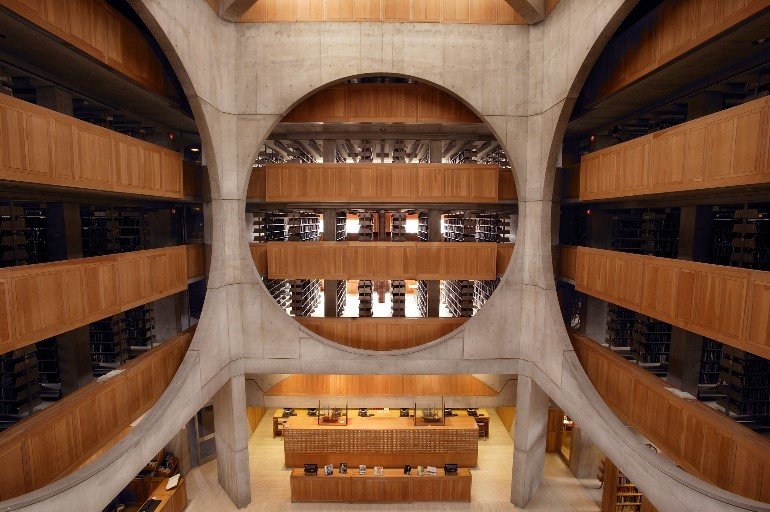
This library is a masterpiece in educational spatial psychology.
Key Spatial Qualities
• Monumental Yet Intimate
The exterior is bold and formal, but inside, students experience warmth, privacy, and emotional comfort.
• Circulation as Learning Experience
Movement between spaces from the outer ring to the central void is designed to be contemplative.
This reinforces the student’s mental transition from social space to focused learning space.
• Natural Light as a Guide
Tall windows and clerestories create an atmosphere of tranquility.
Students reported feeling more focused and less anxious in naturally lit reading areas.
• Layered Spaces for All Personalities
There are:
- solitary reading nooks
- semi-open study spaces
- large tables for group work
This mix supports different learning styles and psychological needs.
7. What Modern Campuses Can Learn from Kahn
Louis Kahn’s work teaches us that:
- learning happens in transitions
- students flourish when spaces feel meaningful
- light and materiality influence emotional states
- communal areas are essential for intellectual exchange
- architecture is not just shelter it is experience
Modern educational architects continue to draw inspiration from his human-centered approach.
8. Designing Emotionally Intelligent Campuses Today
Here are principles that architects and institutions should prioritise:
8.1 Student-Centric Movement
Design paths that are:
- intuitive
- car-free
- interconnected
- shaded
Encourage freedom of movement.
8.2 Relief Spaces
Create “breathing zones” between classes:
- gardens
- breakout terraces
- quiet steps
- shaded pergolas
These reduce cognitive fatigue.
8.3 Social Anchors
Every campus must have strong social magnets:
- central plazas
- amphitheatres
- canteens
- indoor commons
These build community spirit.
8.4 Indoor-Outdoor Continuity
Ensure seamless blending of:
- classrooms → courtyards
- libraries → gardens
- hallways → plazas
Nature should be part of everyday routes.
8.5 Emotional Materials
Use materials that:
- feel warm
- age gracefully
- comfort the senses
Wood, brick, stone, and textured surfaces promote emotional stability.
9. Why Campus Layout Matters More Than Ever
Modern students face:
- digital overload
- rising anxiety
- intense competition
- social isolation
A well-designed campus can counter these challenges.
It can provide:
- calmness
- clarity
- community
- motivation
- identity
Architecture cannot solve all educational problems, but it can create conditions where learning feels natural and joyful.
In an age where attention is fragmented and stress levels are rising, space becomes therapy.
10. Conclusion: The Campus as a Living Teacher
Campus design is not background decoration it is an active participant in learning.
It shapes culture, behaviour, emotions, and memories.
A campus is often a young person’s first experience of independence, community, and identity. The spaces they inhabit become part of their formation.
When designed with psychological insight, educational architecture becomes:
- a catalyst for collaboration
- a sanctuary for mental health
- a structure for intellectual growth
- a framework for social connection
Louis Kahn’s work reminds us that when architecture resonates with human emotion, it becomes timeless.
As we build the campuses of the future, we must remember:
the layout of space is the layout of opportunity.
It shapes who students become.