~B.V. Doshi There are architects who design buildings, and there are architects who let buildings become as if drawn out of the earth by intuition rather than imposed by intellect. Balkrishna Vithaldas Doshi, one of India’s greatest architectural minds and its first Pritzker Laureate, belonged firmly to the second category. For Doshi, architecture was never …
~B.V. Doshi
Table of Contents
- 1. The Architect as Listener
- 2. Understanding the Quote
- 3. Sangath: The Architect’s Own Laboratory
- 4. Form from the Ground
- 5. Space as Experience
- 6. A Dialogue with Tradition
- 7. The Spirit of the Place
- 8. The Human Dimension
- 9. Material as Mediator
- 10. The Architecture of Silence
- 11. The Landscape as Teacher
- 12. Form as Spirit Made Visible
- 13. Lessons for Contemporary Architecture
- 14. A Personal Reflection
- 15. Conclusion: The Spirit Made Solid
There are architects who design buildings, and there are architects who let buildings become as if drawn out of the earth by intuition rather than imposed by intellect. Balkrishna Vithaldas Doshi, one of India’s greatest architectural minds and its first Pritzker Laureate, belonged firmly to the second category.
For Doshi, architecture was never about form for form’s sake. It was about discovering what already exists the spirit of the place, the rhythms of life, the whispers of climate and culture and giving those invisible forces a tangible shape. When he said, “Form emerges from the spirit of the place,” he was not making a poetic statement. He was revealing his design philosophy one rooted in humility, observation, and a profound empathy for the environment and its people.
And nowhere does that philosophy find truer expression than in Sangath, his own studio in Ahmedabad a work that is at once a building, a landscape, a meditation, and a metaphor for the Indian way of life.
1. The Architect as Listener
B.V. Doshi’s journey as an architect began in the crucible of modernism. Having worked with Le Corbusier in Paris and later supervising Corbusier’s projects in India including the Mill Owners’ Association Building and Shodhan House in AhmedabadDoshi was deeply shaped by modernist ideals of geometry, order, and clarity. But unlike many of his contemporaries, he did not accept modernism as a dogma. He saw it as a tool one that needed to be adapted to India’s unique conditions: its climate, culture, and spiritual traditions.
When Doshi returned to Ahmedabad, he found a city alive with contrasts modern industry beside medieval pols, dusty lanes opening into courtyards full of life, brutal heat softened by banyan trees and jalis. He realized that Indian architecture could never be a mere import of Western modernism. It had to grow from the soil, absorbing its climate and culture like roots absorb nourishment.
Thus began his lifelong search for an architecture that listened before it spoke that responded before it imposed.
In that sense, his quote “Form emerges from the spirit of the place” becomes a declaration of faith: faith in context, in intuition, and in the unseen forces that shape how people truly live.
2. Understanding the Quote
To unpack the quote, we must start with the idea of spirit. Doshi’s notion of the “spirit of the place” was not mystical in an abstract way. It was deeply tangible a blend of the site’s physical qualities, its social life, its memory, and its potential.
Every place, he believed, carries within it a set of stories of wind and light, of rituals and daily life, of noise and silence. The architect’s job is not to overwrite those stories but to reveal them. Form, then, is a result not a starting point.
In this view, architecture is not about inventing new shapes; it’s about discovering what the place already wants to become. It’s an act of collaboration between human intention and natural order.
Doshi often spoke about “listening to the site.” He would sit quietly on a piece of land before designing, observing how the sun moved, where the breeze came from, how people might gather, how the sound traveled. He treated the site like a living being with moods, habits, and a soul.
When he says form emerges from the spirit of the place, he’s reminding us that true architecture is not designed it is grown.
3. Sangath: The Architect’s Own Laboratory
Sangath meaning “moving together” or “to accompany” was built in 1981 as Doshi’s own architectural studio on the outskirts of Ahmedabad. It was not just an office; it was an experiment, a philosophy made visible, a garden of ideas.
By the time he began designing Sangath, Doshi had already worked on major projects the Indian Institute of Management in Bangalore, CEPT University, and numerous housing and civic developments. But Sangath was deeply personal. It was to be a place of reflection, where architecture itself could be studied, felt, and lived.
He chose a piece of land that was barren, dusty, and sun-soaked for most of the year. Many would have seen it as an uninviting site. But Doshi saw potential. The heat, the light, the sound of crickets, the rustle of wind through sparse trees all of it would shape the architecture.
Sangath would not be an object placed on the land; it would be an extension of the land itself.
4. Form from the Ground
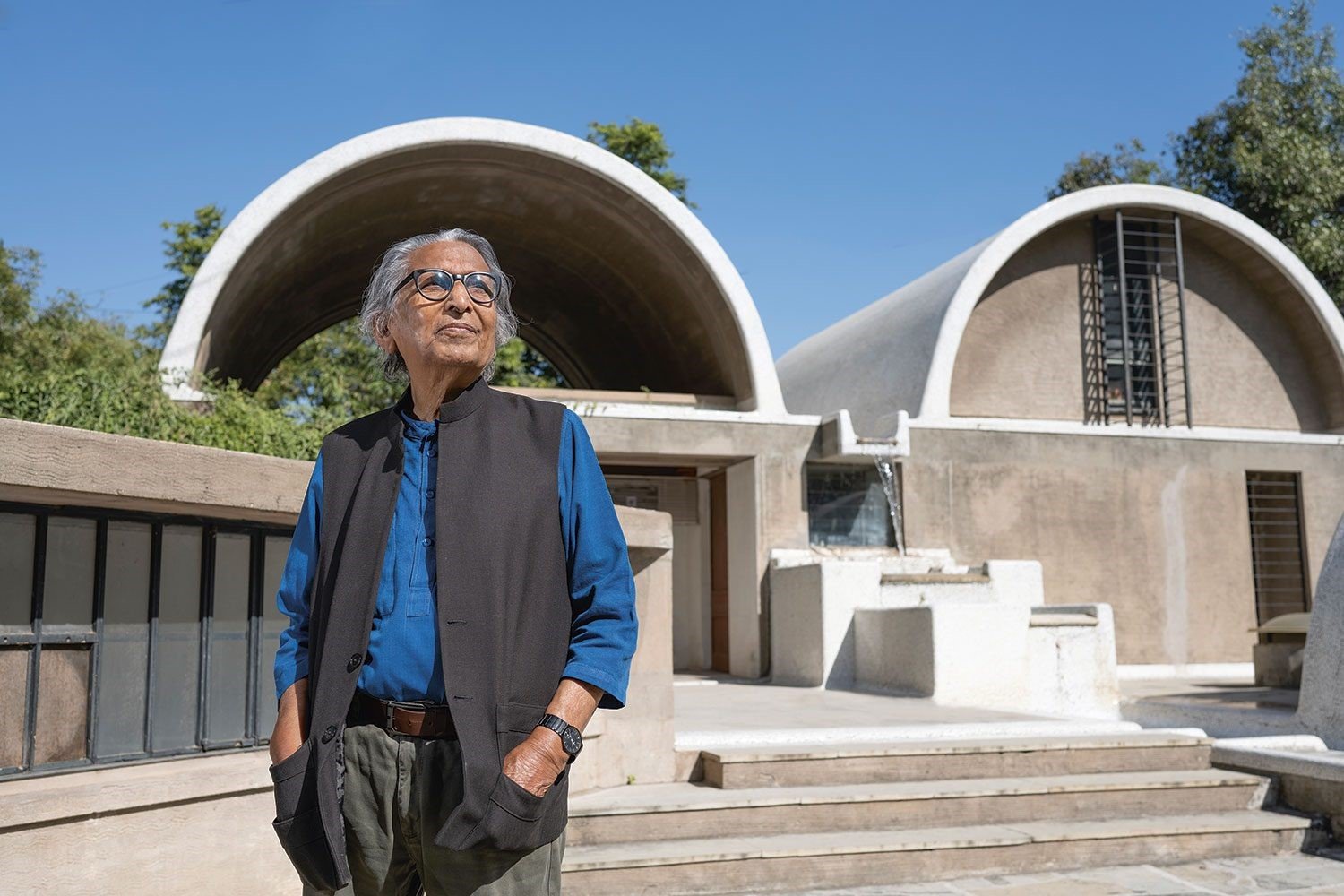
The most striking feature of Sangath is its series of white, vaulted roofs, partly buried into the earth, shimmering under the hot sun. These half-submerged forms look less like a building and more like fragments of an ancient civilization unearthed by time.
The vaults are clad in white ceramic mosaic tiles, a nod to traditional Indian techniques used to reflect sunlight and reduce heat absorption. They sparkle like ripples of water, and beneath them lie cool, quiet interiors an architectural response born directly from the spirit of Ahmedabad’s climate.
Doshi was not designing for style. He was designing for survival and beauty through logic.
By embedding the structure partially into the ground, he harnessed the earth’s thermal mass to moderate temperature. The courtyards between the vaults allow hot air to escape and cool breezes to circulate. Water channels and reflective pools enhance the microclimate, turning the harsh environment into a soothing oasis.
Thus, the form literally emerges from the spirit of the place from its sun, its dust, its water, and its silence.
5. Space as Experience
Walking through Sangath is like wandering through a landscape rather than moving inside a building. The paths curve gently, courtyards open unexpectedly, and light falls through slits and oculi with a painter’s precision. There’s no fixed axis, no single “front” or “back.” Instead, there’s a sense of discovery as though the building reveals itself gradually, like a story unfolding.
This experience reflects Doshi’s view that architecture must feel like life itself unpredictable, layered, and rhythmic.
Inside, the spaces are intimate and tactile. You can feel the rough concrete walls, the cool floor, the filtered light. The offices and studios are connected by courtyards that function as both gathering places and climate moderators. The movement between inside and outside is seamless you are never sure where one ends and the other begins.
In this way, Sangath is not just a workplace; it’s a journey through moods light and shade, enclosure and openness, stillness and movement. The form emerges not from artistic whimsy but from the emotional and sensory qualities of the site itself.
6. A Dialogue with Tradition
While Sangath appears modern, its soul is deeply rooted in Indian tradition. The vaults recall ancient stepwells and temple mandapas; the courtyards echo the spatial grammar of Indian homes. Even the way the building sits in the earth evokes the caves of Ajanta or the vernacular homes of rural Gujarat.
Yet none of these references are literal. Doshi never copied forms; he translated essence.
He once said that in India, space is never static. It changes with rituals, festivals, and seasons. The architecture, therefore, must allow for that fluidity it must adapt and breathe. At Sangath, the courtyards and semi-open spaces accommodate impromptu meetings, quiet reflection, or community gatherings. The space is alive because it invites participation.
This connection to tradition is not nostalgic; it’s experiential. Doshi doesn’t use traditional motifs he uses traditional wisdom. The architecture becomes a living conversation between memory and modernity.
7. The Spirit of the Place
So what is the “spirit” of this particular place?
In Sangath, it’s the interplay between earth and sky, between heat and coolness, between solitude and sociability. It’s the rhythm of Ahmedabad’s climate, the hum of life around it, the architect’s own meditative presence.
Every element the vaults, the courtyards, the water channels, the vegetation contributes to a sense of harmony with nature. The site doesn’t resist its environment; it celebrates it.
When the rain falls, the tiles glisten. When the sun rises, the vaults shimmer. When the wind blows, you hear the rustle of leaves through the courtyards. This is not passive architecture; it’s architecture in dialogue constantly responding, constantly alive.
Doshi said he wanted Sangath to be a “living organism.” That phrase perfectly captures his belief that buildings, like people, must grow with their surroundings, not against them.
8. The Human Dimension
Despite its sculptural beauty, Sangath is fundamentally a place for people. Doshi designed it to nurture creativity, collaboration, and contemplation among his team.
The spaces are modest in scale no grand gestures, no monumental façades. Instead, they create intimacy. Light filters softly into work areas; open-air corridors connect rooms like pathways through a garden. Even the entrance sequence feels humble you don’t enter through a dramatic gate but through a quiet descent, as if entering the earth itself.
This humility reflects Doshi’s humanism. He saw architecture not as a display of power but as a framework for human experience. At Sangath, everyone architect, craftsman, visitor becomes part of a collective rhythm. It embodies the very meaning of its name: “moving together.”
The spirit of the place, then, is not only physical or climatic; it is social and emotional. It’s about creating belonging.
9. Material as Mediator
The material palette of Sangath is minimal yet deeply expressive. The vaults are made of reinforced concrete a modern material but covered in hand-laid ceramic mosaic tiles, a traditional craft. The floors are brick and concrete, and the landscape is dotted with patches of green and reflective water.
This combination blurs the boundary between old and new, between permanence and impermanence. The materials do not seek perfection; they embrace imperfection. You can see the marks of the craftsman, the texture of the tile, the grain of the concrete.
For Doshi, materials were not chosen for aesthetic glamour but for honesty and intimacy. They respond to touch, to heat, to time. They are humble, local, and alive.
In this way, even the materials become expressions of the site’s spirit born of its soil, made by its people, weathered by its sun.
10. The Architecture of Silence
What makes Sangath truly extraordinary is its sense of silence. Despite being a place of work, it feels meditative. The combination of thick walls, underground volumes, and water features creates an acoustic softness a quietness that encourages introspection.
This silence is not emptiness. It’s the kind of silence you find in nature the pause between two gusts of wind, the stillness before rain.
Doshi often said that architecture should evoke the same peace one feels in a temple or under a tree. Sangath achieves that effortlessly. It reminds us that architecture, at its best, does not just provide shelter it provides solace.
11. The Landscape as Teacher
Sangath’s landscape is inseparable from its architecture. The vegetation, the pathways, the water all are part of the composition. But they were not planted to beautify; they were planted to teach.
Doshi believed that architecture must always learn from nature. The way trees shade, the way water cools, the way earth insulates these are lessons more profound than any theory.
In Sangath, the garden becomes a teacher. You see how the reflected light from the pools dances on the vaults, how the rustling bamboo softens the breeze, how the slope of the land guides the rainwater. It’s an ecological choreography, not a stylistic one.
This integration of landscape and architecture is what makes the building feel timeless. It doesn’t sit on the land; it sits within it.
12. Form as Spirit Made Visible
Returning to the quote “Form emerges from the spirit of the place” Sangath demonstrates exactly what that means.
The vaults are not decorative; they are spatial responses. The courtyards are not designed for symmetry; they are designed for air and light. The water channels are not ornamental; they are functional and spiritual at once.
The entire building feels inevitable as though it could not have been any other way. That inevitability is the mark of architecture that has truly listened to its place.
Doshi once said that every site “has its own energy field.” Sangath makes that energy visible, tangible, inhabitable. Its form is born not from the architect’s ego but from the spirit of its environment.
13. Lessons for Contemporary Architecture
In an era when architecture often chases spectacle, Sangath stands as a quiet rebellion. It tells us that the deepest beauty lies not in novelty but in authenticity.
Doshi’s philosophy reminds us that architecture is not a global language it’s a local dialect, shaped by geography, culture, and emotion. The more honestly a building responds to its place, the more universal its resonance becomes.
Today, as cities struggle with climate change, alienation, and homogenized skylines, the wisdom of Doshi’s approach feels more relevant than ever. He shows us that sustainability is not a technology it’s an attitude. It begins with respect for the land, for materials, for people, and for time.
Sangath proves that when architecture grows from the spirit of its place, it doesn’t need to shout. It simply belongs.
14. A Personal Reflection
Visiting Sangath feels less like touring a building and more like entering a living memory. You sense the rhythm of Doshi’s mind in every curve, every shadow, every vault. The architecture breathes; it feels alive.
It’s a place that makes you slow down to feel the warmth of the tiles underfoot, to watch light shift across the domes, to listen to water murmur. It reconnects you to something ancient: the understanding that architecture is not just made of walls and roofs, but of time, air, and spirit.
In an age of digital speed and visual overload, Sangath whispers a different truth that the soul of architecture lies in patience and place.
15. Conclusion: The Spirit Made Solid
B.V. Doshi’s Sangath is more than his studio it is his autobiography written in concrete, tile, and earth. It embodies his belief that architecture is a living art, one that grows from context, culture, and climate.
When he said, “Form emerges from the spirit of the place,” he was giving us a compass a way to find meaning in making. He was reminding architects that before drawing, they must listen; before building, they must feel.
At Sangath, form truly emerges not from ambition or fashion, but from truth. The building rises gently from the land, shaped by sun and soil, by memory and imagination. It teaches us that the most powerful architecture is not the one that dominates the landscape, but the one that becomes part of it.
Sangath is thus both a studio and a sanctuary a space where design becomes meditation, where form becomes feeling, where architecture becomes one with the spirit of its place.
In the end, Doshi’s architecture does not tell us what to see. It teaches us how to see the world, the land, and ourselves through the quiet language of light, earth, and time.
And that, perhaps, is what all great architecture strives for: to turn the invisible spirit of a place into something we can touch, inhabit, and remember forever.